
Printed 2026 · figures read October 2026
Free slots no deposit covers two products, and clearing the paying one costs £15.36
What it costs in expectation to serve forty times wagering on the winnings from a hundred spins of ten pence. Those winnings come to £9.60, so releasing them costs more than they are worth. Forty times is the multiple most of these cashiers apply, read October 2026.
Spins each cashier pins to a deposit, and on what terms
Every link in this rack is a paid placement, and this site is owed a fee when a reader opens an account through one.
Betportal
Lowest wagering
Licence Licensed in Anjouan, Comoros, no Great Britain licence, run by BetPortal Gaming Ltd and Excite Ultra Media Ltd, reference ALSI-202601040-FI2.
WinBeast
Free bet included
Licence Licensed in Curaçao, no Great Britain licence, operator not named on the site.
EliteSpin
New for 2026
Licence Licensed in Costa Rica, no Great Britain licence, run by PrimeTier Limited, opened 2026.
Crown Jewelz
200% first deposit
Licence Licensed in Curaçao, number not verified, no Great Britain licence, operator not named on the site.
Scroll the rack sideways to reach the other columns. The label column stays put.
Not one of the offers printed above holds a Great Britain licence. Outside that licence a British player has none of its protection: Gamstop Online cannot shut the door, the ten-times limit on bonus wagering does not bind the operator, and no British complaints body will take up a dispute. You must be 18 or over to open an account anywhere in this rack.
Every figure in the rack is a term the operator itself publishes, read on 14 October 2026. The operator's terms in full are the ones that bind you.
A hundred spins on a real-money game, in pounds per pound
| What these offers ask | Under a British licence | |
|---|---|---|
| You put in | £20.00 | £20.00 |
| Handed over | £10.00 | £10.00 |
| Wagering | 40x | 10x |
| Cost per £1 kept | £1.60 | £0.40 |
This strip prices the paying product, which is a hundred spins on a real-money game. You put in is the floor these cashiers set, twenty pounds or twenty euro. Handed over is what those spins stake at ten pence apiece. The last row gives the expected loss behind every pound somebody wants out: forty crossings of a 96 per cent game come to £1.60 and ten come to 40p. The staking assumes forty times. A reported thirty to sixty is the span for offers the British licence never touches. The second product on this page, a demo round, cannot be priced in this strip at all, because its payout in cash is nought whatever the reels do. A Great Britain licence stands behind no cashier of this kind.
01
One phrase, two products, and only one of them pays
Two different things answer to the words at the top of this sheet. A demo round, which is a slot running on play money and settling in play money. And a drop of spins on a real-money game, which settles in a balance somebody may eventually be able to take out.
£0.00 is the cash a demo round pays, whatever lands on it. Not a small amount, not a capped amount: nothing, by design, because no stake went in. The reels, the sounds and the maximum win screen are identical to the paying version, which is exactly why the two get confused.
£9.60 is what the paying version gives back, on a hundred spins at ten pence with a 96 per cent payback. That number is the whole subject of the rest of this page.
Adjacent sheets take the counts on their own. 100 free spins no deposit is the same batch without the demo question, free spins no deposit is the general shape, and free daily spins covers the batches released a day at a time. The ladder is at nothing down.
02
A demo round still needs a verified account inside the licence
7 May 2019 is the date that settled this. Age and identity must be verified before a customer gambles, and the same rules reach play that is not gambling at all: a customer has to be age verified before they can get at a free-to-play version of a gambling game, and before they gamble with a free bet or a bonus.
There is therefore no anonymous free play at a British-licensed site, and has not been for seven years. A demo round there is a registered, verified account playing for nothing.
| Question | A demo round | A drop of spins on a paying game |
|---|---|---|
| Cash it can pay | £0.00 | £9.60 on average |
| Stake it sends through | £0.00 | £10.00 |
| Verified account needed | Yes, age verification before access | Yes, name, address and date of birth before play |
| Wagering attached | None, because there is nothing to release | Forty times, which most of them apply |
| Cost of clearing it | £0.00 | £15.36 |
| What it is actually for | Learning the controls and the paytable | Opening a balance that carries a condition |
The last row is the honest division. A demo round is a manual. It teaches the paytable and the feature triggers for nothing, and it is the one product on this page whose expected cost to the reader is exactly nought. The paying drop is a commercial offer with arithmetic attached, and the arithmetic is below.
03
£384.00 of staking stands behind £9.60 of winnings
£384.00 is forty times £9.60. At ten pence a cycle that is 3,840 spins, and with the advertised hundred the claim runs to 3,940 cycles. £15.36 is what that staking costs where the house keeps fourpence per pound, which exceeds the winnings it should release by £5.76.
£96.00 is the obligation ten times would create, at a cost of £3.84, leaving £5.76 standing. The two figures are one number with the sign reversed, which is the arithmetic of multiplying a ceiling by four.
Two hours and forty-four minutes is the floor under 3,940 cycles where a British licence applies, since every slot there must wait two and a half seconds for its next cycle, each one needing a fresh press. Shortening the wait for a result is a function a casino game may not offer under that licence, and automatic play is banned on online gaming outright. A site without the licence is bound by none of the three.
04
What the demo cannot tell a reader, and what the register can
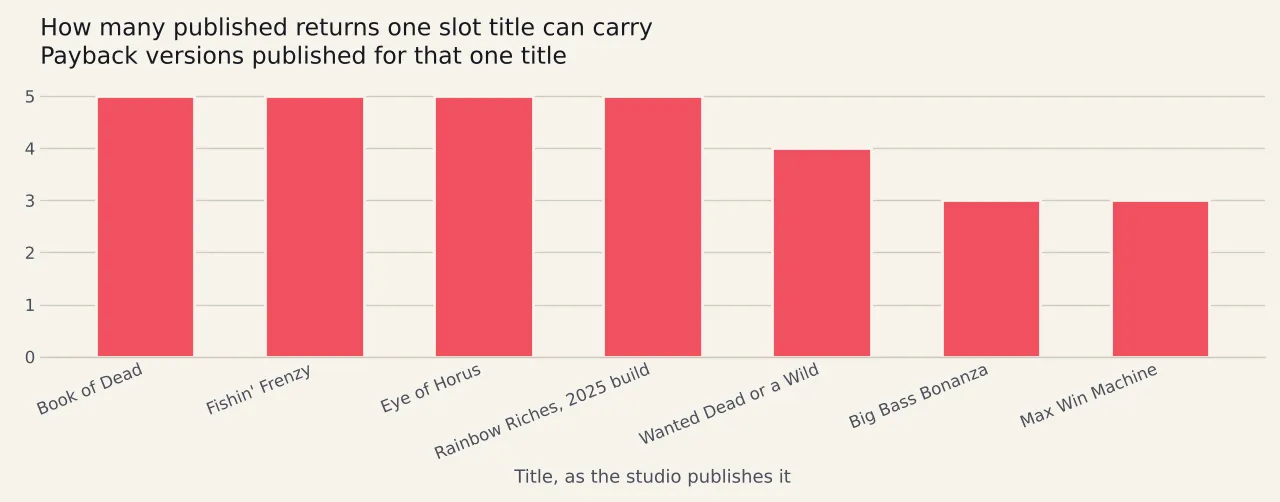
A demo round cannot tell anybody what version of the game they are looking at. One title routinely comes in several published returns, with the operator picking the copy, so the figure that settles the arithmetic sits on an information screen inside the game rather than in the feel of the reels.
What a reader can check is the licence, and the register is public. It holds licensed businesses and personal licences, regulatory actions, premises, public statements and freedom of information requests, all of it searchable, viewable or downloadable.
The third bar carries a warning with it. Remote casino, betting and bingo share one licensed category, so 630 separates none of them and must never be printed as a number of casinos. What the register is good for is the opposite direction: taking a name off a site’s footer and seeing whether anything answers to it.
What it cannot show is whether a site is live. An entry marked active is not proof of a trading site, an inactive domain may have closed years ago, and the register attaches domains to licensees without saying who built or markets the site behind them.
05
Four duties the demo version never mentions
A demo round runs the same reels on either side of the licence. The duties behind them do not, and every one of those below belongs to the licence rather than to the website.
- The multiple has a ceiling inside the licence. Ten times the bonus, which took effect on 19 January 2026. Forty times breaks nothing above this sheet, because the condition was attached to a licence the packages there do not hold.
- The pace has a floor inside the licence. Two and a half seconds between the start of a game and the next cycle, plus a ban on turbo features and on automatic play.
- A complaint has a timetable inside the licence. Six months in which to bring one. Acknowledgement follows within three working days, or inside a day where a site is open all hours. Eight weeks to finish, then a letter pointing at an adjudicator who is not the operator.
- Self-exclusion is built into the licence. The national scheme covers the firms within it. Registering closes those doors and alters nothing beyond them.
So the price line at the top carries two columns rather than one. The left is what this trade sells. The right is the measure it is sold against, and the distance between £1.60 and 40p is what the absent licence is worth per pound.
06
A hundred spins, priced either way
Eight lines, with the demo product left out because its cash answer is nought at every step.
A hundred spins, ten pence apiece
- Stake a hundred spins send through 100 × £0.10 = £10.00
- Given back at a 96 per cent payback £10.00 × 0.96 = £9.60
- Staking forty times demands of that balance £9.60 × 40 = £384.00
- Taken across that staking at four pence in the pound £384.00 × 0.04 = £15.36
- Where those terms leave the balance £9.60 − £15.36 = −£5.76
- Ten times on the same balance, and its cost £96.00 × 0.04 = £3.84
- Where the ceiling of ten leaves the balance £9.60 − £3.84 = £5.76
- One pound of balance, both prices £1.60 then 40p
The demo product would give nought at line one, nought at line two and nought at every line after, which is why it sits in the table above rather than in this working. Left out of all eight lines: a ceiling on what the balance may convert to, which cuts the good runs and lowers the mean by an unpublished amount; a game weighted below the stake it accepts, which stretches line three; a batch expiring inside its window, which deletes the balance rather than the obligation; and the deposit, which never stops being the reader’s.
07
Questions on slots played for nothing
- Can free slots with no deposit pay real money?
- Only one of the two products behind that phrase can. A demo round settles in play money and pays £0.00 in cash whatever lands, because nothing was staked. A drop of spins on a real-money game gives back £9.60 on average for a hundred spins at 10p, and that balance can become cash once whatever wagering is attached has been served.
- Do I need an account to play a demo round?
- At a British-licensed site, yes. Since 7 May 2019 operators have to confirm a customer’s name and address and their date of birth ahead of any gambling, and the same rules require age verification before anybody can reach a free-to-play version of a gambling game or play with a free bet or bonus. There has been no anonymous free play there for seven years.
- What does it cost to clear a hundred free spins?
- £15.36 in expectation at that multiple. Forty times £9.60 comes to £384.00 of staking, of which fourpence in the pound is £15.36, exceeding the winnings being released by £5.76. Ten times instead puts the same balance at £96.00 of staking, costing £3.84 and leaving £5.76.
- Does a demo round tell me the return on the game?
- No. One title is often offered at several published returns, the operator picking which copy goes in, and the reels feel identical either way. Under a British licence the figure, or how likely the winning events are, has to be put within reach before any commitment to gamble, which puts it on an information screen inside the game.
- How long does a hundred spin obligation take?
- 3,940 cycles, being the hundred advertised plus 3,840 bought with £384.00 of staking at 10p. Allow each cycle the two and a half second minimum a British licence imposes and that is two hours and forty-four minutes. Turbo features and automatic play are barred inside that licence, and neither the floor nor the bans touch a site without one.
- Can I check an operator on a public register?
- You can check a licence. The regulator’s register lists licensed businesses and personal licences, regulatory actions, premises, public statements and freedom of information requests, every part of it open to search, view or download. On 31 March 2026 it listed 2,154 operators holding 3,097 licensed activities between them, 364 of them holding more than one.
- Does the register say how many casinos there are?
- No, and the figure most often misused is 630. That counts the remote casino, betting and bingo activities licensed at 31 March 2026, where the year before there had been 582, and three products are rolled into one category. The register also cannot show whether a site is trading: an active entry is not proof of a live site, and an inactive domain may have closed long ago.
- What does a site without a British licence not have to do?
- Cap its wagering at ten times, hold a slot cycle to two and a half seconds, avoid turbo or automatic play, finish a complaint within eight weeks, or point anybody to an independent adjudicator afterwards. It is also beyond the national self-exclusion scheme, which operates through the British licence, so a registration shuts the licensed estate and reaches no further.