
Printed 2026 · figures read October 2026
Free £10 no deposit against the £50 ceiling a tenner of credit runs into
The most a £10 credit can turn into once a ceiling of five times the credit applies, which is the common limit on offers of this shape. Everything past £50 belongs to the house, however the reels run.
A tenner of credit, its multiple and its ceiling, package by package
Every link in this rack is a paid placement, and this site is owed a fee when a reader opens an account through one.
Betportal
Lowest wagering
Licence Licensed in Anjouan, Comoros, no Great Britain licence, run by BetPortal Gaming Ltd and Excite Ultra Media Ltd, reference ALSI-202601040-FI2.
WinBeast
Free bet included
Licence Licensed in Curaçao, no Great Britain licence, operator not named on the site.
EliteSpin
New for 2026
Licence Licensed in Costa Rica, no Great Britain licence, run by PrimeTier Limited, opened 2026.
Crown Jewelz
200% first deposit
Licence Licensed in Curaçao, number not verified, no Great Britain licence, operator not named on the site.
Scroll the rack sideways to reach the other columns. The label column stays put.
Not one of the offers printed above holds a Great Britain licence. Outside that licence a British player has none of its protection: Gamstop Online cannot shut the door, the ten-times limit on bonus wagering does not bind the operator, and no British complaints body will take up a dispute. You must be 18 or over to open an account anywhere in this rack.
Every figure in the rack is a term the operator itself publishes, read on 14 October 2026. The operator's terms in full are the ones that bind you.
A tenner of credit, bought with £20, in pounds per pound
| What these offers ask | Under a British licence | |
|---|---|---|
| You put in | £20.00 | £20.00 |
| Handed over | £10.00 | £10.00 |
| Wagering | 35x | 10x |
| Cost per £1 kept | Nothing kept | £0.67 |
Worked on games paying 96 per cent, slots counting and nothing else, with the obligation served in full. The multiple worked below is thirty-five. Away from the British licence the recorded spread is thirty times to sixty. Thirty-five times ten is £350 of staking, which is expected to take £14.00 against a credit of £10, so the balance is £4.00 adrift when the counter clears and nothing is kept. The £50 ceiling sits outside both figures, which can only make the left one worse. The right-hand side holds the deposit and the credit steady and drops the multiple to the British limit of ten. No offer of this shape carries a Great Britain licence, which is what the right-hand side is pricing. Expectations over many attempts, not a forecast of one.
01
A tenner of credit costs twenty pounds to reach
£10 is the smallest credit offers of this shape run to, and £20 is what has to be paid in to collect it. At the cheaper end of the multiple a third stage matched at half the deposit, capped at €200 and floored at €20, is the usual arrangement, so twenty in brings ten back.
Thirty-five times the bonus is the line that credit carries, which comes to £350 of staking. Fourteen days are allowed. Slots are the only games that count, and a maximum bet of €5 applies while the bonus is live, which is the sort of stake ceiling published at this end of the trade.
A tenner handed over with nothing paid in is a real British product and this is the top of its range. Under the licence cash for nothing runs £5 to £10, a market habit rather than a rule, which makes this key the largest honest version of the thing people search for. A guide of its own covers the rung below, free £5 no deposit casino. The general shape of the thing sits at casino no deposit bonus. The headline that usually turns out to be something else is taken apart at £20 free no deposit casino. The index for all of it is nothing down.
Two terms decide this page and the multiple is only one of them. The other is the ceiling, and on a credit this small the ceiling arrives sooner than most readers expect.
02
A tenner at five multiples, and where the sum turns over
£350 is what this rung owes. The table runs the same tenner through every multiple that matters, from no obligation at all up to the dearest in ordinary use.
| Line on the credit | Staking owed | Expected to be taken | Expected to be left |
|---|---|---|---|
| Nothing to serve | £0.00 | £0.00 | £10.00 |
| 10 times, the limit under a licence | £100.00 | £4.00 | £6.00 |
| 25 times, where it turns over | £250.00 | £10.00 | £0.00 |
| 35 times, this page’s rung | £350.00 | £14.00 | −£4.00 |
| 40 times, the dearer line | £400.00 | £16.00 | −£6.00 |
Four pence of every pound staked is the whole mechanism. Multiply that by the staking owed and column three is the answer. Subtract it from the credit and the answer is the fourth. There is nothing else in the sum.
Which makes twenty-five the pivot. Beneath it the credit is worth something. At twenty-five times over, the staking is expected to cost whatever the credit was worth. Past it the credit has gone before the counter clears and the shortfall falls on money that was already yours. Every multiple this trade runs sits past it.
03
The same tenner, three ways of crediting it
£10, £6 and £2 are the three answers, and the credit is identical in all three. What changes is what the terms call the winnings and which rounds the counter accepts.
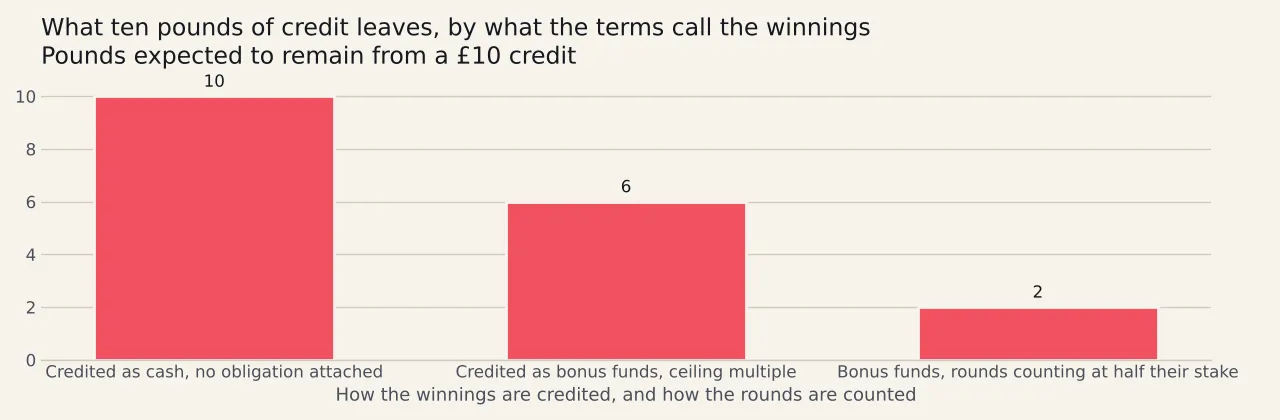
The spread between the first bar and the third is five to one on a credit of the same size. No headline distinguishes them, because all three can be advertised with the same two words and the same figure.
Take the same picture to these terms and a fourth bar would sit below the axis. At thirty-five times the expected balance is minus £4.00, and at forty it is minus £6.00.
04
Nothing to serve is a different product, not a better deal
£10 out of £10 is what the first bar means. Where winnings arrive as cash with no obligation attached, the arithmetic stops at the credit and there is no multiple to price.
Two British-licensed operators are built on that model and may be named for it: PlayOJO, which runs on SkillOnNet, and MrQ, operated by Lindar Media. Both leave every bonus clear of wagering, so a win arrives as cash. Spin counts at operators of that kind run smaller, and that is the exchange. No current offer is attributed to either of them here, because a business model is a fact and this week’s promotion is not.
A cashier that does something comparable with part of its offer does turn up. Its free-spin winnings carry no wagering, while the cash bonus beside them carries thirty-five times. That one clause outweighs the size of any credit on this page, and it is the clause to find first on a terms page.
What the terms call the money is therefore the term that matters most. Read for three things in order: whether winnings come through as cash or as bonus credit, what multiple attaches if they come through as credit, and which games move the counter. Everything else on a bonus page is commentary.
05
Five times ten is fifty, and fifty is the end of the offer
£50 is the ceiling on this rung. A limit of five times whatever was credited is the common one, and a tenner multiplied by five is fifty pounds. Some cashiers cap a spin batch instead, at €100. Some print no figure, so the limit stays unknown until the account is open.
A ceiling does not show up in the multiple and does not show up in the price line, yet it decides what the good outcomes are worth. Take the top off the rare large results and the average falls while every poor result stays exactly where it was. British no-deposit ceilings usually land somewhere between twenty pounds and a hundred, so the term is ordinary on both sides of the licence.
Three rules decide what the phrase about keeping what you win can honestly mean, and only three.
- A wagering requirement on bonus funds stops at ten times under a British licence, and at nothing at all where the terms attach none.
- The balance is the customer’s. Winnings included, it comes out on demand, and operators here have to say so.
- No term may ration that balance. The example the regulator prints as forbidden allows a withdrawal of fifty pounds in any day and five hundred in any week.
A cap on the bonus winnings themselves sits outside all three. So a page can print the phrase and a £50 ceiling at the same time without contradicting itself, which is why this guide prints the ceiling as a figure in the hero rather than leaving it to a footnote.
06
Getting the money out is the step with the rules on it
Withdrawal requests clear at 99 per cent inside 24 to 48 hours, approved and paid, on figures the regulator put out on 17 July 2023, taken from several of the largest gambling companies. The measure covers licensed operators, and it is the only published number attached to the step this whole page leads up to.
It is also the step most complained about. Withdrawal problems are the single biggest issue put to the regulator’s contact centre, and that centre takes upwards of 6,000 calls in a year.
Five duties sit on that step under a British licence, and not one of them travels.
- No cancel button. The system may not offer a route to cancel a withdrawal request, nor to push those funds back in as a deposit.
- No extra friction. An operator may not make taking money out harder than putting it in, and may not put its own commercial interest first.
- Harm checks must not hold it up. Checks run to identify a risk of harm may bear on depositing and on gambling. They are not to bear on a customer’s ability to take money out.
- One published exception. A payout may be held on rare occasions while an operator satisfies itself that the money is not criminal proceeds. A page about delays ought to name that exception instead of implying none exists.
- No charge for emptying the account. Any charge has to stay inside what the processing itself costs. Any restriction on withdrawal size or frequency has to be a reasonable one. A cost-based fee has to be shown before money goes in. And clearing out a deposit balance in full carries nothing.
Documents before the first withdrawal is what these sites say they want, which is ordinary enough. What differs is what happens when the answer comes back no. An operator here cannot make identity a condition of paying out when it had every chance to ask earlier. Off the licence there is no equivalent duty and nobody to raise it with.
07
Ten times on the same tenner, and what the licence adds
The British limit takes £250 of staking off this rung, and £10.00 of expected cost with it. Ten times ten is £100 of staking against £350, the play should take £4.00 against £14.00, and £6.00 is expected to be left standing where nothing stands above. Each pound left carries 67p of play behind it.
Since 19 January 2026 ten has been the most any British licensee may require. The regulator put it there to strip the top off a range that ran to sixty times at some licensees, and one operator’s own figures, published with the decision, already had three quarters of its offers inside one to ten.
Beyond the multiple, three absences matter on a credit this small.
- The scheme stops at the licence. Gamstop Online reaches companies with a Great Britain licence and stops there. Its own terms say it cannot help keep somebody away from operators that do not take part.
- The complaint has nowhere to go. Eight weeks is the limit on handling one here, with an adjudicator outside the company at the end of the process. The Commission is not an ombudsman and settles no individual dispute itself.
- The protections are not optional. Age and identity before play, a prompt towards a financial limit, and a reduction to that limit actioned immediately. These are conditions of the licence rather than features of a site.
On a tenner the sums are small either way. The protections are the same size whatever the credit is, which is the argument for reading this page’s right-hand column rather than its left.
08
A tenner at thirty-five times, line by line
The price line again, one line at a time, with the licensed figure underneath it.
Ten pounds of credit, thirty-five times over
- Paid in to open the stage £20.00
- Credit added at half the deposit £20.00 × 0.5 = £10.00
- Staking the credit owes at thirty-five times £10.00 × 35 = £350.00
- Expected cost of serving it £350.00 × 0.04 = £14.00
- Credit standing at the end of it £10.00 − £14.00 = −£4.00
- Ceiling on what the credit could have become £10.00 × 5 = £50.00
- The identical tenner at a ten times line £100.00 staked, £4.00 gone, £6.00 standing
- A kept pound priced twice over Nothing kept · £0.67
The eight lines do not carry the fourteen day window, which converts an unserved counter into nothing. They do not carry the games list, which at this end of the trade is slots alone. They do not carry the €5 maximum bet, which governs how long the staking takes. And they describe an average rather than an evening, where the usual single result is a balance at zero long before £350 has crossed the counter.
09
Questions about a tenner of credit
- Is there a free £10 no deposit offer at this end of the market?
- No. Ten pounds is the smallest credit on offer and £20 has to be paid in to collect it, as half of a matched stage. A tenner handed over before any payment does exist under a British licence, at the top of a £5 to £10 range that reflects market habit rather than any rule.
- What does a £10 credit owe at thirty-five times?
- £350 of staking, which is expected to take £14.00 on games paying 96 per cent. The credit is £10, so the obligation costs £4.00 more than the thing it was charged against, and the difference comes out of the twenty that was paid in.
- Why is £50 the figure in the hero rather than the staking?
- Because it is the most the credit can turn into. Five times whatever was credited is the limit in general use, which on a tenner is £50. A cap of €100 on a spin batch is the other form, and some cashiers publish no figure whatever. A ceiling never appears in the multiple and decides what every good outcome is worth.
- Where does the arithmetic stop working?
- At twenty-five times, on games paying 96 per cent. Four pence of each pound staked means a multiple of twenty-five costs whatever the credit was worth. Below that something survives, above it nothing does, and the lines this trade runs are thirty-five and forty.
- Does any site really apply no wagering at all?
- Two British-licensed operators are built on it and can be named for the model: PlayOJO, which runs on SkillOnNet, and MrQ, operated by Lindar Media. Winnings there arrive as cash, so a tenner stays a tenner. Spin counts at operators of that kind run smaller, and no current offer is attributed to either here.
- Can the site refuse to pay once the wagering is served?
- Under a British licence the rules on that step are published: no cancel button on a withdrawal request, no more friction than at deposit, harm checks that must not hold a payout up, and nothing charged for clearing out a balance in full. The one published exception is a hold while an operator satisfies itself the money is not criminal proceeds.
- How quickly do licensed withdrawals actually arrive?
- Requests clear at 99 per cent inside 24 to 48 hours, approved and paid, on figures the regulator put out on 17 July 2023 from some of the largest gambling companies. It is also the most complained-about step, and the largest single share of the 6,000 calls a year its contact centre takes.
- What is the licence worth on a credit this small?
- £250 of staking, plus £10.00 of expected cost, on the arithmetic alone, which turns nothing surviving into £6.00 surviving. The rest does not scale with the credit: membership of Gamstop Online, eight weeks as the ceiling on a complaint, an adjudicator beyond the company, and the identity question answered before the first round rather than at the cash desk.