
Printed 2026 · figures read October 2026
Mastercard casino payouts: £5.51 between two schedules for one job
The spread between two published charges for the same piece of work, £100 moved out of a wallet and onto a card. One schedule asks 1.99 per cent of it. The other reaches 7.5 per cent at the top of its band. The network is taken on the way in right across this part of the market, and a charge of the cashier’s own is nowhere in print.
The offers this page covers, and the card networks each takes
Every link in this rack is a paid placement, and this site is owed a fee when a reader opens an account through one.
Betportal
Lowest wagering
Licence Licensed in Anjouan, Comoros, no Great Britain licence, run by BetPortal Gaming Ltd and Excite Ultra Media Ltd, reference ALSI-202601040-FI2.
WinBeast
Free bet included
Licence Licensed in Curaçao, no Great Britain licence, operator not named on the site.
EliteSpin
New for 2026
Licence Licensed in Costa Rica, no Great Britain licence, run by PrimeTier Limited, opened 2026.
Crown Jewelz
200% first deposit
Licence Licensed in Curaçao, number not verified, no Great Britain licence, operator not named on the site.
Scroll the rack sideways to reach the other columns. The label column stays put.
Not one of the offers printed above holds a Great Britain licence. Outside that licence a British player has none of its protection: Gamstop Online cannot shut the door, the ten-times limit on bonus wagering does not bind the operator, and no British complaints body will take up a dispute. You must be 18 or over to open an account anywhere in this rack.
Every figure in the rack is a term the operator itself publishes, read on 14 October 2026. The operator's terms in full are the ones that bind you.
£20 in on this network, in pounds per pound
| What these offers ask | Under a British licence | |
|---|---|---|
| You put in | £20.00 | £20.00 |
| Handed over | £20.00 | £20.00 |
| Wagering | 40x | 10x |
| Cost per £1 kept | Nothing left | £0.67 |
The network on the front of the card is absent from this table because it has no effect on any line in it. Both columns sit at 96 pence back on the pound with no round counting short: at 40 times, £800 of staking takes £32.00 out against £20.00 of credit, leaving nothing; at ten times it takes £8.00 and £12.00 remains, with 67p of cost behind each remaining pound. Ten is the figure a Great Britain licence insists on, and offers of this kind hold Curacao, Anjouan or Costa Rica papers instead. The charges this sheet is about belong to the wallets a payout may travel through, not to the credit in this table, and a payout charge of the cashier’s own is not published.
01
Two schedules, one job, and five pounds fifty-one between them
£1.99 at one wallet. Up to £7.50 at the other. The work is identical in both cases: £100 leaving a wallet balance and arriving on a card of this network, or of the other large one, since both schedules name the two together.
That spread is the only hard number this page can offer about a payout, because a charge for the cashier’s own end of the journey is not published. What can be priced is the leg a wallet sits on, and two wallets publish it.
Everything else on this page follows from reading those two fee pages carefully: what a band means, why no figure belongs to one network, and what a licensed cashier would be permitted to charge for the same work.
The sibling sheets are visa casino for the other large network, Skrill, Neteller and Trustly casino for the wallets these charges come from, and credit card casino for the half of this network a British licence shuts. Every route this section covers is banded at how you pay.
02
Five published percentages touch a card
Five figures in this section price a leg of the journey that involves a card, and they run from nothing to 7.5 per cent.
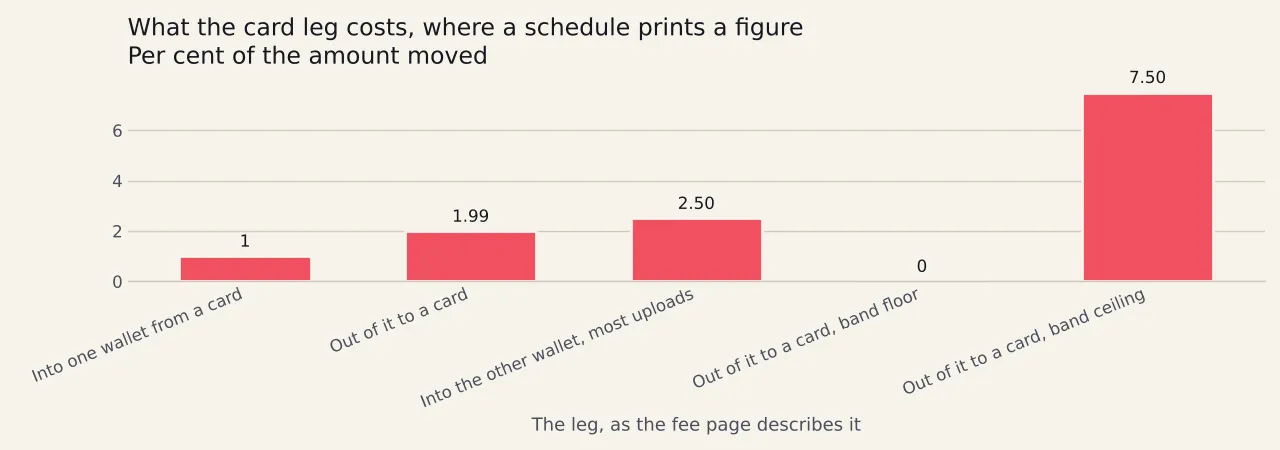
Read the two ends of the fourth and fifth bars together. A reader taking money out through the second wallet may pay nothing or may pay £7.50 on £100, and the fee page gives no rule for which.
The first wallet’s 1.99 per cent is at least certain, subject to a floor in euros. Certainty at a known price is worth something when the alternative is a band four times as wide as the charge itself.
03
A band is two ends and nothing in between
0 per cent to 7.5 per cent is published as a band, so this press draws the band’s ends and refuses to invent a midpoint. Nobody is charged a midpoint. A payout is charged at some point inside the range and the fee page does not say which.
The honest way to plan around that is to use the top. £7.50 on £100 is what the schedule permits, so £7.50 is the figure to hold in mind, and anything less is a benefit rather than an expectation.
Two other figures on the same page work the same way. Uploading to that wallet by a local bank deposit is published as nothing to 1 per cent, and uploading from a prepaid voucher as nothing to 5 per cent. Three bands on one fee page is a pattern rather than an accident.
Two charges there are flat rather than banded, and both are worth knowing before a card is involved. A chargeback costs £25. A currency conversion costs 4.49 per cent, falling to as little as 1 per cent for the wallet’s own top tier.
04
What £100 actually comes to, leg by leg
£92.50 is the worst published outcome for £100 coming back to a card through a wallet, and £98.01 is the best priced one. The table puts every leg touching a card into pounds on a hundred.
| Leg | Rate | Taken from £100 | Left |
|---|---|---|---|
| Into the first wallet from a card | 1.00% | £1.00 | £99.00 |
| Out of the first wallet to a card | 1.99% | £1.99 | £98.01 |
| Into the second wallet, most uploads | 2.50% | £2.50 | £97.50 |
| Out of the second wallet, band floor | 0% | £0.00 | £100.00 |
| Out of the second wallet, band ceiling | 7.50% | £7.50 | £92.50 |
| A currency conversion on the way | 4.49% | £4.49 | £95.51 |
The last row is the one most often missed. A cashier settling in euros and a card settling in sterling put a conversion somewhere in the journey, and 4.49 per cent of £100 is more than double the first wallet’s charge for the whole payout.
Some offers of this kind price their minimum deposit in euros rather than pounds. That is where a conversion enters, and this press does not estimate one, because no exchange rate stands behind anything printed here.
05
No published figure belongs to one network
Neither fee page separates the two large card networks: both appear in one line at one rate. So a page claiming a separate price for one of them is claiming something nobody printed, and this sheet will not.
The same is true of the cashiers. A payment list carries both networks and distinguishes neither, and debit is not separated from credit either. Two networks, and no distinction drawn between them anywhere.
A prepaid card of this network is the one genuine third case. One wallet in this section issues one, operated by an electronic money firm authorised here and issued under licence by the network through a Belgian institution supervised by its national bank. That wallet’s own listing claims loading is free from a card or a bank transfer, the prepaid card itself costs nothing, and each online purchase gets a freshly generated three-digit security code. Nothing else it charges appears in the sources this sheet rests on, and the gap is printed rather than filled.
The identification question runs the other way. The opening digits of a card number tell a wallet provider which sort of card it is holding, and that is how a wallet can assure a gambling operator no credit will reach it. That mechanism is the reason the credit-card condition reaches wallets at all on the licensed side.
06
What a licensed cashier may charge for the same work
Four limits apply to a licensee and all of them are absent here. A charge for a payout may be no more than the direct cost of handling it. Emptying a deposit balance in full must not be charged for at all. Any cap on the size or frequency of payouts has to be a reasonable one. And a charge reflecting cost belongs in front of the customer before a deposit is taken, not after.
Against that, an industry statement from April 2024, which belongs to the payments firm that made it rather than to this press: cards are said to remain king here, with digital wallets very popular alongside them, and until not long ago a cash-out often ran to several days, to a bank account or a debit card or anything else.
Put those together and the shape of the comparison is clear. On the licensed side the cashier’s own charge is capped by rule and the wallet’s charge is the reader’s choice. Outside that licence neither charge is governed, and the only figures in print are the wallets’.
Nothing in the four limits turns on the card network, which is the theme of this page. A network is a set of rails and a code. What it costs to use them is set by whoever stands at each end of the journey.
07
The same hundred pounds, through both schedules
Six lines. Two schedules, one job, and the spread between them at the foot.
£100 out to a card, priced twice
- First wallet, at its single published rate 1.99% of £100.00 = £1.99
- Second wallet, at the ceiling of its band 7.5% of £100.00 = £7.50
- Second wallet, at the floor of the same band 0% of £100.00 = £0.00
- Width of the band, in pounds £7.50 − £0.00 = £7.50
- What the cashier adds, on published terms not published
- Spread between the two schedules at the top £7.50 − £1.99 = £5.51
Line one is subject to a floor set in euros, printed as it stands because nothing on this sheet converts currencies. Lines two and three are the published ends of one band, and nobody is charged the average of them. Line five is the honest gap: a payout charge of the cashier’s own is not in print, which is not a promise that none exists. A conversion of 4.49 per cent, if the journey crosses currencies, would take £4.49 more and is not in any line here. A British licensee could charge nothing for clearing a balance out in full, so every figure in this sum belongs to a wallet.
08
Questions about paying on this network
- What does it cost to get £100 back onto a card?
- £1.99 at one wallet, whose rate is 1.99 per cent with a floor underneath it set in euros. Up to £7.50 at the other, whose band for the same job runs from nothing to 7.5 per cent. The spread between the two published schedules is £5.51, and the cashier itself prints no charge.
- What does a band of 0 to 7.5 per cent mean in practice?
- That the charge could be anything inside it, and the fee page gives no rule for which. Nobody is charged the midpoint, so there is no honest midpoint to print. Plan on the ceiling of £7.50 for every £100 and treat anything less as a benefit rather than an expectation.
- Is one card network cheaper than the other?
- No published figure says so. Neither wallet fee page separates the two large networks, listing both in one line at one rate, and a cashier’s payment list carries both without distinguishing them. A page quoting a separate price for one network is quoting something nobody printed.
- Does the card network change what the bonus costs?
- Not at all. Twenty pounds credits twenty pounds, the counter reads 40 times, and £800 of staking takes £32.00 out in expectation whichever card arrived. The network decides the rails and the category code, not the terms of the credit.
- What is the currency conversion worth?
- 4.49 per cent at one wallet, falling to as little as 1 per cent on its top tier, and 3.99 per cent at the other. On £100 that is £4.49, which is more than double the cheaper wallet’s charge for the whole payout. Some offers of this kind price the minimum deposit in euros rather than pounds, which is where a conversion enters.
- Are there flat charges as well as percentages?
- Two worth knowing. A chargeback costs £25 at one wallet. A bank transfer out of the other costs 1.75 per cent with a floor in euros, and a transfer by the international route a flat amount in euros. A monthly charge also starts at both wallets once half a year has passed with nobody signing in or transacting.
- What may a licensed cashier charge for a payout?
- No more than handling it actually costs, nothing at all for clearing a balance out in full, and nothing hidden: a charge reflecting cost belongs in front of the customer before a deposit is taken. A cap on how big or how frequent payouts may be must also be reasonable. Not one of those limits reaches an offshore cashier.
- What about a prepaid card on this network?
- One wallet in this section issues one, through an electronic money firm authorised here and a Belgian institution supervised by its national bank. That wallet’s own listing claims loading is free from a card or a bank transfer, the prepaid card costs nothing, and each online purchase gets a freshly generated three-digit security code. Nothing else it charges appears in the sources this sheet rests on.