
Printed 2026 · figures read October 2026
Visa casino payouts carry one printed clock, and it runs 30 minutes
The outer limit the card network’s fast funds service puts on an issuer that supports it, counted from the moment a payment is approved. On the way in this network is taken almost everywhere. On the way out, this is the only figure anybody publishes, and the cashier’s own approval step publishes none at all.
Sites of this kind, and the card network each one takes
Every link in this rack is a paid placement, and this site is owed a fee when a reader opens an account through one.
Betportal
Lowest wagering
Licence Licensed in Anjouan, Comoros, no Great Britain licence, run by BetPortal Gaming Ltd and Excite Ultra Media Ltd, reference ALSI-202601040-FI2.
WinBeast
Free bet included
Licence Licensed in Curaçao, no Great Britain licence, operator not named on the site.
EliteSpin
New for 2026
Licence Licensed in Costa Rica, no Great Britain licence, run by PrimeTier Limited, opened 2026.
Crown Jewelz
200% first deposit
Licence Licensed in Curaçao, number not verified, no Great Britain licence, operator not named on the site.
Scroll the rack sideways to reach the other columns. The label column stays put.
Not one of the offers printed above holds a Great Britain licence. Outside that licence a British player has none of its protection: Gamstop Online cannot shut the door, the ten-times limit on bonus wagering does not bind the operator, and no British complaints body will take up a dispute. You must be 18 or over to open an account anywhere in this rack.
Every figure in the rack is a term the operator itself publishes, read on 14 October 2026. The operator's terms in full are the ones that bind you.
£20 in on a debit card, in pounds per pound
| What these offers ask | Under a British licence | |
|---|---|---|
| You put in | £20.00 | £20.00 |
| Handed over | £20.00 | £20.00 |
| Wagering | 40x | 10x |
| Cost per £1 kept | None stands | £0.67 |
A card deposit buys exactly the credit any other accepted route buys, so the card changes nothing in this table and the table is here to show that. Taken where 96 pence returns on each pound staked and no round counts short: £800 of staking against £20 of credit retains £32.00, more than the credit, so nothing stands at the finish. At ten times the retention is £8.00, £12.00 stands, and 67p of cost sits behind each pound of it. Ten rides on a Great Britain licence; sites of this kind carry papers from Anjouan, from Curacao or from Costa Rica instead. Where the card does matter is the exit: one published clock, no published fee of the cashier’s own, and documents before a first payout.
01
The card is taken nearly everywhere, and the credit half is shut
A debit card on this network is the most widely accepted route in this section, alongside the other large network and the phone wallets, and £20 on one clears the floor offers of this kind usually set.
The credit half of the same network is a different question and it has a different answer. Paying for gambling by credit card is something a British licensee may not accept, under a condition live since 14 April 2020, and the condition binds the licensee rather than the card. No cashier in this part of the market holds that licence, and a split between debit and credit is not something their payment lists publish.
So this sheet prices the debit case and sends the credit question where it belongs, to credit card casino. The other large network is priced at mastercard casino, and the two phone wallets that carry the same cards are at apple pay casino and google pay casino.
What a card cannot do is move the bonus arithmetic, which is set out once at how you pay and in the strip above.
02
A four-digit code travels with the payment
7995 is the code. Betting is what it covers, and the description behind it reaches lottery tickets, then chips bought at a casino, then betting away from a track, then a wager placed at one. Gambling paid for online, with no card in the hand, has to be coded that way.
That code is the thing every bank gambling block reads. A block does not know the name of a cashier or where it is licensed; it knows whether the payment in front of it is tagged 7995, and it declines on that basis.
Two consequences follow and both are useful. A reader who wants the brake can switch a block on and have it apply to every tagged payment, wherever the cashier sits. And a payment carrying the wrong tag can get through a block meant to catch it, which the banks that publish blocks say themselves.
A number of those banks print the wait that runs before a lifted block stops applying. One gives two days, a second the same, a third a cooling-off period of equal length, and a fourth lets the customer pick the length anywhere between a couple of days and a full year. More than 700,000 customers at one bank have used its block, on that bank’s own figure.
03
Thirty minutes, two hours, five days
Three published figures describe how long money takes to travel, and they differ by a factor of 240 from end to end.
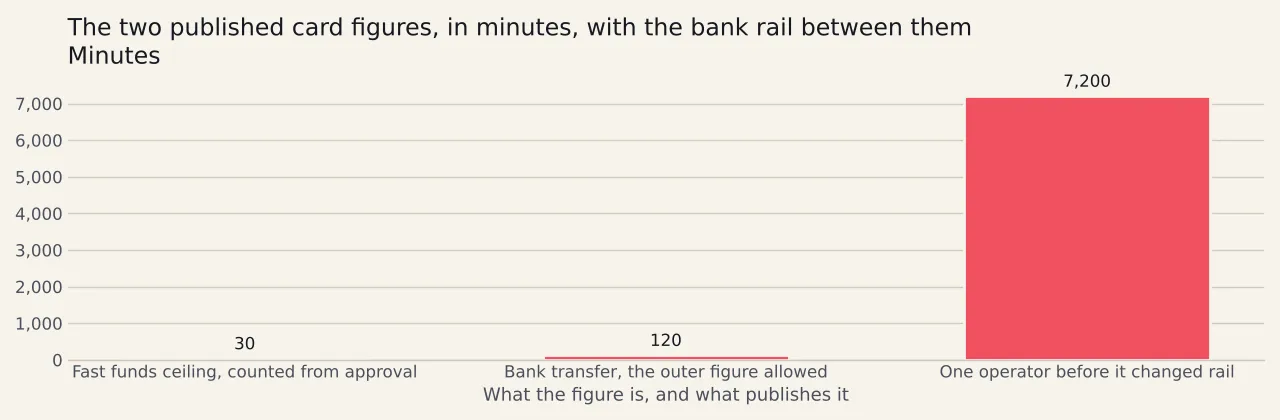
Three more figures come from the same case study. The share of that operator’s payouts running through the service was 40.6 per cent. Before it arrived, a payout could take the five days in the chart. And the sum paid out in real time was £398m, across a customer count given as above 360,000.
Those are one operator’s published numbers from 2022 and they describe a licensed British business. Nothing comparable is published on the offshore side, so the chart is a measure and not a forecast of what any cashier will do.
04
The longest step on the journey is the one with no clock
Only three things about a payout carry a published rule or a published time. The payment rail is the first, and the chart above is all of it. The duty to keep the process as free of friction as possible is the second. Third comes the bar on waiting until the exit to ask for something that could have been asked at the entrance.
The cashier’s own approval step carries nothing. No rule names a maximum, no licence condition sets a deadline, and offers of this kind publish no figure of their own. A page claiming a payout speed for an operator is claiming something nobody has published, and this press does not.
What is published is the order of events. Documents are required before a first withdrawal at sites like these, which means the approval step includes an identity step the first time it runs. The deposit, by contrast, needs nothing in advance.
| Stage | Published figure | Who sets it |
|---|---|---|
| The cashier approves the request | None | Nobody has published one |
| Documents, on a first payout | Required | Offers of this kind, in their own terms |
| Fast funds, at a supporting issuer | 30 minutes | The card network |
| The domestic bank rail instead | 2 hours | The rail operator, as an outer figure |
| The receiving bank posts it | None | Availability depends on the bank |
The timing question in full is at fast withdrawal casinos, and the identity question at no verification casinos. Neither sheet, and nothing here, assists anybody in getting past a check.
05
Four rules protect the exit at a licensed cashier
- No taking it back. A licensed system has to withhold the option of cancelling a payout request, and once one is made those funds may not be put back in front of the customer to deposit.
- No extra hurdles. A cashier may not put hurdles in the way of a payout that it leaves out of a deposit, nor place its own commercial interest ahead of its customers.
- Harm checks do not delay money. What a cashier learns in the course of looking for signs of gambling harm can bear on what is deposited and played. Keeping a payout waiting is not one of its permitted uses.
- One published exception. A withdrawal may be held on rare occasions while checks run to make sure the operator is not taking the proceeds of crime. That is the only published reason for a hold, and a page on payouts should name it rather than pretend there is none.
Alongside those, the charging rules. A payout fee may not exceed what handling the payout costs, emptying a balance in full has to be free of charge, and a fee that reflects cost has to be shown before any money is paid in. A payout fee of the cashier’s own is seldom published at all, and publishing none is a different matter from being forbidden to charge one.
Nothing is raised with the regulator’s contact centre more often than trouble getting money out, out of an annual volume above 6,000 calls. That is about licensed operators, where a complaint has somewhere to go.
06
The deposit is instant and the offer is unchanged
A floor of £20 is usual on offers of this kind, a £20 card payment credits £20, and the counter reads 40 times whichever accepted route brought the money. A card neither improves nor worsens a bonus.
Two things about a card deposit are genuinely different from the alternatives, and neither is a term of the offer. The money leaves an account the reader already holds, so no second balance sits in the middle collecting idle charges. And the payment is tagged 7995, so it is visible to whatever controls the reader has set.
A wallet in the middle changes both of those. It adds a balance with its own fee page and its own idle clock, and it can obscure the tag, because a block reading merchant codes may not recognise a payment to a wallet as a payment to a gambling operator.
For a reader who wants the controls to work, the card is the plainest route in this section. For a reader who wants the controls not to work, nothing on this site is of any help.
07
Five days against thirty minutes, worked out
Six lines. The first four convert the published figures into one unit; the last two set the fast rail against the slow one.
The three published times, in minutes
- Fast funds ceiling, counted from approval 30 minutes
- Domestic bank rail, at its outer end 2 hours = 120 minutes
- Five days, as published at the slow end 5 × 24 × 60 = 7,200 minutes
- The slow figure against the fast one 7,200 ÷ 30 = 240
- Time the cashier’s own approval may take not published
- Published minutes on the whole journey out 30
Line one applies only where the issuer supports the service, and real availability still depends on the receiving bank. Line two is the far end of a rail that normally delivers within moments, and a payment sent outside business hours can run longer still. Line three comes from a 2022 case study about a licensed British operator and describes what it had moved away from. Line five is the honest answer to how long a payout takes: the step that governs the wait is the one nobody has put a number on, and at sites of this kind it includes an identity check the first time.
08
Questions about paying by card
- Do offers of this kind take this card network?
- Nearly all of them, on the way in. It is the most widely accepted route in this section alongside the other large network and the phone wallets, and £20 on a debit card clears the floor they usually set. A split between debit and credit is not something their payment lists publish.
- How long should a card payout take?
- Thirty minutes is the only figure anybody publishes, and it is the ceiling the network’s fast funds service puts on an issuer that supports it, counted from approval. Real availability still depends on the receiving bank, and the cashier’s own approval step before that carries no published time limit whatever.
- What is the code that travels with the payment?
- 7995, the category code for betting. Its description reaches lottery tickets, then chips bought at a casino, then betting away from a track, then a wager placed at one. Gambling paid for online with no card in the hand has to be coded that way, and every bank gambling block works by reading the code rather than by recognising a cashier.
- Will a bank block stop a deposit to these sites?
- It stops what it can read. A block declines payments tagged 7995 wherever the cashier sits, so it does not depend on the licence. Those same banks say a payment carrying the wrong tag can get through, and several of them publish a two-day wait before a lifted block stops applying.
- Does paying by card change what the bonus costs?
- Not by a penny. Twenty pounds credits twenty pounds and the counter stays at 40 times whichever of the fourteen accepted routes carried the money. What the card changes is the exit: one published clock, no payout fee of the cashier’s own, and documents before the first withdrawal.
- Can a withdrawal request be cancelled?
- At a licensed cashier, no. That option has to be withheld, and funds already requested may not be put back in front of the customer to deposit. Hurdles on the way out that are absent on the way in are not permitted either. Not one of those rules reaches a cashier licensed elsewhere.
- Why would a payout be held up?
- One published reason exists at a licensed cashier: checks run on rare occasions to make sure the operator is not receiving the proceeds of crime. What a cashier learns in looking for signs of harm can bear on what is deposited and played, and is no basis for keeping a payout waiting. Away from a Great Britain licence, neither rule applies.
- Is a card safer than a wallet here?
- It is plainer. The money leaves an account you already hold, so no second balance sits in the middle collecting idle charges, and the payment carries the tag your own controls read. A wallet in the middle adds a fee page, an idle clock, and the chance that a block reading merchant codes does not recognise the payment.