
Printed 2026 · figures read October 2026
Best non GamStop casinos, ranked by what a pound of credit costs to clear
Stakes a full match of £20 asks to see before the credit can be withdrawn, at thirty-five times the bonus. Thirty-five is the cheaper of the two lines usual on offers of this kind. Forty is the other. Slots count towards it and nothing else does.
Packages ranked here, with their floors, their multiples and their ceilings
Every link in this rack is a paid placement, and this site is owed a fee when a reader opens an account through one.
Betportal
Lowest wagering
Licence Licensed in Anjouan, Comoros, no Great Britain licence, run by BetPortal Gaming Ltd and Excite Ultra Media Ltd, reference ALSI-202601040-FI2.
WinBeast
Free bet included
Licence Licensed in Curaçao, no Great Britain licence, operator not named on the site.
EliteSpin
New for 2026
Licence Licensed in Costa Rica, no Great Britain licence, run by PrimeTier Limited, opened 2026.
Crown Jewelz
200% first deposit
Licence Licensed in Curaçao, number not verified, no Great Britain licence, operator not named on the site.
Scroll the rack sideways to reach the other columns. The label column stays put.
Not one of the offers printed above holds a Great Britain licence. Outside that licence a British player has none of its protection: Gamstop Online cannot shut the door, the ten-times limit on bonus wagering does not bind the operator, and no British complaints body will take up a dispute. You must be 18 or over to open an account anywhere in this rack.
Every figure in the rack is a term the operator itself publishes, read on 14 October 2026. The operator's terms in full are the ones that bind you.
A full match of £20, in pounds per pound
| What these offers ask | Under a British licence | |
|---|---|---|
| You put in | £20.00 | £20.00 |
| Handed over | £20.00 | £20.00 |
| Wagering | 35x | 10x |
| Cost per £1 kept | No pound survives | £0.67 |
A 96 per cent return is assumed on both sides, with every round counted at face value and the counter finished inside the window. £700 of stakes carries an expected cost of £28.00. The credit is £20, so it falls £8.00 short of its own obligation and no surviving pound is left for a price to attach to. The licensed side freezes the deposit and the credit where the first one has them and moves the multiple alone, down to ten, the furthest a wagering requirement may be taken under a Great Britain licence. At ten, £12.00 of the £20 is expected to remain. No cashier of this kind holds the licence that sets that figure, so the licensed side states the size of what is absent rather than an offer anybody can take. Averages describe a great many attempts and predict none of them.
01
Thirty-five times is the cheaper line in this market, and forty is the other one
Thirty-five times the bonus appears on some packages of this kind. More of them ask forty. Those two numbers carry most of the price, because a multiple is what turns a headline into an obligation.
Per pound of credit the arithmetic is short. Thirty-five times a pound is £35 of stakes, and turnover costs 4 per cent of itself at a 96 per cent return, so a pound of credit costs £1.40 to clear. Forty times the same pound costs £1.60. The distance between the cheaper line and the dearer one is 20p for every pound handed over.
Scale that to the rung this page prices and it is £700 of stakes against £800, or £28.00 of expected cost against £32.00. A reader choosing on price alone is choosing between those two figures and nothing else.
£20 is the floor these cashiers usually set, and some write it as €20 instead. Nothing is credited until that deposit lands, so no package opens on an empty account. Three guides take the surrounding rungs apart: non GamStop casinos UK 10 deposit prices a tenner against that floor, non GamStop casinos with £5 deposit does the same for a fiver, and non GamStop casinos no deposit bonus covers what is handed over before any deposit at all. The section index is outside the licence.
02
Five terms between them fix the price, and few packages print all five
Five terms fix what a bonus costs. The multiple. What it is applied to. The ceiling on the winnings. The window. And the largest bet permitted while the bonus is live. Some packages print every one of them. Others print none of the last three.
| Package | Multiple | Applied to | Ceiling on the winnings | Window | Biggest bet |
|---|---|---|---|---|---|
| The thirty-five times package | 35x | Bonus only | 5x the bonus | 14 days | €5 |
| Forty times, spins counted | 40x | Bonus and spin winnings | €100 a batch | 7 days | Not published |
| Forty times, five stages | 40x | Bonus and spin winnings | 5x the bonus | 7 days | Not published |
| Forty times, reported only | 40x | Bonus only | Not published | Not published | Not published |
Not published is the entry that matters most in that table. A term the cashier has not printed cannot be priced before the money goes in, and most of them leave the largest bet unstated. The last row carries a multiple that reaches this page through reviews rather than through an operator’s own pages, which is weaker again.
Ranking on price therefore means ranking on what is legible. Few packages of this kind can be costed in full from their own published terms, and being legible is a separate point from being cheap.
03
At twenty-five times a credit is expected to cost precisely what it is worth
Twenty-five is the break-even multiple at a 96 per cent return. Each pound of turnover is expected to cost 4p, twenty-five of those pennies make a pound, so a credit turned over twenty-five times is expected to cost its own value exactly. Under that figure a residue survives. Past it the credit is consumed and the deposit covers the rest.
Both lines sit past it. Thirty-five times leaves an expected deficit of 40p per pound of credit, forty times leaves 60p. Ten, the figure a Great Britain licence allows, leaves 60p of each pound standing instead.
Wagering of thirty to sixty times is the band recorded away from the British licence, a figure this press takes from a trade publication rather than from a regulator and prints as a pattern. Both lines priced here fall inside that band, towards its cheaper end. Ten sits a long way below the whole of it, which is why the right-hand column of the price line is the only place on this page where a kept pound carries a price at all.
None of this forecasts one session. The sum is an average over a great many attempts, and in most single attempts the balance reaches nought long before the counter is served.
04
What the multiple is applied to moves the bill further than the multiple does
Some packages apply their forty times to bonus funds and to the winnings from free spins. Others apply it to the bonus alone. That clause is worth more than the gap between thirty-five and forty.
A hundred spins at 10p stake £10 of the cashier’s money and give back £9.60 at a 96 per cent return. On a package that counts spin winnings, that £9.60 becomes a second bonus, and forty times it is £384.00 of further stakes at an expected cost of £15.36. On a package that does not, the same £9.60 is subject to whatever its terms say about cash.
A few go further and pay the winnings from their spins without any wagering at all. On a hundred spins that is £9.60 of cash for nothing more staked, and it is the cheapest item this page prices.
- Spin winnings counted at forty times. £384.00 of stakes stands behind £9.60 of winnings, at an expected cost of £15.36. The cost exceeds the winnings by £5.76.
- Spin winnings counted at ten times. The same £9.60 would carry £96.00 of stakes, expected to cost £3.84 and to leave £5.76. A cashier outside the licence is held to no such figure.
- Spin winnings with nothing owed. £9.60, kept, where a package attaches nothing to its spins. Read which one from the ranking rather than from a headline.
Slots are the only games that move any of these counters. A roulette round shifts them by nought under terms of this shape, so the games carrying the thinnest house edge are precisely the games that do not count.
05
The window turns £700 of stakes into a daily figure
£50.00 a day, for fourteen days without a gap, is £700 of stakes inside the longest window these packages print. Seven days is the other window in regular use, which puts £800 of stakes at £114.29 a day. Where no window is printed, an obligation has no pace at all until the terms arrive.
The spins carry shorter clocks of their own. A package may drip 500 spins out at 25 a day across four days, with each batch lasting a single day from release. Another allows three days from activation. A batch left overnight is forfeited, and the winnings that would have carried the wagering go with it.
€5 is the largest bet published where one is published at all. At that ceiling £700 of stakes is 140 rounds, which is a short evening. At 10p a spin it is 7,000 rounds, which is not. The same obligation can be served in an hour or stretched over a fortnight, and the stake chosen decides which, inside whatever ceiling the terms set.
A British licence puts a floor under the clock from the other direction. No slot cycle there may run shorter than 2.5 seconds, and a casino game other than a slot must take five. Those minimums are conditions of a licence these cashiers do not hold, so the pace here is set by the software and by nothing else.
06
The ceiling on the winnings decides what £700 of stakes can ever become
£100 is the most £20 of credit may turn into where bonus winnings stop at five times the bonus, which is the commonest ceiling of the two. Others hold the winnings from each batch of spins to €100. An unprinted ceiling is not an absent one.
That kind of cap breaks no rule on either side of the water. It is also a different animal from a cap on withdrawals, and the two get confused constantly. A British licensee may not impose a term whose object or effect is a maximum limit on the amount withdrawable from a deposit balance. The example the Commission prints of a term it forbids is one allowing £50 out a day and £500 out a week. Players are entitled to withdraw from a deposit balance, winnings included, whenever they choose.
So a phrase like keep what you win and a ceiling of £100 can both stand on one page, and a reader has to tell them apart. Three things rest on a rule at a licensed site: a wagering requirement cannot pass ten times the bonus, the deposit balance can be emptied at will, and no term may ration that emptying. A ceiling on what a bonus may become is outside all three.
Outside that licence none of the three applies in the first place, because each rule attaches to it. A ceiling there is whatever the terms page says on the day the account opens, and whatever it says afterwards.
07
What the absent licence would have been worth, item by item
Four things are given up at the moment a deposit lands at a cashier of this kind, and each is a duty riding on a Great Britain licence rather than a courtesy anybody has offered.
The ten-times ceiling is the first. It has applied to British licensees from 19 January 2026, under a code provision that stops a wagering requirement going past ten times the bonus. The second is self-exclusion. Every online operator the Commission licenses has to join Gamstop Online, so the scheme’s cover maps onto the licence and onto nothing else. The scheme puts its own limit in writing: it can assist in excluding a person from the services of participating operators, and it states that it cannot keep anybody away from gambling run by firms that stand outside it. A door it cannot close is a door it cannot close.
The third is the complaint. A British licensee has three working days to acknowledge one, or 24 hours where it runs a 24-hour operation, and eight weeks from receipt to finish the process including any internal escalation. Its closing letter must explain the decision, say the process has ended, and point to the independent dispute entity that comes next. The fourth is the regulator itself. The Commission is not an ombudsman, as it says on the page answering its commonest consumer enquiries, so it settles no individual dispute even against a company it has licensed. Against one it has never licensed there is no lever at all for a player to reach for. A gambling business trading without the licence is acting illegally, and the consequences the Commission names fall on the operator: enforcement, and payment providers possibly withdrawing their facilities. Neither of those is a refund.
Its warning notice of 20 January 2025 puts the rest of it plainly. A site trading without the licence is unregulated and carries none of the safeguards a licensee is made to provide. The notice records that sites of that kind may go after vulnerable customers, people who have registered with the national scheme among them, and that their controls on social responsibility and on money laundering may be weak. Fraud, data privacy and unfair practice are what it names a player as running into. A familiar game in the lobby proves nothing either way, because the same notice records games made by licensed suppliers surfacing on sites reachable here illegally, placed there by resellers acting against their contracts.
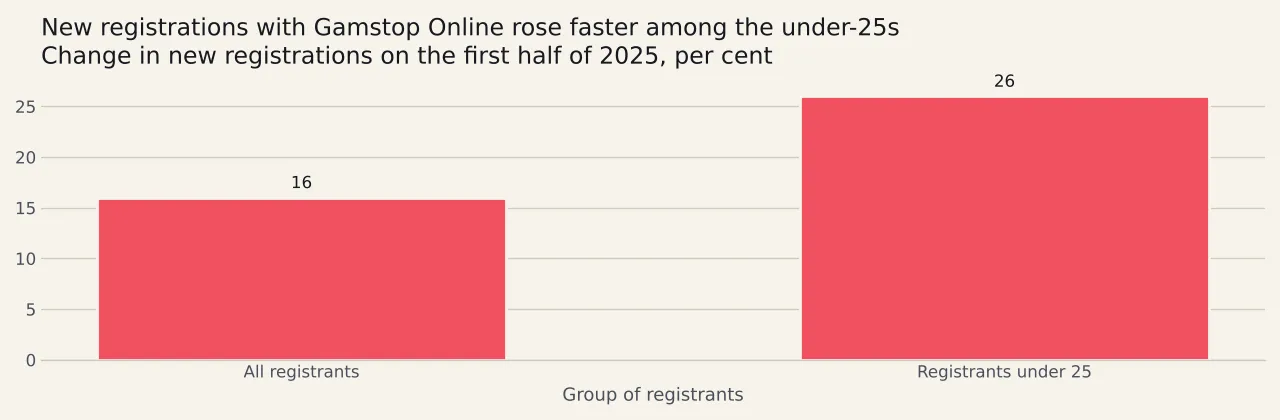
Neither bar prices an offer. They are here because the scheme is the one protection on the list a reader can switch on without asking anybody, and because cashiers of this kind sit beyond its reach by construction rather than by accident.
08
Twenty pounds matched in full, thirty-five times over, step by step
The offer’s own column is below in single steps, with the British answer set beside the one it produces.
A full match of £20 at 35 times
- Paid in at the cashier £20.00
- Credit at a full match £20.00 × 1.0 = £20.00
- Counter raised to thirty-five times over 35 × £20.00 = £700.00
- What that turnover is expected to cost £700.00 × 0.04 = £28.00
- What is left of the credit £20.00 − £28.00 = −£8.00
- Ceiling the terms put on the winnings £20.00 × 5 = £100.00
- The same credit at a licensed ten times £200.00 × 0.04 = £8.00, so £12.00 stands
- A kept pound, priced in both columns No pound survives · £0.67
Three omissions. The ceiling at step six removes the large outcomes that give an average its shape, so the spread of real results is worse than the figure looks. A game counted below face value multiplies the real stakes behind step three, and a game off the slots list moves the counter not at all. An unserved counter at the end of the window leaves a forfeited bonus rather than a part-paid one.
09
Questions about choosing between packages of that sort
- Which package at this end of the market is cheapest to clear?
- The one at thirty-five times. A pound of credit costs £1.40 of expected losses to clear there and £1.60 at forty times, so £20 of credit costs £28.00 against £32.00. Cheapest is not the same as worth taking: both lines sit above twenty-five times, where a bonus is expected to cost exactly its own value.
- What does £20 of credit cost to clear at thirty-five times?
- £28.00 in expectation. Thirty-five times £20 is £700 of stakes, and turnover costs 4 per cent of itself at a 96 per cent return. The credit is £20, so the sum runs £8.00 past it and that difference comes out of the money paid in.
- Does the same £20 leave anything under a British licence?
- £12.00 of it. A British licensee stops at ten, so £20 of credit carries £200 of stakes, which costs £8.00 and leaves £12.00 of the credit in place. Each pound kept has 67p of expected play standing behind it. The ceiling has applied to every holder of the licence since 19 January 2026 and to no cashier without one.
- Are sites of this kind connected to Gamstop Online?
- No. The scheme is built into the Great Britain licence, and these sites hold none, so a registration does not close them. Its terms state that it cannot keep a person away from operators that do not participate. A warning notice the Commission published on 20 January 2025 adds that unlicensed sites may go after people who have self-excluded.
- What is the most £20 of credit may pay out?
- £100 where bonus winnings stop at five times the bonus, the commoner of the two ceilings. Some cap the winnings from each batch of spins at €100 instead. No published ceiling leaves the figure unknown rather than absent.
- How long does £700 of stakes take to put through?
- 7,000 rounds at 10p a spin, or 140 rounds at a €5 largest bet where one is printed. Spread across a fourteen-day window it comes to £50.00 of stakes a day. On a seven-day window, £800 of stakes is £114.29 a day.
- Do the winnings from free spins carry the wagering as well?
- On some of them, yes. Forty times applies to bonus funds and spin winnings alike, so the £9.60 that a hundred 10p spins return at a 96 per cent payback owes a further £384.00 of stakes, expected to cost £15.36. A package that pays its spin winnings with no wagering attached leaves that £9.60 as cash.
- If a payout is refused, who takes the complaint up?
- Nobody in Britain. A licensee here must acknowledge a complaint within three working days, finish the process inside eight weeks and name an independent dispute entity in its final letter. The Commission states that it is not an ombudsman, and over a company it has not licensed it has no power to act for a player.