
Printed 2026 · figures read October 2026
PayPal casino deposits are not on offer, and the detour costs £2.19
The cash cost of the detour a reader takes because the button is not there: £20 loaded into a wallet off a debit card at 1.00 per cent, nothing to pay the cashier out of the balance, and £100 back out to a card at 1.99 per cent. An idle charge follows if the wallet is then left alone. Taken from the two wallet schedules, read 13 October 2026.
Sites like these, and the deposit routes each one prints
Every link in this rack is a paid placement, and this site is owed a fee when a reader opens an account through one.
Betportal
Lowest wagering
Licence Licensed in Anjouan, Comoros, no Great Britain licence, run by BetPortal Gaming Ltd and Excite Ultra Media Ltd, reference ALSI-202601040-FI2.
WinBeast
Free bet included
Licence Licensed in Curaçao, no Great Britain licence, operator not named on the site.
EliteSpin
New for 2026
Licence Licensed in Costa Rica, no Great Britain licence, run by PrimeTier Limited, opened 2026.
Crown Jewelz
200% first deposit
Licence Licensed in Curaçao, number not verified, no Great Britain licence, operator not named on the site.
Scroll the rack sideways to reach the other columns. The label column stays put.
Not one of the offers printed above holds a Great Britain licence. Outside that licence a British player has none of its protection: Gamstop Online cannot shut the door, the ten-times limit on bonus wagering does not bind the operator, and no British complaints body will take up a dispute. You must be 18 or over to open an account anywhere in this rack.
Every figure in the rack is a term the operator itself publishes, read on 14 October 2026. The operator's terms in full are the ones that bind you.
£20 in, by a route that exists here
| What these offers ask | Under a British licence | |
|---|---|---|
| You put in | £20.00, not by PayPal | £20.00, PayPal allowed |
| Handed over | £20.00 | £20.00 |
| Wagering | 40x | 10x |
| Cost per £1 kept | None survives | £0.67 |
This is the one strip on the site where the top row carries the whole story. PayPal is not a route offers of this kind publish, so the left-hand £20 has to arrive by card, wallet, voucher or coin instead, and the rest of the left-hand column is the arithmetic those terms usually set: 40 times £20 is £800 of staking, retaining £32.00 at a payback of 96 per cent, which is more than the credit, so none survives. The right-hand column can be filled, because the route does exist on the licensed side: the wallet lets a gambling payment through to a seller it has approved, where that gambling is lawful. There the counter stops at ten times, £8.00 is retained and £12.00 survives at 67p a pound. Buyer Protection covers £0.00 in both columns, which is the one figure the licence does not change.
01
The route is absent, and the absence is the page
The button is not on offer. Every other route in this section is carried somewhere in this part of the market and this one is carried nowhere in it, a decision made by the wallet rather than by any cashier. Checked against published payment lists in October 2026.
So the practical question is not how PayPal behaves at these sites. It is what a reader who wanted PayPal does instead, and what the substitute costs. The answer on published figures is £2.19 for a round trip of £20 in and £100 out through a wallet, with an idle charge afterwards if the wallet is left alone.
That detour is worked line by line in part seven. Three other things are worth settling first: why the button is missing, what cover it would carry if it were there, and what the balance behind it actually is.
Where a wallet is taken, the fee pages are at Skrill, Neteller and Trustly casino and MuchBetter casino. The two routes carried almost everywhere are at Visa casino and Apple Pay casino. All sixteen routes are banded at how you pay.
02
The button is not the cashier’s to offer
Where a gambling payment travels is the wallet’s decision. Under its own acceptable use rules such a payment goes through for an approved gambling seller, in a place where the gambling is lawful, and is barred anywhere else.
That is a materially different thing from a cashier choosing not to list a route. A cashier can add a card processor by commercial agreement. It cannot add this one without being approved by the wallet, and approval turns on the licensing position of the operator.
Read the absence that way and it carries information. A cashier licensed in Anjouan, Curacao or Costa Rica, and absent from the British register, is a cashier that has not cleared that approval.
No part of this page sets out to work round that, and nothing here hints that a way exists. Two honest options remain: pay by a route the cashier does publish, or pick a cashier that publishes the route.
03
£0.00 of cover, on either side of the comparison
£0.00 is what Buyer Protection pays out on a payment to a casino. Gambling and gaming are named exclusions, and so is anything at all that charges to enter and hands out a prize, which takes in the whole category rather than one product inside it.
This is the rare figure that does not move with the licence. A payment to a British-licensed casino through the button carries the same nil cover as a payment anywhere else, because the exclusion is written by the wallet and not by the regulator.
So the reason to want the button is not protection against the cashier. It is that the card number stays with the wallet, that one place holds the record of the payment, and that the wallet’s own controls sit in front of the account. Those are real, and they are not cover.
Three further exclusions follow from the same clause and all three matter at a cashier. A disputed bonus is not a disputed purchase. A closed account is not a non-delivery. And a term applied after the event is not a faulty item.
04
What sits behind the balance, and what does not
994790 is the firm reference number to look up. The UK entity holds an electronic money institution authorisation from the Conduct Authority, which is a payments permission and not a banking one, so no deposit guarantee comes with it.
So whatever electronic money an account holds is outside the compensation scheme that stands behind bank deposits. What happens instead is safeguarding: the money is held apart from the firm’s own, a different mechanism with a different failure case. Every large wallet in this section sits under the same regime.
For a reader comparing routes that matters in one specific way. Money left in a wallet is not money in a bank account, whichever wallet it is, and the balance should be read as a payment instrument rather than as savings.
The licensed side does not change that either. What a licence changes is the cashier at the far end of the payment, which is why the licensed side of the strip above shifts the counter and leaves the cover where it was.
05
The block is the feature worth switching on
The control is five screens deep. Account first, then settings, payments, payment preferences and finally payment controls, where a gambling block waits. Switched on, it refuses the eligible payments going to merchants the wallet has tagged as gambling operators.
- Three days. Switch it off and a three-day wait runs before that takes effect.
- It reads a tag. The tagging comes out of merchant records and industry codes, so a merchant that has not been tagged as gambling can slip past it.
- It is not a self-exclusion. The national scheme covers sites by licence; this covers payments by classification. The two are different instruments and neither replaces the other.
Bank blocks work the same way and the same limitation applies. The classification code for betting and gambling is what they all read, and a payment not tagged with it can pass through. Several banks publish a wait before a lifted block stops applying: two days at one, two days at another, and a cooling-off of the same length at a third.
A reader who wants a block rather than a route has the stronger instrument available to them. Register with Gamstop Online and every gambling site carrying a British licence closes to you; 614,738 people had done so by 16 July 2026. It does not reach a cashier that holds no such licence, which the scheme states as a limit on what it can do.
06
The wallets that are taken charge for sitting still
Two months is the shortest idle clock in this section and thirteen is the longest. A reader pushed off one wallet and onto another inherits whichever clock the new one publishes, and all of them publish something.
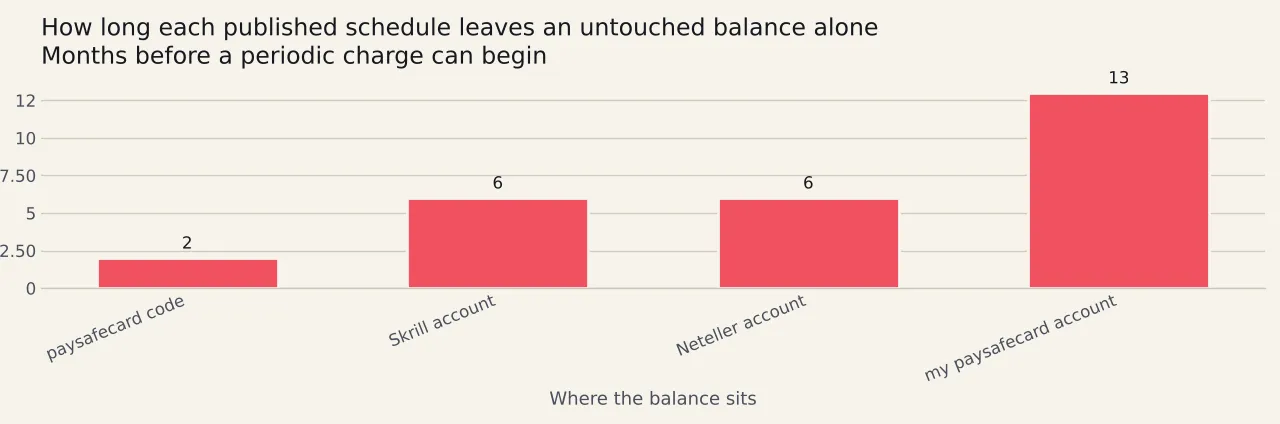
Getting money into those wallets is priced as well, and the table sets the two schedules against each other leg by leg.
| Leg of the journey | First wallet | Second wallet |
|---|---|---|
| In, from a debit card | 1.00% | 2.5% |
| In, by bank transfer | 0.00% | 0% to 1% |
| In, out of a prepaid voucher | 5.00% | 0% to 5% |
| On to the cashier | Not charged | 0% |
| Out, to a card | 1.99% | 0% to 7.5% |
| Out, to a bank | 1.75% | USD 10 |
Only one row in that table is free at both wallets, and it is the row a casino deposit uses. Everything a reader pays sits on the way in or on the way out, never in the middle, and the floors attached to several of those percentages are set in euros and dollars and are left unconverted here.
07
What the detour costs, line by line
Six lines on published figures: £20 into a wallet from a card, out to the cashier, and £100 back again.
£20 in and £100 out, through a wallet instead
- Loading £20 from a debit card at 1.00 per cent £20.00 × 0.01 = £0.20
- Paying the cashier out of the balance no fee listed = £0.00
- Cover carried by that payment £0.00
- £100 back out to a card at 1.99 per cent £100.00 × 0.0199 = £1.99
- Charge if the wallet then sits idle six months EUR 5.00 a month
- Cash cost of the detour, before any idle charge £0.20 + £1.99 = £2.19
Line one would be nothing on a bank transfer and 5.00 per cent out of a prepaid voucher, so the route into the wallet is the one line a reader controls. Line four has a floor in euros beneath it, printed as it stands because nothing here converts currencies. Line five is avoided by using the account at least twice a year. Emptying a deposit balance in full is something a British licensee has to do for nothing, so not one of these figures is a casino charge: every one belongs to the wallet. The bonus arithmetic in the strip above is untouched by every line here.
08
Questions about paying through a wallet
- Do offers of this kind take PayPal?
- No. Every other route in this section is carried somewhere in this part of the market, and this one is carried nowhere in it. Where a gambling payment may travel is the wallet’s decision, and it has not approved these sellers.
- Why is the button missing?
- Because the wallet decides, not the cashier. Under its acceptable use rules a gambling payment is allowed through to a seller the wallet has approved, where that gambling is lawful, and is barred otherwise. A cashier cannot add this route by commercial agreement the way it can add a card processor.
- Does Buyer Protection cover a casino payment?
- It covers £0.00. Gambling and gaming are named exclusions, and so is anything at all that charges to enter and hands out a prize. That exclusion is the wallet’s own writing rather than any regulator’s, so a payment to a British-licensed casino carries exactly the same nil cover.
- Is a wallet balance protected the way a bank balance is?
- No. The UK entity holds an electronic money institution authorisation, firm reference 994790, which is a payments permission rather than a banking one. The money sits outside the compensation scheme standing behind bank deposits, and is held apart from the firm’s own instead. That regime covers every large wallet named in this section.
- What does the gambling block do?
- It refuses the eligible payments going to merchants the wallet has tagged as gambling operators, and it is five screens deep: account, settings, payments, payment preferences, then payment controls. Switch it off and a three-day wait runs first. The tagging comes out of merchant records and industry codes, so an untagged merchant can slip past.
- What does a wallet deposit cost instead?
- £2.19 on published figures for £20 in and £100 out: 1.00 per cent to load £20 from a debit card, nothing to pay the cashier from the balance, and 1.99 per cent to move £100 back to a card. A bank transfer in would be free and a prepaid voucher in would be 5.00 per cent.
- Will an untouched wallet balance shrink?
- At every schedule in this section, eventually. An unregistered code hands over £4 every month from the month after the month of purchase. The two big wallets levy a monthly charge on anybody who has neither signed in nor transacted inside six months. A registered voucher account takes £5 a month from month thirteen.
- Is a payment block the same as self-exclusion?
- No, and the difference matters. A payment block reads merchant classification codes and stops payments it recognises. Register with Gamstop Online and every gambling site carrying a British licence closes to you, as 614,738 people had by 16 July 2026. The scheme states plainly that it cannot close a site standing outside it.