
Printed 2026 · figures read October 2026
200% deposit bonus: £40 of credit that costs £64.00 of play to unlock
Expected cost of the play a doubled match sets against a £20 first payment. Forty pounds of credit at 40 times is £1,600 of staking, and 4p in each of those pounds is retained by the games. At a cashier holding a British licence the same credit would cost £16.00 to clear. Read from the terms these cashiers publish for themselves, October 2026.
The rate each column puts on its opening payment
Every link in this rack is a paid placement, and this site is owed a fee when a reader opens an account through one.
Betportal
Lowest wagering
Licence Licensed in Anjouan, Comoros, no Great Britain licence, run by BetPortal Gaming Ltd and Excite Ultra Media Ltd, reference ALSI-202601040-FI2.
WinBeast
Free bet included
Licence Licensed in Curaçao, no Great Britain licence, operator not named on the site.
EliteSpin
New for 2026
Licence Licensed in Costa Rica, no Great Britain licence, run by PrimeTier Limited, opened 2026.
Crown Jewelz
200% first deposit
Licence Licensed in Curaçao, number not verified, no Great Britain licence, operator not named on the site.
Scroll the rack sideways to reach the other columns. The label column stays put.
Not one of the offers printed above holds a Great Britain licence. Outside that licence a British player has none of its protection: Gamstop Online cannot shut the door, the ten-times limit on bonus wagering does not bind the operator, and no British complaints body will take up a dispute. You must be 18 or over to open an account anywhere in this rack.
Every figure in the rack is a term the operator itself publishes, read on 14 October 2026. The operator's terms in full are the ones that bind you.
£20 doubled, in pounds per pound
| What these offers ask | Under a British licence | |
|---|---|---|
| You put in | £20.00 | £20.00 |
| Handed over | £40.00 | £40.00 |
| Wagering | 40x | 10x |
| Cost per £1 kept | Nothing to price | £0.67 |
Both sides are worked with 96 per cent returning to the player, every round counted whole, and the obligation completed. Sixteen hundred pounds of staking retains £64.00 for the house, set against credit of £40.00, so the credit is exhausted before the counter reaches zero and there is no surviving pound to divide into. Four hundred pounds of staking at ten times retains £16.00 and leaves £24.00 standing. Only a Great Britain licence puts the multiple at ten. Anjouan, Curacao and Costa Rica answer for these cashiers instead. Some stop the credit at five times its own size, which caps the right-hand figure further without touching the left.
01
Doubling the rate doubles the credit and the work in the same breath
£40.00 of credit, £1,600.00 of staking and £64.00 of expected cost is what a doubled match comes to on the smallest payment these cashiers accept. Set the last figure against the first and the arrangement prices itself.
Where this rate is advertised it tends to run across three payments, at 200 per cent and then 150 twice. Most offers of this kind do not reach it on an opening payment at all. So a reader searching for a doubled match has fewer choices in front of them than the headlines suggest.
Nothing about the unit price changes between this page and the one below it. A full match is one lot of £40.00 of staking for each pound of credit; this is the same lot, twice over. The arithmetic is laid out once at matched money and does not vary by rate.
What does change is the share of the money on screen that answers to you. That is the subject of the next two parts, and it is the honest reason to prefer a smaller rate rather than a larger one.
02
A third of what shows on screen could be asked for today
33.3 per cent is the share of a doubled balance that answers to you. £20 of your own against £40 of credit makes £60 on screen, and only the first figure can be asked for without serving anything first.
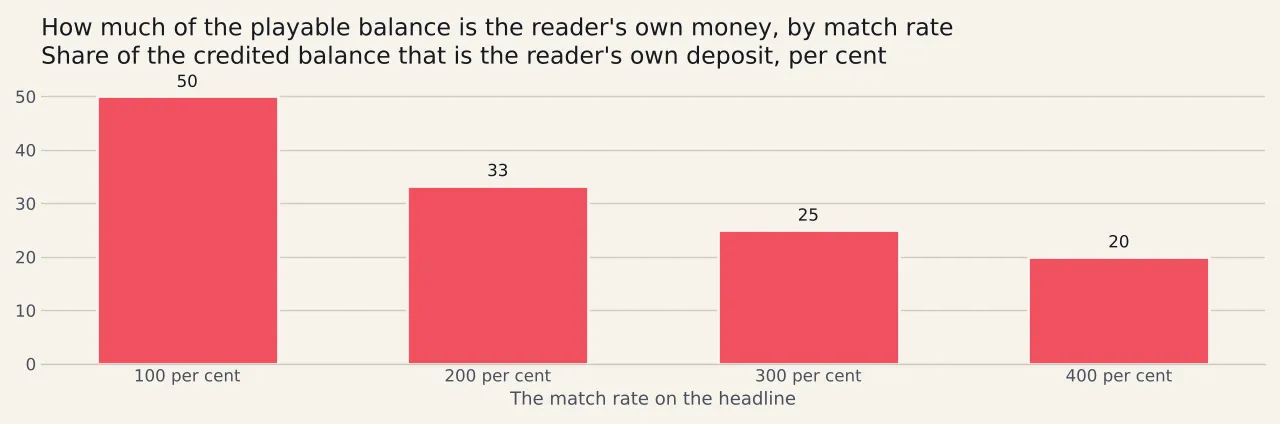
Headline rates are advertised upwards and this measure runs downwards, which is why the two are rarely printed together. A bigger rate is a smaller stake in your own balance.
The three stages of the doubled package illustrate the point at its full extent. Taking all three at the floor puts £60 of your money in and £100 of credit beside it, so your share of a £160 balance has fallen to 37.5 per cent, and £4,000.00 of staking stands over the rest.
03
Two ceilings sound alike and only one of them is lawful here
One sort of ceiling limits what a bonus may win. The other limits what may be taken out of the account. The licensed market treats them as entirely different animals.
The first is permitted. Some cashiers hold a credit to five times its own size, so £40 of credit cannot become more than £200 whatever happens on the reels. Others limit each batch of spin winnings to €100. That is a term about the bonus.
The second is forbidden to a licensee outright. A licence holder may neither write nor lean on a term that caps withdrawals out of the money a customer paid in. The clause the regulator prints as an example of one permits no more than £50 in any day and £500 in any week. The balance, winnings and all, belongs to the player whenever they want it, and a licensee has to say so.
Both sentences can be true of one offer at a licensed cashier: the credit capped at five times, the deposit balance never capped at all. Outside the licence only the first sentence has any machinery behind it, and the second is whatever the terms happen to say.
That is also the honest reading of the phrase about keeping what you win. Three things rest on rules at a licensed site: the staking limit of ten times, the entitlement to the deposit balance at any moment, and the ban on capping withdrawals from it. A win limit on the bonus itself answers to none of the three, so keep what you win and capped at five times its own value can both hold at once. Say which is which before signing.
04
The same doubled credit, read at four deposit sizes
Everything on the left of the table scales. The price of a surviving pound does not, which is why the two right-hand columns are the ones to read.
| Paid in | Credit | Staking | Expected cost | Shortfall |
|---|---|---|---|---|
| £20, the floor | £40.00 | £1,600.00 | £64.00 | £24.00 |
| £50 | £100.00 | £4,000.00 | £160.00 | £60.00 |
| £100 | £200.00 | £8,000.00 | £320.00 | £120.00 |
| £500, the published ceiling on one stage | £1,000.00 | £40,000.00 | £1,600.00 | £600.00 |
The right-hand column is credit minus the expected cost of unlocking it, and it is negative in every row. A bigger payment buys a bigger shortfall in exactly the same proportion, which is what it means to say the rate does not change the unit price.
Under the British ceiling the same four rows owe £400.00, £1,000.00, £2,000.00 and £10,000.00, cost £16.00, £40.00, £80.00 and £400.00, and leave £24.00, £60.00, £120.00 and £600.00 standing. A shortfall column becomes a surplus one, and that single sign change is what the missing licence is worth.
05
What the doubled package does over its three stages
£100.00 of credit is the whole package at the floor, built from 200 per cent on the first payment and 150 on each of the next two. Each stage asks for its own £20, so £60 of your own money is needed to collect it.
£4,000.00 of staking follows, at an expected cost of £160.00, against credit worth £100.00. The shortfall across the whole package is £60.00, which happens to equal the money paid in to obtain it.
No expiry, no maximum bet and no ceiling on what the credit may win is published at all. Three empty cells in one column mean the plan cannot be timed, paced or capped from published information, and nothing here fills an empty cell by borrowing from a different cashier.
It does publish two things: paperwork is called for ahead of any first payout, and the account answers to Curacao on a licence number nobody has verified. Both facts belong in the reading of the £100.00.
06
What a licence would alter, beyond the multiple
The multiple would fall to ten and the shortfall of £24.00 would become a surplus of £24.00. That much is arithmetic. The rest is not.
A licensed cashier settles the three identity details, name and address and date of birth, before play begins rather than when a payout is asked for, so the identity step sits at the entrance rather than the exit. It must publish how a complaint travels and finish that journey inside eight weeks. It must take part in the national self-exclusion scheme, so a registration closes it.
And a licensed cashier can be penalised. The published enforcement list shows a £10m penalty against one online operator in October 2025, with loss thresholds recorded in the decision, and a £170,000 penalty in July 2025 for a bonus term reserving a discretion to take winnings away. Enforcement follows the licence, so none of it reaches an unlicensed cashier.
Those absences are taken apart one by one in outside the licence. The neighbouring rates are at 100% deposit bonus and 300% deposit bonus, with the stacked headlines at 400% deposit bonus, and the opening package priced whole at casino welcome bonus.
07
A doubled match on the floor payment, worked through
Five lines, the deposit kept out of them, and the answer set against what ten times would have produced.
£20 doubled, served at 40 times
- Credit at 200 per cent of the opening payment £20.00 × 2 = £40.00
- Staking the counter asks for £40.00 × 40 = £1,600.00
- What the games retain, 4p in each pound staked £1,600.00 × 0.04 = £64.00
- Credit weighed against that retention £40.00 less £64.00 = −£24.00
- Expected to survive, where ten times leaves £24.00 £0.00
At ten times the same five lines read £40.00, £400.00, £16.00, £24.00 and a cost of 67p for each surviving pound. The answer here is set at nought rather than at a loss: credit that never converts cannot remove money from an account, and the minus sign records that the counter is expected to outlive the credit. Three published terms cut the figure further and none of them lifts it: a win ceiling of five times where one is set, a window of seven or fourteen days where one is given at all, and any game crediting less than its face value towards the counter. These are averages over a very large number of rounds and say nothing about a single evening.
08
Questions about a doubled match
- What does a 200% deposit bonus cost to clear?
- £64.00 in expectation on a £20 opening payment. Forty pounds of credit at 40 times is £1,600 of staking, and 4p in the pound is retained, so the cost exceeds the credit by £24.00. Ten times, the British figure, puts the cost of clearing the same credit at £16.00 and leaves £24.00 standing.
- How much of a doubled balance is my own money?
- A third. Twenty pounds of yours against forty of credit shows £60 on screen, and only your twenty can be asked for without serving the counter first. At a full match the share is a half, at triple a quarter and at quadruple a fifth, so a larger headline always means a smaller stake in your own balance.
- Is a maximum win cap allowed?
- A limit on what a bonus may win is permitted, and some cashiers set theirs at five times the credit. A term capping withdrawals out of the money a customer paid in is a different animal, and a British licensee may neither write nor lean on one; the example the regulator prints permits no more than £50 in any day and £500 in any week.
- Can an offer say keep what you win and still cap the winnings?
- Yes, and that is why the phrase has to be read carefully. Three things rest on rules at a licensed site: a staking limit of ten times, the right to the deposit balance at any moment, and the ban on capping withdrawals from it. A limit on what the bonus itself may turn into sits outside all three.
- Which offers actually run this rate?
- Few of them, and where it is run it goes over three payments at 200 per cent and then 150 twice, with a floor of £20 at each stage. Taken whole at the floor that is £60 of your own money for £100 of credit and £4,000.00 of staking. Most do not reach this rate on an opening payment.
- What is not published about the doubled package?
- Three terms. It prints no expiry date, no maximum bet and no ceiling on what the credit may win. Without those the obligation cannot be timed, paced or capped from published information, and this press will not borrow a figure from another cashier to fill the gap.
- Does doubling the deposit improve anything?
- It enlarges every line in proportion, and what a surviving pound costs does not shift. Fifty pounds paid in brings £100 of credit, £4,000.00 of staking, £160.00 of expected cost and a shortfall of £60.00. The decision is how much money to put in play, not whether the terms get better, because they do not.
- What would a British licence add to this offer?
- The multiple would drop to ten and the shortfall would turn into a surplus of £24.00. Identity would be dealt with at the entrance instead of the exit, a complaint would have a route and an eight-week deadline, the national self-exclusion scheme would close the account on request, and the regulator could penalise the operator. Enforcement follows the licence and stops where it ends.