
Printed 2026 · figures read October 2026
No KYC casinos, and the £2,100 of stakes that comes before the question
Stakes owed by a full three-stage ladder at the cheaper multiple, where £60 of deposits collects £60 of credit at thirty-five times. These cashiers print one practice between them, which is documents ahead of a first payout. The counter is served before the paperwork is wanted, not instead of it.
What each cashier credits, and when each one asks for documents
Every link in this rack is a paid placement, and this site is owed a fee when a reader opens an account through one.
Betportal
Lowest wagering
Licence Licensed in Anjouan, Comoros, no Great Britain licence, run by BetPortal Gaming Ltd and Excite Ultra Media Ltd, reference ALSI-202601040-FI2.
WinBeast
Free bet included
Licence Licensed in Curaçao, no Great Britain licence, operator not named on the site.
EliteSpin
New for 2026
Licence Licensed in Costa Rica, no Great Britain licence, run by PrimeTier Limited, opened 2026.
Crown Jewelz
200% first deposit
Licence Licensed in Curaçao, number not verified, no Great Britain licence, operator not named on the site.
Scroll the rack sideways to reach the other columns. The label column stays put.
Not one of the offers printed above holds a Great Britain licence. Outside that licence a British player has none of its protection: Gamstop Online cannot shut the door, the ten-times limit on bonus wagering does not bind the operator, and no British complaints body will take up a dispute. You must be 18 or over to open an account anywhere in this rack.
Every figure in the rack is a term the operator itself publishes, read on 14 October 2026. The operator's terms in full are the ones that bind you.
Three stages, £60 of credit, per pound kept
| What these offers ask | Under a British licence | |
|---|---|---|
| You put in | £60.00 | £60.00 |
| Handed over | £60.00 | £60.00 |
| Wagering | 35x | 10x |
| Cost per £1 kept | Nothing to keep | £0.67 |
Three deposits of £20 take a three-stage ladder to its end, at 150 per cent, then at 100, then at 50, so £60 of cash collects £60 of credit. Both sides take a 96 per cent return, count every round whole, and assume the counter is met before the fourteen days such a package allows run out. Thirty-five times £60 is £2,100 of stakes at an expected cost of £84.00, which overruns the credit by £24.00, so there is nothing to keep and no kept pound to price. Leave the deposits and the credit alone, set the multiple at ten, which is the figure a Great Britain licence enforces, and the counter becomes £600, the expected cost £24.00 and the survivor £36.00, pricing a kept pound at 67p. Not one cashier of this kind holds that licence. Identity appears in neither column, because the question lands at the point of a payout request and not at the point the counter opens.
01
Zero British licensees may take a stake before identity is settled
Zero is the count of British-licensed casinos that may let anybody gamble unchecked. A licensee has to settle age and identity before play, a duty running from 7 May 2019, and no bet can be placed until it has. The thing this search term describes has no licensed version.
Outside the licence a cashier prints something narrower than the term implies. Each asks for paperwork ahead of a first payout. The check is moved rather than removed, and what fills the space between opening an account and reaching that request is the counter.
£2,100 is that counter at its longest on the cheapest package: three stages of £20 at 150 per cent, then 100, then 50, giving £60 of credit at thirty-five times. £84.00 is its expected cost, which is £24.00 more than the credit itself.
Two neighbouring guides take the next questions. No verification casinos works the clock the counter has to be served inside, and best non GamStop casinos puts these packages in order of what their credit costs. Independent casinos not on GamStop covers what a cashier declines to publish about itself, and the index is outside the licence.
02
The same five steps, in a different order on each side
Five steps make up an account’s life from the sign-up form to the money leaving. The table sets the licensed order against the practice published at cashiers of this kind.
| Step | At a British licensee | At a cashier of this kind |
|---|---|---|
| Account opened | Name, address and date of birth verified | Details taken |
| First round, bonus or demo | Barred until verification is complete | Available |
| Counter served | £600 of stakes at ten times | £2,100 of stakes at thirty-five |
| Withdrawal requested | No new identity question if it could have come sooner | Documents asked for here |
| Dispute, if any | Eight weeks, then an independent body | Nothing published |
Row two is the one readers come looking for and row four is the one that decides the outcome. A check deferred to the payout is a check that arrives after every pound of the £2,100 has been staked.
Row one is worth reading twice as well. A licensed site establishes three things before a first round: who the customer is, where they live, and the date they were born. A cashier outside that licence collects details at the same point without any published duty to confirm them.
03
A licensed check often wants nothing from the customer at all
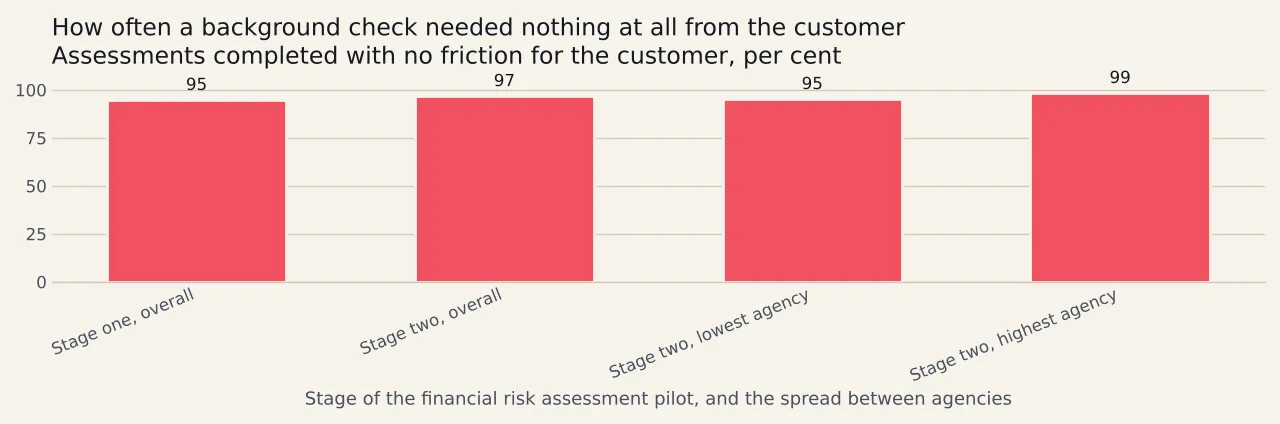
97 per cent is the share of assessments in the regulator’s financial risk pilot that went through without troubling the customer. Identity works on the same principle at a licensed site, which is why an account can feel unexamined when it has in fact been examined.
The details a customer types in can be matched against data that already exists, credit reference files and the electoral register among it. Paperwork is wanted only where that match comes back short.
What the paperwork can cover is published too: a passport or a driving licence, a bill from the household, and bank information where the money laundering rules are in play. A photograph of the holder is a response to suspected fraud, identity theft among it, rather than a routine step.
Which items to ask for is left to the business. When to ask is not, and that single distinction is what separates the two sides of the table above.
04
A payout may not be held up over a question that could have come earlier
One sentence in the rules does more work here than the rest of them together. Where a business could have asked earlier, it may not turn proof of age and identity into a precondition of taking money out, and a payout stalled for want of that proof can breach the licence condition that covers verifying a customer.
Money laundering information follows the same logic. Where more is needed, it is to be sought promptly rather than produced as an obstacle at the cash desk.
The regulator’s reasoning reads like a description of this market. Leaving the question until the payout risks failure on two duties at once, the anti-money-laundering one and the social responsibility one. Checks are meant to track each customer’s level of risk and to develop as the relationship does. And a late request leaves people depositing and playing in the belief that the money can come back out without unreasonable delay.
The same guidance runs the other way as well, which belongs here for fairness. A blanket demand on every customer ahead of any payout, whatever the level of risk, could itself be out of proportion and unfair. Timing and proportion are the test rather than volume.
05
What a deferred check costs, in stakes rather than in principle
£84.00 is the expected cost of the counter that stands between a first deposit and the documents question on this ladder. The figures underneath it are worth setting out one at a time.
- Three deposits. £60 of real money, because the ladder pays 150 per cent on the first £20, 100 on the second and 50 on the third.
- Sixty pounds of credit. Thirty-five times that credit is £2,100 of stakes, which is the obligation in full.
- Fourteen days. £150.00 of stakes every one of them, which at 10p a spin is 1,500 rounds a day.
- A ceiling of £300. Five times the credit is the point at which bonus winnings halt, so £300 is the most the £2,100 can ever produce.
- €5 a round. The one largest-bet figure these terms print, which puts the counter at 420 rounds if it is used in full.
Nothing in that list is affected by when identity is checked. What the timing decides is how much play happens before a reader learns whether the account can pay out at all, and on these figures the answer is all of it.
An account that cannot satisfy a documents request at the end has served £2,100 of stakes for a balance it cannot move. That is the practical cost of the search term, and it is larger than any fee on any page in this section.
06
Four protections, and the complaint is the one that bites here
A complaint is where a deferred check turns into a dispute, so it goes first. An acknowledgement is owed within three working days at a British licensee, or within a day where the site never shuts. Eight weeks from receipt is the limit on the whole process. The letter that ends it must give the decision, state that the process is over and name an independent dispute entity. Six months at minimum is the window for starting one, and that eight-week clock stops only where a customer leaves a reasonable request for information unanswered for a week.
The regulator is second, and it is the limit on all of this. An ombudsman is what it says it is not, so individual disputes are settled nowhere in its offices even where it issued the licence, and where no licence exists there is no power to use and no file to open. Trading here without a licence is unlawful, and what the regulator names as following from it are action against the business and payment providers possibly withdrawing their facilities.
The wagering ceiling is third. Ten times the credit for a licensee, in force from 19 January 2026, against the thirty-five in the price line and the forty that is commoner here.
Self-exclusion is fourth and it is the one a reader controls. Gamstop Online takes in the operators obliged to join, meaning every company licensed for online gambling here, and its terms state that it cannot help against a firm standing outside. A registration runs to the end of its minimum period, does not expire by itself afterwards, and 614,738 people were holding one in the figures of 16 July 2026.
07
Sixty pounds of credit, three stages, thirty-five times
The ladder in single steps. The licensed answer stands beside the figure these terms reach.
The full ladder, priced to the documents question
- Three deposits at the floor 3 × £20.00 = £60.00
- Credit across the three matches £30.00 and £20.00 and £10.00
- Counter at thirty-five times £60.00 at 35x = £2,100.00
- Expected loss across it £2,100.00 at 4 per cent = £84.00
- Credit standing at the end £60.00 − £84.00 = −£24.00
- Rounds at 10p to serve it £2,100.00 at £0.10 = 21,000
- Documents requested at Round 21,001
- The identical credit at a licensed ten £600.00 at 4 per cent = £24.00, £36.00 kept
- Cost of a kept pound, each side Nothing to keep · £0.67
Step seven is figurative and the arithmetic under it is not: the paperwork is wanted at the moment a payout is asked for, and the counter is already served by then. Left out of the other eight lines: the £300 limit the terms set on bonus winnings, the fourteen-day window, the games counting for nothing because only reels count here, and the fact that a licensed site would have settled identity before the first of those 21,000 rounds.
08
Questions about identity checks and when they happen
- Is there such a thing as a British-licensed casino without identity checks?
- No. A business licensed here has to settle age and identity before anybody gambles, a duty running from 7 May 2019, and no bet is accepted until it has. The count of licensed sites free to skip it is zero.
- What do these cashiers actually publish?
- Paperwork ahead of a first payout, every one of them. The check is moved rather than removed, and the wagering is what happens in between. On the three-stage ladder priced here, £2,100 of stakes stands between a first deposit and that request.
- Why does a licensed site sometimes seem to ask for nothing?
- Because the matching happened out of sight. The details typed in can be checked against data that already exists, credit reference files and the electoral register among it, with paperwork wanted only where that comes back short. In the regulator’s separate financial risk pilot, 97 per cent of assessments troubled the customer not at all.
- What can a verification request cover?
- A passport or a driving licence, a bill from the household, and bank information where the money laundering rules apply. A photograph of the holder answers suspected fraud rather than routine. Which items to choose is left to the business.
- Can a licensed site demand documents only when you withdraw?
- Not where it could have asked earlier. Proof of age and identity may not be made a precondition of taking money out in that case, and a payout stalled for want of it can breach the licence condition that covers verifying a customer. Money laundering information is to be sought promptly instead.
- Is asking everybody for documents the safe option?
- No, and the regulator says as much. A blanket demand on every customer ahead of any payout, whatever the risk, could be out of proportion and unfair. Checks are meant to track a customer’s level of risk and to develop as the relationship does.
- What does the deferred check cost in practice?
- £84.00 in expected losses, which is the price of serving £2,100 of stakes at a 96 per cent return. That is £24.00 more than the £60 of credit it was charged against, and every pound of it is staked before anybody asks who the account belongs to.
- What protections are given up alongside the check?
- A complaint acknowledged in three working days and concluded inside eight weeks, with an independent entity named at the close. A regulator with the power to act, absent over an unlicensed company. The ceiling of ten times on wagering. And Gamstop Online, which takes in licensed operators and states that a firm outside it is past its help.