
Printed 2026 · figures read October 2026
No verification casinos, and the £64.00 the window is really charging
Expected cost of clearing £40 of credit at forty times, which is two stages of a five-stage ladder taken at the top of its published match range. £1,600 of stakes has to be placed inside seven days, and the identity question arrives after all of it.
What each package credits, how long it allows and when it asks
Every link in this rack is a paid placement, and this site is owed a fee when a reader opens an account through one.
Betportal
Lowest wagering
Licence Licensed in Anjouan, Comoros, no Great Britain licence, run by BetPortal Gaming Ltd and Excite Ultra Media Ltd, reference ALSI-202601040-FI2.
WinBeast
Free bet included
Licence Licensed in Curaçao, no Great Britain licence, operator not named on the site.
EliteSpin
New for 2026
Licence Licensed in Costa Rica, no Great Britain licence, run by PrimeTier Limited, opened 2026.
Crown Jewelz
200% first deposit
Licence Licensed in Curaçao, number not verified, no Great Britain licence, operator not named on the site.
Scroll the rack sideways to reach the other columns. The label column stays put.
Not one of the offers printed above holds a Great Britain licence. Outside that licence a British player has none of its protection: Gamstop Online cannot shut the door, the ten-times limit on bonus wagering does not bind the operator, and no British complaints body will take up a dispute. You must be 18 or over to open an account anywhere in this rack.
Every figure in the rack is a term the operator itself publishes, read on 14 October 2026. The operator's terms in full are the ones that bind you.
Two stages, £40 of credit, per pound kept
| What these offers ask | Under a British licence | |
|---|---|---|
| You put in | £40.00 | £40.00 |
| Handed over | £40.00 | £40.00 |
| Wagering | 40x | 10x |
| Cost per £1 kept | Nothing left over | £0.67 |
Two deposits of £20 open two stages of a five-stage ladder whose five matches are printed as a band, 50 per cent up to 100, so £40 of cash collects somewhere between £20 and £40 of credit and this table takes the upper reading. Both sides then run on a 96 per cent return with every round counted whole. £40 at forty times comes to £1,600 of stakes, expected to cost £64.00, which is £24.00 beyond the credit and leaves nothing over to be priced. Drop the multiple to ten, the limit a Great Britain licence puts on a wagering requirement, and the counter is £400, the expected cost £16.00 and the remainder £24.00, which is 67p of play behind each kept pound. The licence that fixes that limit is held by none of these cashiers. Seven days is the window such a package allows, so the £1,600 has to be placed at £228.57 a day, and the identity question does not arrive until a payout is asked for.
01
The clock decides this page, not the paperwork
£228.57 a day for seven days is what £40 of credit asks of a reader at forty times. That is the figure a search for an unverified account runs into first, long before anybody is asked who they are.
£64.00 is the expected cost of that counter on a game paying back 96 per cent, measured against £40 of credit, so the arithmetic closes £24.00 down. The paperwork question lands at the end of it, because a cashier of this kind asks for documents before a first payout.
So the honest reading of the term is a sequence rather than an absence. Nothing is verified at the door. Everything is verified at the exit. In between sits a counter that has to be served at a pace the window sets.
Two neighbouring guides carry the rest: no KYC casinos takes the order of the checks and the duty behind it, and best non GamStop casinos weighs one package against another on price. Slots not on GamStop prices the games the counter is served on, and the section index sits at outside the licence.
02
What £1,600 of stakes looks like inside each window in use here
Five windows are in use on offers of this kind, counting the one that is not published at all. The table puts the same £1,600 counter inside each of them and reads off the daily pace.
| Window | Stakes a day | Rounds a day at 10p | Rounds a day at €5 |
|---|---|---|---|
| 14 days, the cash bonus | £114.29 | 1,143 | 23 |
| 7 days, the commoner case | £228.57 | 2,286 | 46 |
| 3 days, a batch of spins | £533.33 | 5,333 | 107 |
| 1 day, a batch of spins | £1,600.00 | 16,000 | 320 |
| Not published at all | Unknown | Unknown | Unknown |
The last row is the one to be careful with. Where no window is printed there is no pace to plan for, and the obligation carries no published end.
The €5 column is the one largest bet these terms ever print, and it tends to sit with the fourteen-day window rather than with the seven-day ones. Most offers of this kind print no ceiling on a bet at all, which means the pace in the right-hand column can be multiplied by whatever the software accepts.
03
The published record of unchecked accounts comes from the licensed side
£742,000 in fourteen months is the largest single figure in the regulator’s enforcement statements about accounts nobody questioned. It sits beside £524,501 deposited by another customer from December 2019 to October 2020, £65,835 spent in five months, £43,000 deposited and £36,000 lost in seven days, and £23,000 spent inside twenty minutes on an account opened the same day.
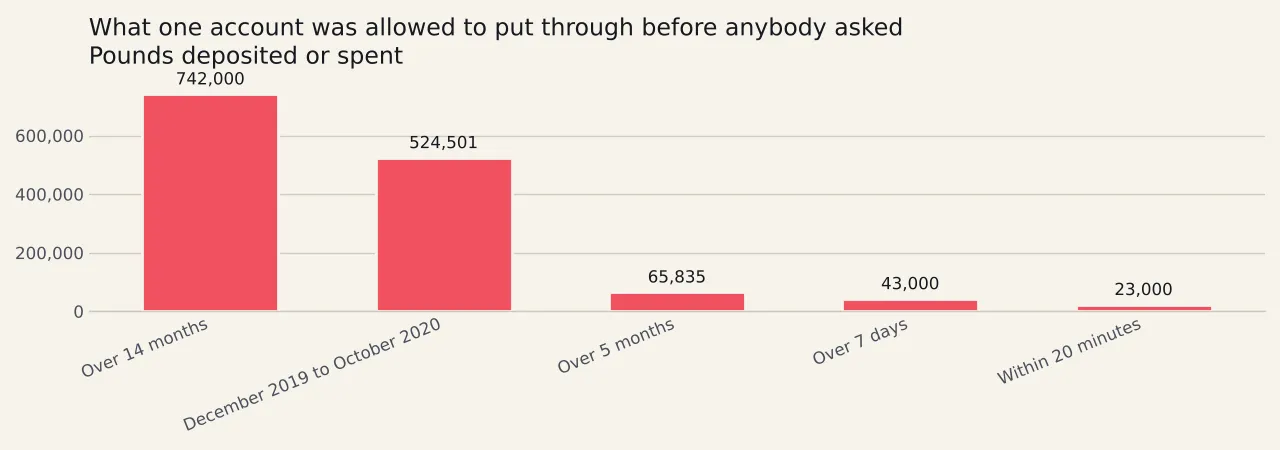
Those penalties ran to £17m, £19.2m, £9.4m and £7.1m, each against a holder of a British licence. One statement recorded 331 customers who had self-excluded from one brand of a group and were able to gamble with another. Another recorded affordability checks that began only once deposits reached £40,000.
The lesson is not that licensed operators check thoroughly. It is that failures at a licensed operator are found, named, dated and fined, and the figures above exist for that reason alone.
Red flags in bank statements and payslips already handed over had been missed, and financial thresholds leaned on too heavily: that was the regulator’s director of enforcement on 10 June 2026, describing licensees. It is a criticism of the checking that does happen, published by the body able to act on it.
04
Three checks a licensed account meets that are not identity checks
Three separate mechanisms sit behind a licensed account, and none of them is about proving who somebody is.
- The limit prompt. Every customer has to be invited to fix a financial limit as early as can be managed, must be able to set one at any point afterwards, and a reduction has to be actioned immediately. Anybody without a limit must be prompted to review that at least once a year, with setting one the default option and declining it requiring an action and a confirmation.
- The account review. Customers have to be prompted to look at their account and transaction information at least every six months, and must be able to ask for more frequent reminders.
- The financial check. A month’s net deposits above £150 bring the light-touch version, a threshold cut from £500 on 28 February 2025. It runs on public data, wants no job title and no postcode, and leaves a credit rating alone.
£40 of deposits on this page is comfortably below that £150, and two more stages of the same ladder would pass it. The point is not the threshold but the existence of a threshold: a figure at which something happens, published in advance.
Not one of the three is published out here. A reader gets whatever prompts the software offers and whatever review the operator chooses to run, at points nobody has stated.
05
Two hundred pounds is the ceiling over this credit, and that is lawful
£200 is five times £40, and five times the credit is the commonest point at which bonus winnings are halted. Some put €100 on each batch of spin winnings instead. Where no figure is printed at all, a ceiling is unknown rather than absent.
Such a ceiling is lawful wherever the site sits, and it is not the same thing as a cap on withdrawals. No British licensee may use a term designed or operating to ration what a consumer draws out of a deposit balance, and the example the regulator prints of a forbidden one allows £50 a day and £500 a week. A deposit balance can be emptied whenever its owner likes, winnings included.
The term worth hunting for is neither of those. A bonus rule keeping a discretion to shut an account or cancel winnings cost £170,000 at a British licensee in July 2025, and an audit of its controls was ordered too. The objection recorded was that wording of that sort is opaque and can land unfairly on a customer.
Outside the licence a clause of exactly that shape costs nothing, because the condition it breached belongs to a licence these cashiers do not carry. £1,600 of stakes served into an account that can be closed at the operator’s discretion is the real exposure on this page, and it is larger than the £64.00.
06
What a British licence would have put around the same account
Four protections, and on a page about deferred checks the order matters.
Identity first. A licensed business settles age and identity before a customer gambles, which has been its duty from 7 May 2019, and it cannot make that proof a precondition of a payout where it could have asked sooner. The order is the protection.
The complaint second. An acknowledgement owed in three working days, or in 24 hours at a site that never closes. Eight weeks for the whole process. A dispute body outside the operator, named in the final letter. And six months as the minimum window for raising anything.
The wagering ceiling third. Since 19 January 2026 a licensee has had ten times the credit as its limit, against the forty in the price line, which is £400 of stakes set against £1,600.
The scheme fourth. Every company licensed for online gambling here has to be in Gamstop Online, so a single registration shuts the lot, and the scheme’s terms accept that an operator outside is beyond its powers. 614,738 people were registered in the figures published on 16 July 2026. The regulator settles no individual dispute, no ombudsman being its own word for itself, and against an unlicensed company it has no authority to use.
07
Forty pounds of credit, forty times, inside seven days
The counter and the clock together, in single steps, and the licensed answer against the total.
£40 of credit against a seven-day window
- Two deposits at the floor 2 × £20.00 = £40.00
- Credit at the top of the band a full match of £40.00 = £40.00
- Counter at forty times £40.00 at 40x = £1,600.00
- Expected loss across it £1,600.00 at 4 per cent = £64.00
- Credit standing at the finish £40.00 − £64.00 = −£24.00
- Daily pace across the window £1,600.00 ÷ 7 = £228.57
- Ceiling on what the credit may win 5 × £40.00 = £200.00
- The identical credit at a licensed ten 4 per cent on £400.00 = £16.00, £24.00 over
- A kept pound, priced each side Nothing left over · £0.67
Step two takes the upper end of the band, 50 per cent up to 100; at its lower end the credit is £20, the counter £800 and the expected cost £32.00, so the deficit halves without disappearing. Step six assumes seven days used in full and no day missed, because an unfinished counter at the end of a window leaves nothing rather than part of something. Not in the sum: the identity request waiting at the payout, the games that move this counter at a discount or not at all, and whatever discretion the terms keep over the account.
08
Questions about an account nobody checks at the door
- What does the window ask of a reader each day?
- £228.57 of stakes a day for seven days, on £40 of credit at forty times. At 10p a round that is 2,286 rounds a day. The package with a fourteen-day window spreads the same £1,600 at £114.29 a day instead.
- When is identity actually checked out here?
- At the payout. A cashier of this kind prints documents ahead of a first withdrawal, so the question lands once the counter has been met rather than before a first round. A licence has carried the duty to establish age and identity before the first round since 7 May 2019.
- What does £40 of credit cost to clear?
- £64.00 in expectation, which is the price of £1,600 of stakes on a game paying back 96 per cent. The credit is £40, so the sum finishes £24.00 below where it began and the difference comes from the money paid in.
- How far can the credit go at the very best?
- £200, where bonus winnings halt at five times the credit, which is the commonest term of its sort. Some put €100 on each batch of spin winnings. Where nothing is printed, a ceiling is unknown rather than missing.
- Why are the big unchecked-account figures all from licensed sites?
- Because a licence makes them findable. £742,000 deposited in fourteen months, £65,835 spent in five months and £23,000 spent in twenty minutes all come from published penalties against British licensees. Nobody collects the equivalent for a cashier outside the licence.
- What checks does a licensed account meet that are not about identity?
- Three. An invitation to fix a financial limit as early as can be managed, with a reduction actioned immediately and an annual review where none is set. A prompt to look over account and transaction information at least every six months. And a light-touch financial check once a month’s net deposits pass £150.
- Can an operator here cancel a balance after the counter is served?
- Nothing published prevents it. A bonus term keeping a discretion to shut accounts or cancel winnings drew £170,000 against a British licensee in July 2025, and an independent audit of its controls went with the penalty. The condition breached belongs to a licence no offshore cashier holds.
- What is given up by using an account nobody checks at the door?
- Identity settled before play rather than at the exit. A complaint bounded at eight weeks, with an independent entity to turn to next. Ten times as the ceiling on wagering. And Gamstop Online, which closes licensed operators while stating that one outside the scheme is past its reach.