
Printed 2026 · figures read October 2026
How you pay decides the fee and the clock, and leaves the bonus price alone
The dearest published charge in this section for sending £100 back out to a card, taken at the top of one wallet’s band. A second wallet prints 1.99 per cent for the identical job, which is £1.99. Neither figure touches the credit or the counter: the route moves the fee and the clock and leaves the bonus price where it is. Sources: two wallet fee pages, read 13 October 2026.
Offers of this kind, with the cashier each one runs
Every link in this rack is a paid placement, and this site is owed a fee when a reader opens an account through one.
Betportal
Lowest wagering
Licence Licensed in Anjouan, Comoros, no Great Britain licence, run by BetPortal Gaming Ltd and Excite Ultra Media Ltd, reference ALSI-202601040-FI2.
WinBeast
Free bet included
Licence Licensed in Curaçao, no Great Britain licence, operator not named on the site.
EliteSpin
New for 2026
Licence Licensed in Costa Rica, no Great Britain licence, run by PrimeTier Limited, opened 2026.
Crown Jewelz
200% first deposit
Licence Licensed in Curaçao, number not verified, no Great Britain licence, operator not named on the site.
Scroll the rack sideways to reach the other columns. The label column stays put.
Not one of the offers printed above holds a Great Britain licence. Outside that licence a British player has none of its protection: Gamstop Online cannot shut the door, the ten-times limit on bonus wagering does not bind the operator, and no British complaints body will take up a dispute. You must be 18 or over to open an account anywhere in this rack.
Every figure in the rack is a term the operator itself publishes, read on 14 October 2026. The operator's terms in full are the ones that bind you.
£20 in by any accepted route, in pounds per pound
| What these offers ask | Under a British licence | |
|---|---|---|
| You put in | £20.00 | £20.00 |
| Handed over | £20.00 | £20.00 |
| Wagering | 40x | 10x |
| Cost per £1 kept | None survives | £0.67 |
The route is missing from this strip on purpose. Whether the £20 arrives on a card, through a wallet, out of a voucher or in coins, the credit and the counter are identical, so the method cannot change a single figure in either column. What it changes sits elsewhere: the fee on the way out, the wait, and whether winnings can travel back the way the deposit came. Worked at 96 pence returning on each pound staked with every round counted whole. Forty times a £20 credit is £800 of staking, retaining £32.00, which exceeds the credit, so none survives; the British ten times retains £8.00 and leaves £12.00 at 67p a pound. A Great Britain licence is what sets ten, and sites of this kind answer instead to Anjouan, to Curacao or to Costa Rica.
01
Two routes a British reader assumes, and neither is carried here
Two of the sixteen routes in this section are not carried by offers of this kind at all: PayPal and a charge to a phone bill. In each case the payment side settles it rather than the cashier, and the reason is published.
Those two absences are the most useful facts on this page, because they are the routes a British reader is most likely to assume. Anyone who wants PayPal casino payments or a pay by phone casino deposit is after something sites like these do not carry, and each sheet opens on the reason instead of the route.
What is carried is a short list, and it repeats from one site to the next. Visa casino and Mastercard casino payments are close to universal, Apple Pay casino deposits nearly as widespread, and coins of some kind are usual. A Google Pay casino deposit is the least predictable of them, which makes it the sharpest divide in the list.
The credit question is separate and it is answered at credit card casino. The one route priced end to end from a published schedule is at paysafecard casino, and the wallet route with the longest fee page is at Skrill, Neteller and Trustly casino.
02
How widely each route is carried, and where this site prices it
Three bands cover the sixteen routes in this section. The table takes the eight at the ends of the range; the middle band is in the paragraph below.
| Route | How widely carried | Where it is priced on this site |
|---|---|---|
| Debit card, either network | Close to universal | Two sheets, one for each network |
| Apple Pay | Close to universal | One sheet, priced on the card inside |
| Coins of any kind | Usual | Four sheets, by coin and by network |
| Open banking | Common | One sheet, with the two wallets |
| Dollar-pegged coin | Common | One sheet of its own |
| Google Pay | Mixed | One sheet, priced on the card inside |
| PayPal | Not carried | One sheet, which says so first |
| Charged to a phone bill | Not carried | One sheet, which says so first |
The middle band holds the rest. Two large prepaid wallets, a prepaid voucher, a bank-backed card app and the first and second of the large coins turn up at some sites of this kind and not at others, and a wallet built around a prepaid card is the thinnest of the set. Those are the sheets at MuchBetter casino, crypto casino, best bitcoin casino, Ethereum casino and USDT casino.
A band is not an endorsement of a route. It says how likely a method is to be on offer and nothing whatever about what it costs once it is, which is the next two parts. The live list for any one site belongs to that site, and it is printed where the offer is.
03
Where a ceiling on moving money is actually printed in pounds
Five ceilings in this section carry a figure. One of them is nought.
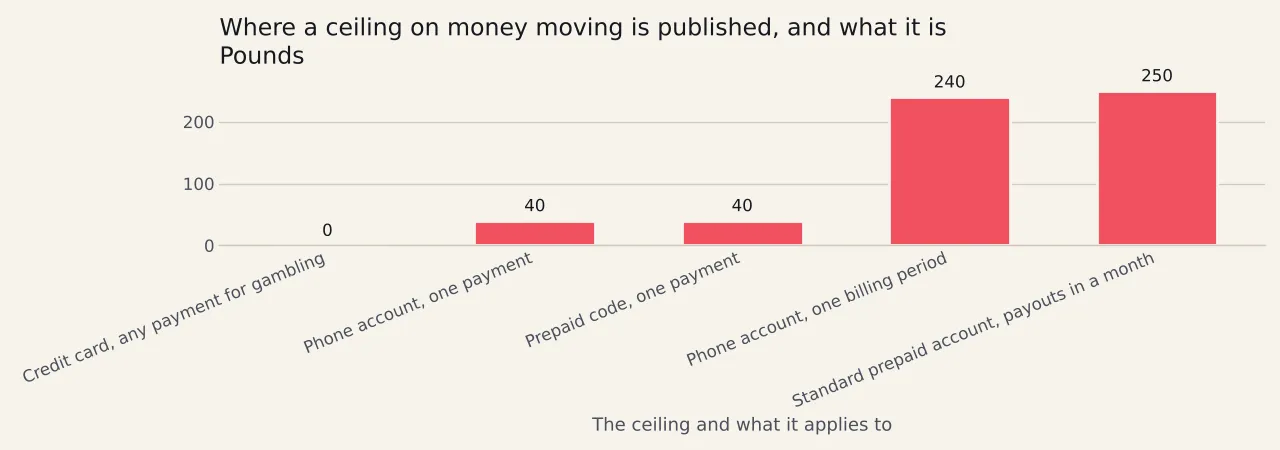
Four things follow from that chart for a reader picking a route. The credit bar binds a British licensee and nobody else. The phone bars explain why offers of this kind do not carry a charge to a phone bill: the exclusion the route rests on is a British payments rule rather than a gambling one, and outside those rules the route has nothing to rest on. The voucher bar means a £20 deposit fits in one code and a £50 deposit does not.
And the payout bar is the only one in the set about money coming back rather than going in, which is the imbalance this whole section is about.
04
The route moves three figures and the bonus is not among them
Three things change with the method and nothing else does.
- A fee, sometimes. Two wallet schedules in this section put a figure on the card leg of a payout: one charges 1.99 per cent subject to a floor, the other a band running from nothing to 7.5 per cent. A voucher charges £4 a month against an untouched balance from the second month.
- A wait, sometimes. One card service requires an issuer that supports it to make funds available inside 30 minutes of approval. Bank transfers on the domestic rail are usually near-immediate and can take up to two hours. A coin confirms when the network confirms.
- A direction. Some routes run one way only. A phone bill takes money in and never pays it out, so winnings from that route leave by card, by wallet or into a bank.
What does not change is the arithmetic in the strip above. £20 is £20 whether it arrives from a card or from a coin, the counter is 40 times either way, and the retention is £32.00 either way. Any page that implies a payment method improves a bonus is describing something that is not in the terms.
The one genuine interaction is the floor. A minimum first payment of £20 or €20 is usual on offers of this kind, and two of the routes in this section carry a per-payment ceiling of £40, so a route can be too small for a deposit but never too small for the bonus.
05
What a licence says about charging for a payout
Four rules stand as the measure every fee page in this section is read against. First, no charge for a payout may be larger than what handling that payout actually costs. Second, there can be no charge whatever for clearing a balance out completely. Third, a cap on how many payouts or how large they may be has to be reasonable. Fourth, a charge that reflects cost has to be on the table before a penny is paid in, not afterwards.
The strongest published figure on timing sits beside those four. Across some of the largest gambling companies, roughly 99 payout requests in every hundred were cleared, handled and settled in a day or two. That was published on 17 July 2023 and it describes licensed operators.
Three further points come with it. Trouble getting money out is the thing the regulator’s contact centre hears about most, out of more than 6,000 calls a year. Friction at the exit that is absent at the entrance is not allowed. And whatever is gathered to spot a risk of harm may not be turned into a reason for holding a payout, though one may be held back on the rare occasion when checks are running to keep an operator clear of the proceeds of crime.
None of those four rules and none of that machinery reaches a cashier holding no Great Britain licence. The sheet at fast withdrawal casinos takes the timing question apart on its own.
06
Money in is faster than money out, and documents are the reason
Documents are called for ahead of a first payout at offers of this kind, and nothing whatever is called for ahead of a first deposit. That ordering is published in plain terms, and it is the largest asymmetry in this section.
A licensed cashier runs that sequence backwards. Nobody gambles there until age and identity are settled, a duty that reaches bonus play and the demonstration versions as well, so the paperwork question lands at the entrance. Most of it passes unseen, run against records including the electoral roll and the credit reference files, with papers asked for only where the records fall short.
A licensee is also told not to make identity a condition of a withdrawal where it could have been asked for earlier, and that asking only at the exit risks breaching its own verification condition. The regulator has put that to operators directly, while noting that asking everyone for papers before any payout regardless of risk could itself be unfair.
So the honest comparison is not that one side checks and the other does not. It is that one side checks before the money goes in and the other checks before it comes out. Nothing on this site helps anybody avoid either check, and the sheets at no KYC casinos and no verification casinos say what those phrases can and cannot mean.
07
A hundred pounds coming back, where the figures exist
Six lines. The first four are published charges; the last two are what is left of £100 by the dearest and the cheapest priced route in this section.
£100 out, by the two routes with a printed schedule
- Cheaper wallet, moving money out to a card £100.00 × 0.0199 = £1.99
- Dearer wallet, at the top of its published band £100.00 × 0.075 = £7.50
- Dearer wallet, at the foot of the same band £100.00 × 0 = £0.00
- Gap between the two published ends £7.50 − £1.99 = £5.51
- Left of the hundred on the dearer route £100.00 − £7.50 = £92.50
- Left on the cheaper route £98.01
These are wallet charges for moving money out to a card, not charges made by a cashier. A cashier’s own charge is a separate question, and where an operator publishes none the cost of a payout cannot be worked out in advance. Both schedules name the two card networks together and at one rate, so neither figure belongs to one network. A floor in euros applies to the cheaper schedule and is left unconverted, since this sheet rests on no exchange rate. A British licensee could charge nothing at all for emptying a deposit balance in full, which is the fourth rule in part five, so every penny of these figures belongs to the route and not to the licence.
08
Questions about the cashier
- Which payment methods do offers of this kind actually take?
- Both card networks, Apple Pay and coins of some kind are the usual list. Open banking, the dollar-pegged coin and Google Pay turn up at some sites and not at others. PayPal and a charge to a phone bill are not carried anywhere in this part of the market, and in each case the payment side settles it rather than the cashier.
- Does the payment method change what a bonus costs?
- No. Twenty pounds is twenty pounds whether it arrives by card, wallet, voucher or coin, the counter stays at 40 times and the retention stays at £32.00. What the method changes is the fee on the way out, the wait, and whether winnings can return the way the deposit came.
- What is the most any published schedule here takes from £100?
- £7.50, at the top of one wallet’s published band for moving money out to a card. The other wallet charges 1.99 per cent for the same job, which is £1.99, so the gap between two printed schedules for identical work is £5.51. Neither charge is the cashier’s.
- Can a licensed cashier charge me to withdraw?
- No more than handling the payout actually costs it, and nothing whatever for clearing the balance out completely. A cap on how many payouts or how large they may be has to be reasonable, and a cost-based charge has to be on the table before a penny is paid in. Not one of those four rules binds a cashier licensed elsewhere.
- How fast should a withdrawal be?
- Across some of the largest gambling companies, roughly 99 requests in every hundred were cleared, handled and settled in a day or two, as published on 17 July 2023 in respect of licensed operators. A published clock exists for the payment rail alone, and the cashier’s own approval step has none.
- Why do these sites take money faster than they return it?
- Because documents are called for ahead of a first payout and nothing at all is called for ahead of a first deposit. A licensed cashier runs that backwards, settling age and identity before anybody plays, with the duty reaching bonus play and the demonstration versions too.
- Is there a payment route that cannot pay winnings back?
- Yes. A phone bill takes money in and never pays it out, so winnings from that route leave by card, by wallet or into a bank. Offers of this kind do not carry the route at all, which makes the point academic here and worth knowing elsewhere.
- Does a smaller deposit route limit the offer?
- It can limit the deposit without touching the offer. A floor of £20 or €20 is usual, and two routes in this section cap a single payment at £40, so a £20 deposit fits in one and a £50 deposit does not. The counter and the credit are unaffected either way.