
Printed 2026 · figures read October 2026
Non GamStop PayPal casinos, and the £32.00 no payment route can move
Expected cost of clearing £20 of credit at forty times, which is the line most offers of this kind carry. £800 of stakes sits behind it, and every pound sent through a 96 per cent game is expected back as 96p. The route the money arrives by alters none of this.
Which routes in each cashier publishes, and what it asks for
Every link in this rack is a paid placement, and this site is owed a fee when a reader opens an account through one.
Betportal
Lowest wagering
Licence Licensed in Anjouan, Comoros, no Great Britain licence, run by BetPortal Gaming Ltd and Excite Ultra Media Ltd, reference ALSI-202601040-FI2.
WinBeast
Free bet included
Licence Licensed in Curaçao, no Great Britain licence, operator not named on the site.
EliteSpin
New for 2026
Licence Licensed in Costa Rica, no Great Britain licence, run by PrimeTier Limited, opened 2026.
Crown Jewelz
200% first deposit
Licence Licensed in Curaçao, number not verified, no Great Britain licence, operator not named on the site.
Scroll the rack sideways to reach the other columns. The label column stays put.
Not one of the offers printed above holds a Great Britain licence. Outside that licence a British player has none of its protection: Gamstop Online cannot shut the door, the ten-times limit on bonus wagering does not bind the operator, and no British complaints body will take up a dispute. You must be 18 or over to open an account anywhere in this rack.
Every figure in the rack is a term the operator itself publishes, read on 14 October 2026. The operator's terms in full are the ones that bind you.
A full match at the forty times line, in pounds per pound
| What these offers ask | Under a British licence | |
|---|---|---|
| You put in | £20.00 | £20.00 |
| Handed over | £20.00 | £20.00 |
| Wagering | 40x | 10x |
| Cost per £1 kept | None expected to last | £0.67 |
Forty times is the commoner of the two lines printed here, it is applied to bonus funds wherever it appears, and it reaches free-spin winnings on some offers as well. Both sides of this table assume a 96 per cent return, full counting on every round and the obligation completed before the window shuts. £800 of stakes carries £32.00 of expected cost, which is £12.00 beyond the £20 of credit, so the credit cannot survive it and there is no lasting pound to divide the cost by. Move the multiple to the ten that a Great Britain licence permits, leaving the deposit and the credit untouched, and the obligation falls to £200 of stakes, £8.00 of cost and £12.00 still standing. That ten exists because a licence enforces it, and no cashier of this sort holds a licence of that kind, which is what the right-hand column is measuring. The wallet, card or transfer used to pay the £20 appears nowhere in either column, because it changes neither.
01
No offshore cashier publishes this wallet, and the price would be identical if one did
Nought is the number of cashiers of this kind listing that wallet at the deposit desk. The phone bill is the other route that returns nothing. Everything else a reader is likely to try appears somewhere. Cards are standard. The two big phone wallets are standard. A bank transfer is standard, and so are coins.
£32.00 is the figure the search term is really about. A full match of £20 at forty times owes £800 of stakes, and stakes shed 4 per cent of themselves on a 96 per cent game. The credit is £20, so the obligation outruns it by £12.00.
Not one penny of that figure depends on how the £20 arrived. A route settles whether the deposit can happen, may take its own cut in transit, and may be quicker or slower coming back. It cannot touch a multiple, because the multiple is applied to the credit after the money has landed.
Two neighbouring guides take the other routes: non GamStop Paysafe casinos for cash vouchers and non GamStop pay by phone casinos for the bill. Non GamStop casinos with £5 deposit prices what the cheapest route costs to use, and outside the licence lists the section.
02
Sixteen routes were checked and two of them reach nobody
Sixteen payment filters were run across cashiers of this kind in October 2026. The table gives the seven a reader is most likely to search for, with how common each one is and what the choice does to the price of the credit.
| Route in | How common it is | Effect on the £800 counter | Effect on the £32.00 cost |
|---|---|---|---|
| This wallet | Not published | No deposit possible | £0.00 |
| The phone bill | Not published | No deposit possible | £0.00 |
| Debit cards | Standard | Unchanged | £0.00 |
| Phone wallets | Standard | Unchanged | £0.00 |
| Named money wallets | Some do, some do not | Unchanged | £0.00 |
| Cash vouchers | Some do, some do not | Unchanged | £0.00 |
| Coins | Standard | Unchanged | £0.00 |
Column three holds the only real distinction on that sheet. Two routes fail at the door and five arrive without changing anything that follows.
Pairing a search term with a payment method therefore answers a narrower question than it looks. It answers whether a deposit can be made. It says nothing about what the credit costs, what it may become, how long the counter has to run or who will listen afterwards.
03
The wallet’s own rulebook says three things worth printing
994790 is the reference the Financial Conduct Authority holds for the wallet’s British company, registered there as an issuer of electronic money. Three consequences follow, and all three are published by the wallet rather than inferred here.
A balance of this kind is not a bank deposit, so a failed bank’s compensation scheme does not stand behind it, and the money is held in segregated accounts under a safeguarding duty instead. That is a real protection and a different one from the protection most readers assume they have.
Gambling payments are allowed only where the wallet has approved the seller and the law of the place permits gambling. Everywhere else its acceptable use policy forbids them outright. And the purchase protection that would cover a parcel is drawn to leave out gambling, gaming and anything else that charges an entry fee against a prize.
Set that against the price line and the division of labour is plain. A wallet moves £20. It does not cap a wagering requirement, order a payout or adjudicate a bonus, and it has never offered to.
04
One setting inside a wallet is worth more than any deposit route
Three days is the wait a reader buys by switching the wallet’s gambling block on and then changing their mind. The block itself lives in the wallet’s payment controls, and while it stands the wallet declines the payments it can identify as going to a gambling operator.
Its reach is published too, and the limit is the important half. The block reads classification data, so a merchant filed under some other category can pass it. Card blocks at the banks work the same way, from the merchant category code that covers betting and casino play, numbered 7995.
- One bank blocks card payments to companies filed under that code automatically, takes requests to add a merchant it has missed, and holds the block for a cooldown the customer picks, from two days out to a year. The count of users at that bank has passed 700,000.
- A second declines cards at most gambling merchants and states in writing that some gambling-related payments may still pass, with 48 hours standing between a request to lift the block and the lifting.
- A third runs the same 48-hour wait and declines attempted gambling payments for as long as the block is up. It reported gambling spending running about 32 per cent above its 2019 level during September 2020.
- An open-banking block at one bank reaches only the payment providers that chose to wire themselves into it, which is the clearest published statement of how far any block goes.
Those controls are in this guide because the figures above give nobody a reason to go hunting for a deposit route. A reader who has set one has already answered the question the page was opened with.
05
A wallet is where the credit card rule gets enforced
The credit card route shut on 14 April 2020 for anybody holding a British licence, under licence condition 6.1.2, and it reaches inside a wallet as well. A licensee may use one only where the provider can show that money arriving from a credit card never reaches a gambling account. Providers can tell which cards are credit cards from the opening digits of the number, which name the issuer.
So a wallet that can be loaded from a card may need separate pots, keeping money that came from a credit card away from any gambling merchant. A credit card does not stop being a credit card because it is sitting inside a phone.
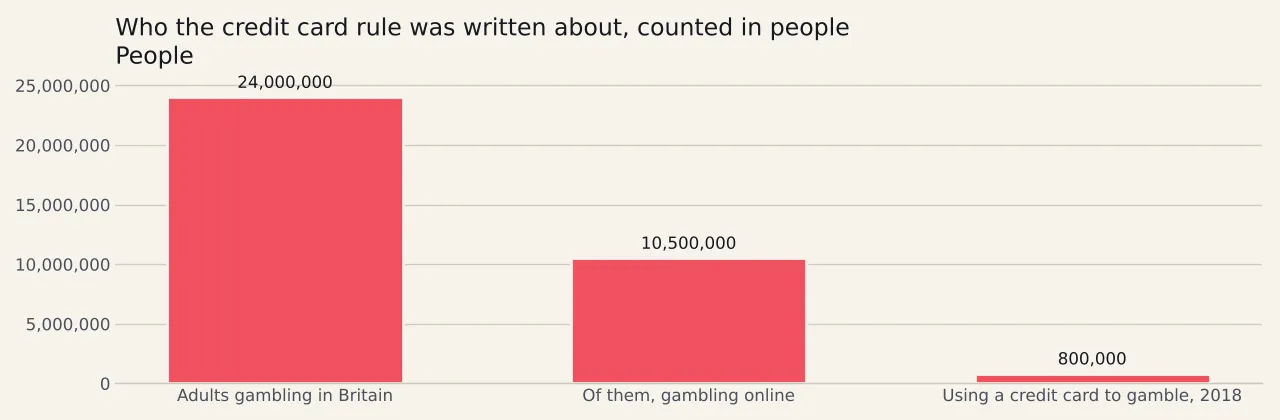
The evaluation of 2 November 2021 found most card gamblers did not look for a way around the closure. 15 per cent said otherwise, which in that small survey meant 17 people borrowing elsewhere instead: four by payday loan and one on a phone account.
The rule binds licence holders, which leaves a cashier outside it taking whatever its acquirer will process. Outside that licence the only thing standing between a credit line and a bonus counter is the wallet’s or the card issuer’s own policy.
06
The pairing changes the route and leaves four protections behind
Four protections are attached to the licence rather than to the payment, which is why no choice of wallet retrieves any of them.
- The multiple. Ten times the credit is the licensed limit, dated 19 January 2026. Thirty-five and forty are what these offers print, and a wallet cannot alter either.
- The scheme. Gamstop Online covers the operators required to be in it, which is every company licensed here for online gambling, and the scheme states in its terms that a firm outside it is beyond its help. 614,738 people held a registration in figures issued on 16 July 2026.
- The complaint. Three working days to acknowledge, eight weeks to finish, and a final answer naming an independent body. A payment provider’s dispute process is not that: its buyer protection excludes gambling outright.
- The regulator. No ombudsman is the Commission’s own description of itself, so individual disputes are not its work, and over an unlicensed business it has no authority whatever. Trading without a licence is the operator’s offence, and it returns nothing to the player.
A payment firm can close an account, decline a transaction and publish a policy. It cannot cap a wagering requirement, order a payout or answer a dispute about a bonus, and it has never claimed to.
07
A twenty pound credit against the forty times line, line by line
The forty times line, in single steps, with the licensed figure set beside the answer.
A £20 credit on the 40x line
- Deposit, by whichever route a cashier takes £20.00
- Credit, matched pound for pound £20.00 of credit on £20.00
- Counter at forty times the credit 40 × £20.00 = £800.00
- Expected cost of serving it £800.00 × 0.04 = £32.00
- Credit standing when it is served £20.00 − £32.00 = −£12.00
- Fee the payment route adds to the counter £0.00
- The same credit at the licensed ten £8.00 of cost on £200.00 of stakes, so £12.00 lasts
- Cost of a pound kept, both columns None expected to last · £0.67
Step six is the honest answer to the search. A route can take a fee from the money on its way in, and two of the sixteen routes checked cannot carry it at all, but no route moves the counter in step three. What the sum leaves out is a limit on the winnings, commonly fixed at five times what was credited, the games counted at less than face value, and the window, usually seven days where this multiple is asked.
08
Questions about paying a cashier outside the licence
- Do cashiers of this kind take that wallet?
- None of them publishes it. Sixteen payment filters were run over this bracket of the market in October 2026 and two returned nothing at all: this wallet and the phone bill. The routes that do appear are cards, the phone wallets, a transfer and coins.
- Would paying by wallet make the credit cheaper?
- No. £20 of credit at forty times owes £800 of stakes whatever route the £20 took, and £800 of stakes is expected to cost £32.00 at a 96 per cent return. The multiple is applied to the credit after the deposit lands, so the route cannot reach it.
- Does the wallet’s buyer protection cover a disputed bonus?
- No. The purchase protection is drawn to exclude gambling, gaming and anything else charging an entry fee against a prize. The account holds electronic money rather than a bank deposit, so the scheme that compensates for a failed bank does not reach it, and the money is safeguarded in segregated accounts instead.
- What does the wallet’s own policy say about gambling?
- Payments for gambling go only to sellers it has approved, and only where the law of the place allows gambling. Anywhere else they are barred. That is the wallet’s rule about its own service. It is not a licence, a supervision arrangement or a promise about the terms attached to any bonus.
- Can a credit card be used at a site with no British licence?
- A British licensee may not accept one, under licence condition 6.1.2 in force from 14 April 2020, and it reaches a card sitting inside a wallet, identified there by the opening digits that name the issuer. A cashier outside the licence is bound by none of it, so the barrier left is whatever the wallet or the card issuer has set.
- How do the gambling blocks work, and what do they miss?
- They read merchant classification. The wallet declines what it can identify as a payment to a gambling operator and imposes three days of waiting once it is switched off, while the banks work from category code 7995. Each of them says a merchant filed elsewhere may pass, and one bank’s cooldown runs from two days out to a year.
- Does a self-exclusion stop a deposit to these cashiers?
- No, and this page is not a route around one. Gamstop Online covers the operators obliged to join, meaning the companies licensed here, and its terms put a firm outside the scheme past what it can do. The blocks in part four are the controls that work on the payment rather than on the licence.
- What is given up by paying a cashier of this kind at all?
- The ten-times ceiling on wagering, fixed on 19 January 2026. Membership of the national self-exclusion scheme. A complaint acknowledged inside three working days, concluded inside eight weeks, and closed with an independent body named. And a regulator that can act at all, which over an unlicensed company it cannot.