
Printed 2026 · figures read October 2026
Best bitcoin casino offers cost £1.40 to £1.60 for each pound of bonus
What a £100 bonus costs to play off. A package of this kind matches a £100 coin deposit pound for pound, its terms ask forty times the credit in turnover, and four pence of every turned-over pound goes to the house where 96 pence comes back. Source: the terms printed beside offers like these, read October 2026, with the sum in part 07.
Coin offers ordered by what a pound of bonus costs
Every link in this rack is a paid placement, and this site is owed a fee when a reader opens an account through one.
Betportal
Lowest wagering
Licence Licensed in Anjouan, Comoros, no Great Britain licence, run by BetPortal Gaming Ltd and Excite Ultra Media Ltd, reference ALSI-202601040-FI2.
WinBeast
Free bet included
Licence Licensed in Curaçao, no Great Britain licence, operator not named on the site.
EliteSpin
New for 2026
Licence Licensed in Costa Rica, no Great Britain licence, run by PrimeTier Limited, opened 2026.
Crown Jewelz
200% first deposit
Licence Licensed in Curaçao, number not verified, no Great Britain licence, operator not named on the site.
Scroll the rack sideways to reach the other columns. The label column stays put.
Not one of the offers printed above holds a Great Britain licence. Outside that licence a British player has none of its protection: Gamstop Online cannot shut the door, the ten-times limit on bonus wagering does not bind the operator, and no British complaints body will take up a dispute. You must be 18 or over to open an account anywhere in this rack.
Every figure in the rack is a term the operator itself publishes, read on 14 October 2026. The operator's terms in full are the ones that bind you.
A bitcoin deposit, priced per pound of bonus
| What these offers ask | Under a British licence | |
|---|---|---|
| You put in | £100.00 | Bitcoin not accepted |
| Handed over | £100.00 | Bitcoin not accepted |
| Wagering | 40x | Bitcoin not accepted |
| Cost per £1 kept | £1.60 | No licensed site takes the coin |
Nothing goes in the right-hand column because no site licensed for Great Britain takes a deposit in this coin, so the same transaction has no licensed version to be priced against. The position is published rather than inferred: a guidance page carrying the date 5 July 2021 lists what a licensee would have to establish before accepting a digital currency, nobody has shown it established, and no rule forbids the attempt. In the left-hand column, a 100 per cent match at a £100 stage on one of the five-deposit packages, 40 times the credit in turnover, free-spin winnings carrying the same multiple, conversion stopped at five times the credit, and a week to finish. A 96 per cent payback is assumed and the figure is a long-run average.
01
A hundred pounds of coin buys a hundred pounds of bonus and £4,000 of staking
£100.00 of credit is what a £100.00 coin deposit opens at the top match of a five-deposit package of this kind. Turnover follows at 40 times the credit, which is £4,000.00 to be staked, and four pence of each staked pound goes to the house on a 96 per cent payback. £160.00 is the expected bill against £100.00 of credit.
That is the figure a buyer acts on, and it is the thing the word in this page’s title would have to be measured by. Ranking sites by how fast a chain moves ranks the chain. Ranking them by the price of their terms prices the offer instead, and the price of these terms runs from £1.40 to £1.60 for each pound of bonus.
Coin is listed by offers of this kind and a Great Britain licence is held by none of them. Those two things travel together, because the licensed side of the market does not run this method at all.
02
A ranking needs a field, and on the licensed side the field is empty
Zero is the number of sites licensed in Great Britain that accept this coin, so a ranking of them would be an empty list. Nobody should read that as a rule. The published position is a condition: a regulator’s guidance page carrying the date 5 July 2021, unaltered since, setting out what a licensee would need to establish before it could take a digital currency at the door, whether from the customer or through a processor. Obligations against money laundering capable of being met, and conduct that is socially responsible. Conditions, not refusals.
A prohibition in this section looks quite different. Licence condition 6.1.2 carries both a number and a start date of 14 April 2020, and what it says is that a credit card may not be taken in payment for gambling. That rule is worked through on credit card casino. One of the two is shut. The other stands open behind a test nobody has visibly taken.
So a comparison on this page has to be made among offers of this kind, and the measure has to be something they publish. What follows is that comparison, built only from terms they print.
03
Priced per pound of bonus, these terms run from £1.40 to £1.60
£1.40 is the cheapest counter in this part of the market and £1.60 is the usual one. The arithmetic is short: the multiple multiplied by four pence, since four pence of every staked pound is the house share at a 96 per cent payback. Thirty-five times four pence is £1.40. Forty times four pence is £1.60. The British ceiling of ten gives £0.40, and nothing in this market comes anywhere near it.
| Terms, by the wagering | Multiple | Cost per £1 of bonus | Ceiling on the win | Days to finish |
|---|---|---|---|---|
| The shortest counter seen here | 35x | £1.40 | Five times the bonus | 14 |
| A longer counter, spins capped in euros | 40x | £1.60 | EUR 100 for each batch of spins | 7, spins 1 |
| A longer counter, winnings capped on the bonus | 40x | £1.60 | Five times the bonus | 7, spins 3 |
| A longer counter, terms left unpublished | 40x, as reported | £1.60 | Not published | Not published |
| A holder of a British licence | 10x | £0.40 | Not capped on a deposit balance | No rule sets one |
Three things in that table are worth as much as the prices. The cheapest multiple comes with the longest clock, at 14 days. The dearest clock, at seven days with one day on a batch of spins, sits beside a ceiling expressed in euros for each batch rather than on the package. And one row carries three blanks: no published ceiling on the win, no published expiry and no published maximum bet, so a reader cannot cost it in advance at all, and this page will not guess.
The bottom row is a different kind of row. A term limiting what a customer withdraws from their own deposit balance is forbidden outright to a British licensee. The regulator’s illustration of one it would strike out offers a daily £50 with a weekly £500. A ceiling on bonus winnings is a separate thing and is not forbidden, which is why two of the rows above carry one.
04
Six blocks average an hour, and nobody owes a reader that hour
60 minutes is six blocks at the ten-minute average the network runs to. Block gaps arrive at random, so an hour is where the long run settles rather than a time anybody is promised, and a deposit can clear well inside it or well outside. Six is a benchmark users converged on, not a figure written into a rule.
Two sterling clocks exist that somebody is answerable for. One payment system says funds are usually there almost immediately, sometimes taking as long as two hours, and slower again once the working day has ended. The card scheme’s fast funds service binds an issuer that supports it to a maximum of 30 minutes measured from approval. Those are commitments. A block interval describes behaviour and promises nothing.
The waiting is also not where the money goes. What a transfer costs on the network itself rises and falls with congestion, so it cannot be established before the transfer is sent, and that unknowable amount sits on top of everything the price line counts.
05
One sterling price in this whole section attaches to coin
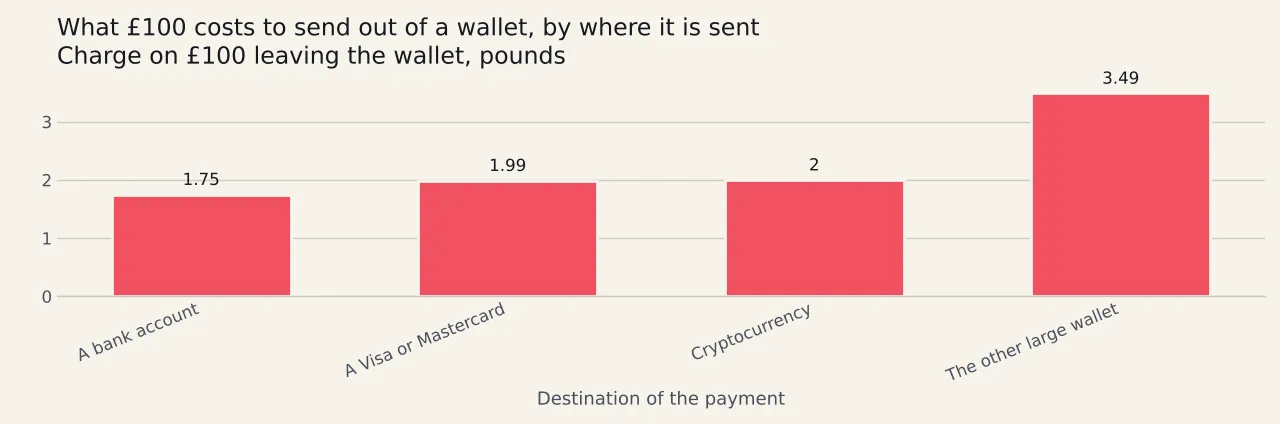
2.00 per cent is that price. A wallet charges it; no casino and no chain does. One of the electronic money wallets covered on Skrill, Neteller and Trustly casino publishes that rate for sending a balance out to cryptocurrency, which is £2.00 on £100. Its other published destinations are dearer or cheaper depending on where the money lands: 1.75 per cent to a bank, 1.99 per cent to a card, 3.49 per cent to the other wallet.
Nothing else in the sources behind this guide puts a sterling figure on getting into coin. The chains publish their fees in their own units, which is the subject of Ethereum casino and USDT casino. The exchange rate between the coin and the pound is not published by anybody as a fixed thing, because it is a market price that moves.
So the honest account of a £100 coin deposit has three parts. £2.00 to leave the wallet, where a wallet is used. An unknown network fee. And a rate of exchange applying twice, once on the way in and once on anything coming back. Against those three, the £160.00 printed above is the large figure, and the only one taken entirely from terms the operator publishes.
06
Final means there is no chargeback at any price
A payment on this network cannot be undone. That property is part of what the network is for, and it removes a mechanism a card user takes for granted. On the card rail a chargeback is routine enough that one wallet prints a flat charge for one at GBP 25, which tells a reader it happens often enough to need a price.
Two consequences are worth setting down. A deposit sent to the wrong address is gone, with nobody to ask. And a dispute with the operator cannot be pursued through the payment, because there is no payment to reverse. A British licensee would have to answer a complaint inside eight weeks and then point the customer at an independent dispute entity, with at least six months to bring one. No cashier of this kind is under that duty, and in its own words the regulator is not an ombudsman, even where it granted the licence.
What a British licence does carry, item by item, and what is therefore absent from offers of this kind, is set out on crypto casino. In short: the self-exclusion scheme takes in the companies that hold the licence, the ceiling of ten binds them, the complaints route belongs to them, and none of it travels to a site outside.
07
A hundred pounds in coin, worked through to the staking bill
The top match of a five-deposit package, taken at a £100 stage, with the licensed side left empty for the reason under the sum.
£100 of coin, from credit to expected cost
- Value of coin reaching the cashier £100.00
- Credit at the package’s top match, pound for pound £100.00
- Turnover owed, forty times that credit £100.00 × 40 = £4,000.00
- House share, four pence in each staked pound £4,000.00 × 0.04 = £160.00
- What one pound of that credit is expected to cost £160.00 ÷ £100.00 = £1.60
- Cheapest multiple seen here, thirty-five times 35 × £0.04 = £1.40
- The spread a reader is choosing between £1.40 to £1.60
No British figure stands beside these, and the reason is the finding rather than a gap in the research: no site licensed for Great Britain accepts the coin, so this deposit has no licensed twin to be priced against. Left out of the sum: the network fee, which tracks congestion and cannot be known in advance; the exchange rate, which applies on both journeys; the 2.00 per cent one wallet charges to send a balance into coin; conversion stopped at five times the credit; and a seven-day deadline, which puts £4,000.00 of staking inside a week. A 96 per cent payback is an average across many plays.
08
Eight questions about ranking a coin casino
- Which terms here are cheapest per pound of bonus?
- The set asking 35 times, at £1.40 for each £1 of credit. A counter of 40 times is the commoner one, and it works out at £1.60. The arithmetic is the multiple times four pence, four pence being what the house keeps from a staked pound at 96 per cent back. A holder of a British licence could not go past ten times, which is £0.40.
- Is there a bitcoin casino licensed in Great Britain?
- None takes the coin. That is about the market, not about a rule. A guidance page dated 5 July 2021 lists what a licensee would need to establish before accepting a digital currency, which is that its anti-money-laundering duties can be discharged and that its conduct is socially responsible, and nobody has shown it established. No rule forbids the attempt, and saying one does would misstate the source.
- How long does a deposit take to confirm?
- Six blocks average 60 minutes, because a block averages ten minutes, and the gaps between blocks arrive at random. Six confirmations is a benchmark users settled on rather than a rule. Nobody is answerable for the hour, unlike the card scheme’s fast funds service, which holds a supporting issuer to a maximum of 30 minutes from approval.
- What does a coin deposit cost to make?
- Three parts, and only one is published in sterling. A wallet charges 2.00 per cent to send a balance out into cryptocurrency, which is £2.00 on £100. The network fee moves with congestion and cannot be looked up beforehand. The exchange rate applies on the way in and again on anything coming back, and nobody publishes it as a fixed figure.
- Why does the price line’s second column carry no number?
- Because the licensed side has nothing to count. No British-licensed cashier takes the coin, so this deposit has no twin there to be held to ten times or to anything else. A number in that cell would be an invented offer, and the blank is the comparison that matters.
- Can a coin payment be reversed if something goes wrong?
- No. Payments on this network are final, so no chargeback exists at any price, and a deposit sent to a wrong address is gone. On the card rail a chargeback is common enough that one wallet publishes a flat GBP 25 charge for one. A dispute therefore has to be pursued with the operator, and no cashier of this kind is under a British complaints duty.
- What happens where the terms are not published at all?
- Three things go missing at the thinnest end of this market: a ceiling on the win, an expiry, and the biggest bet permitted while a bonus is running. The 40 times is reported rather than printed by the operator as well. A reader cannot cost those terms in advance, and this page prints that rather than borrowing figures from offers that do publish them.
- Does the self-exclusion scheme cover any of these?
- Its membership is the set of gambling companies holding a British online licence, and an offshore cashier is not among them. Its terms put the limit plainly: exclusion applies to participating operators, and gambling run outside the scheme is beyond what it can stop. The helpline printed below is open at every hour.