
Printed 2026 · figures read October 2026
400% deposit bonus is a stacked total, and £4,000 is what it owes
Staking a five-stage package asks for when every stage is taken at the floor and matched in full. Five payments of £20 collect £100 of credit, and 40 times £100 is this figure. A four hundred per cent headline is normally a total of instalments rather than a rate paid on one payment. Worked from terms of the usual pattern, October 2026.
The number of payments behind each headline
Every link in this rack is a paid placement, and this site is owed a fee when a reader opens an account through one.
Betportal
Lowest wagering
Licence Licensed in Anjouan, Comoros, no Great Britain licence, run by BetPortal Gaming Ltd and Excite Ultra Media Ltd, reference ALSI-202601040-FI2.
WinBeast
Free bet included
Licence Licensed in Curaçao, no Great Britain licence, operator not named on the site.
EliteSpin
New for 2026
Licence Licensed in Costa Rica, no Great Britain licence, run by PrimeTier Limited, opened 2026.
Crown Jewelz
200% first deposit
Licence Licensed in Curaçao, number not verified, no Great Britain licence, operator not named on the site.
Scroll the rack sideways to reach the other columns. The label column stays put.
Not one of the offers printed above holds a Great Britain licence. Outside that licence a British player has none of its protection: Gamstop Online cannot shut the door, the ten-times limit on bonus wagering does not bind the operator, and no British complaints body will take up a dispute. You must be 18 or over to open an account anywhere in this rack.
Every figure in the rack is a term the operator itself publishes, read on 14 October 2026. The operator's terms in full are the ones that bind you.
A whole five-payment package, in pounds per pound
| What these offers ask | Under a British licence | |
|---|---|---|
| You put in | £100.00 | £100.00 |
| Handed over | £100.00 | £100.00 |
| Wagering | 40x | 10x |
| Cost per £1 kept | None survives | £0.67 |
Five deposits of £20, each matched at the top of the published band, worked where 96 per cent comes back to the player and every round counts whole. Four thousand pounds of staking leaves £160.00 behind against £100.00 of credit, so the credit is gone before the counter is and nothing survives for a price to be put on. Ten times the same credit is £1,000.00 of staking, £40.00 left behind and £60.00 surviving. The multiple of ten comes with a Great Britain licence, and a five-stage cashier of this kind is licensed in Curacao or in Costa Rica instead. Nothing in the left-hand column is 400 per cent, because the rate on a single payment does not go that high here; the four-figure headline is a sum of five instalments and this strip prices the sum.
01
The rate a reader searched for is absent, and the one above it is a total
200 per cent is the largest rate normally paid on a single payment here. 300 per cent appears as a total built from three instalments. 400 per cent appears as a total and not as a rate.
So the honest answer to a search for a quadruple match is that the headlines reaching four figures get there by multiplying payments rather than by multiplying a rate. Some spread their advertised total across five deposits, and no stage pays without its own deposit of £20 or €20.
Rates past a double are, as a rule, found away from the British licence. Inside it the usual welcome is a full match, with a double turning up now and then on a small opening payment. Offers of this kind sit outside that licence from end to end and still stop at 200 on a single payment, which is worth knowing before a search term is trusted.
The rates that do get paid on one payment are priced at 100% deposit bonus, 200% deposit bonus and 300% deposit bonus. The opening package as a whole is at casino welcome bonus, and the unit all of them share is set out at matched money.
02
Two routes to a hundred pounds of credit, and they cost different amounts
£100.00 of credit can be reached two ways here, and the cheaper route is not the one with the bigger headline. The table sets them beside each other.
| Route | Payments | Your money | Credit | Staking |
|---|---|---|---|---|
| Five stages, each matched in full | 5 | £100 | £100.00 | £4,000.00 |
| Five stages, each matched at half | 5 | £100 | £50.00 | £2,000.00 |
| Three stages at 200, 150 and 150 per cent | 3 | £60 | £100.00 | £4,000.00 |
| One payment at 200 per cent | 1 | £20 | £40.00 | £1,600.00 |
Rows one and three end at the same credit and the same counter. Row three gets there for £40 less of the reader’s own money, because its rates are higher. That is the only sense in which a bigger rate is better, and it is a sense worth having.
Row two is the warning. A rate advertised as 50 up to 100 can land at either end of itself, and at the lower one £100 of deposits brings only £50 of credit. Neither five-stage cashier says which stage pays which rate, so the upper end is an assumption rather than a term.
03
£571.43 a day, for seven days, with no published ceiling on the pace
£571.43 is £4,000 divided by the seven days both five-stage cashiers allow. At 10p a stake that is 5,714 rounds a day. Neither of them publishes a maximum bet, so there is no printed figure against which to check whether that pace is permitted.
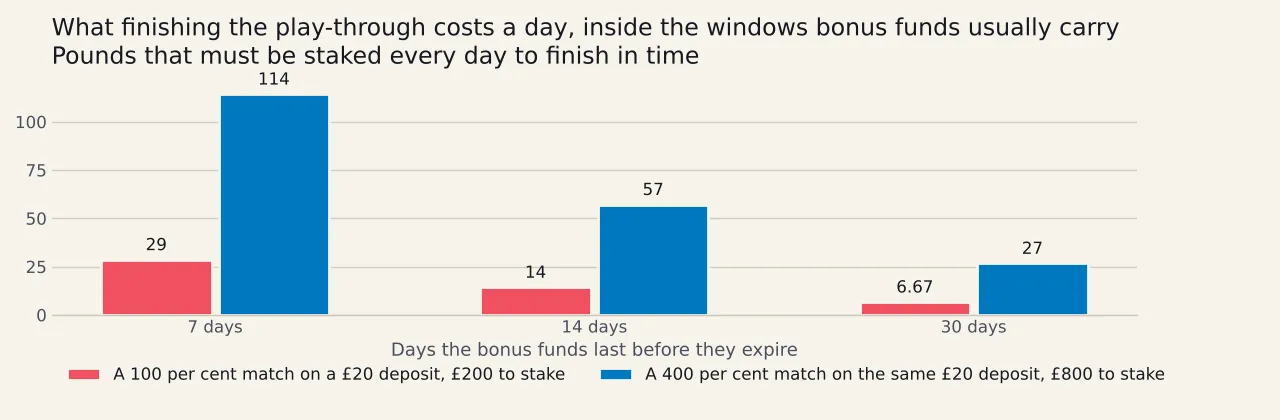
Doubling a headline doubles the turnover owed on the same deposit, and quadrupling it quadruples the turnover. The obligation grows with the rate while the window stays where it was, so the daily figure is where the two collide.
A pace like that is the reason the licensed market puts a running total on the screen. From 17 January 2025 a site holding the British licence has had to display, as play happens, both the net spend and the time elapsed. Nothing above is under that duty.
04
Seven days is also the window a British penalty turned on
£43,000 deposited and £36,000 lost inside seven days by one player is a published figure from a British enforcement case of March 2023, where a group paid £7.1m across two of its licensees. Seven days is also the window a five-stage package of this kind tends to allow.
The same decision records something sharper for anyone planning a sequence of deposits. An account asked to prove where its money came from was usually left able to keep paying money in while the two-week deadline for answering ran. The regulator counted that as a failure and the operator paid for it.
That is what enforcement looks like where a licence exists. The record also carries a £10m penalty in October 2025, the largest on the published list, with loss thresholds set out in the decision, and £609,104 in August 2026. Penalties attach to licensees, so a cashier outside the system contributes nothing to that record and answers to nothing in it.
Advertising guidance adds one point bearing directly on a ladder. A promotion ought not to pay at a rising rate as the time or money going into it rises, and the example offered of something acceptable is a modest free bet once £50 has been staked. A package whose best percentage sits at the top of its own ladder is the shape that guidance was written about.
05
What the five-stage packages publish, and what they leave blank
- Seven days to finish. At both of them. One gives its spins a single day each, the other asks for a batch to be activated inside a day and spent inside three.
- Counter, 40 times. Applied to the credit and to spin winnings alike at both, so winning on a free spin creates an obligation instead of a balance.
- Winnings ceiling. In some terms a batch of spin winnings is capped at €100. In others the credit itself cannot pass five times its own size, so £100 of credit stops at £500.
- Maximum bet, not published. Neither prints one, which is the blank that matters most on a page about pace.
- Spins, 500 across the package. A hundred with each payment at both, with one releasing them 25 at a time over four days.
Documents are called for before a first payout, as at any cashier of this kind. £100 of deposits can therefore be made across five transactions before any identity question is settled, and the question arrives when the money is asked for back.
Where a term is blank this press leaves it blank. A pace cannot be planned against a figure that does not exist, and borrowing one from a different cashier would make the arithmetic tidier and the page wrong.
06
The same five stages with a British licence behind them
£1,000.00 of staking instead of £4,000.00. £40.00 retained instead of £160.00. And £60.00 of the £100.00 surviving, with 67p of expected cost behind each surviving pound.
Alongside the multiple come the prompts. A licensee owes every customer the chance to set a financial limit at the earliest point, and the chance to set one later; a reduction has to be acted on without delay. Where no limit exists the customer has to be asked about it yearly, with setting one the default and refusing it a step of its own. Account and transaction information goes in front of the customer twice a year at least.
For a package built on five deposits inside a week, those prompts are the difference between a ladder a reader climbs by choice and one they climb by default. No cashier of this kind owes a single one of them.
The absences are short to state. The staking carries no British ceiling. The national register of self-exclusions does not reach the account. A dispute has nowhere British to go. And the regulator holds no power over the operator. Each of those absences is taken in turn across outside the licence.
07
Five stages taken to the end, worked through
Seven lines, worked at 40 times, and the £100 of deposits stays outside all of them.
£100 of credit over five payments, at 40 times
- Credit on one payment at the top of the band £20.00 × 1 = £20.00
- Credit once all five payments are made £20.00 × 5 = £100.00
- What the counter asks for £100.00 × 40 = £4,000.00
- Retention at four pence in every pound of it 4% of £4,000.00 = £160.00
- What the credit is worth after that £100.00 less £160.00 = −£60.00
- Pace the seven-day window demands £4,000.00 ÷ 7 = £571.43 a day
- Expected to survive, where ten times leaves £60.00 £0.00
Held to the British multiple, line three becomes £1,000.00, line four £40.00, line five a surplus of £60.00 and line six £142.86 a day, and 67p buys each surviving pound. Nought is printed rather than a loss because credit that never converts cannot leave the account lighter; the minus sign is the counter outliving the credit. Three terms in print cut the figure and not one lifts it: five times the credit as the most it may win in one set of terms, €100 for each spin batch in another, and any game crediting less than face value towards the counter. The rate, advertised as 50 up to 100, is the largest single unknown here, since the bottom of it halves the credit while leaving the deposits where they are.
08
Questions about a quadruple match
- Is a 400% deposit bonus paid on one payment?
- No. The largest rate normally paid on one payment is 200 per cent, and 300 per cent appears only as a total built from three instalments. The four-figure headlines are reached by stacking five deposits rather than by raising a rate, and no stage pays without its own deposit of £20 or €20.
- What does the biggest stacked headline actually owe?
- £4,000.00 of staking, where five payments of £20 are matched in full to give £100 of credit at 40 times. Four pence in each pound staked is left behind, which comes to £160.00 against credit worth £100.00. Ten times the same credit would owe £1,000.00 and leave £60.00 standing.
- How fast would I have to play to finish in time?
- £571.43 every day for seven days, which is the window both five-stage cashiers give. At 10p a stake that is 5,714 rounds a day. Neither of them publishes a maximum bet, so there is no printed ceiling to check that pace against.
- Is a bigger match rate ever worth more?
- Only in the money you put in, not in the price per pound of credit. Three stages at 200, 150 and 150 per cent reach £100 of credit for £60 of your own, where five stages at a full match need £100 of yours for the same credit and the same counter. The rate buys a shorter route, not cheaper credit.
- What does a rate advertised as 50 up to 100 mean?
- That the credit could come to half what the upper end suggests. At the lower end, £100 of deposits across five stages brings £50 of credit rather than £100. Which stage pays which rate is not stated anywhere, so the upper end is an assumption rather than a term.
- Are tiered offers that pay more for more allowed?
- Advertising guidance says a promotion ought not to pay at a rising rate as the time or money going into it rises, and the example it offers of something acceptable is a modest free bet once £50 has been staked. A package whose best percentage sits at the top of its own ladder is the shape that guidance is about.
- Would a licensed site show me how much I had spent?
- At a British-licensed one, yes. From 17 January 2025 such a site has had to put the net spend and the time elapsed on the screen as play happens. No cashier of this kind carries that duty, and the Commission’s register lists none of them.
- What protection is given up by climbing this ladder?
- The counter runs at four times the British limit. The prompts that would interrupt a five-deposit week are not owed. A self-exclusion registration leaves the account open. A dispute has nowhere British to go. Documents are still asked for, but only once the money is wanted back.