
Printed 2026 · figures read October 2026
Credit card casino deposits buy £32.00 of expected play on £20
Expected cost of the play a £20 card payment commits an account to at the counter this part of the market usually sets. That payment unlocks £20 of credit, the counter wants £800 put through, and 4p out of every pound of it stays with the games. The £20 is still owed to the card issuer whichever way the staking goes.
Where a card payment lands, and what each offer credits for it
Every link in this rack is a paid placement, and this site is owed a fee when a reader opens an account through one.
Betportal
Lowest wagering
Licence Licensed in Anjouan, Comoros, no Great Britain licence, run by BetPortal Gaming Ltd and Excite Ultra Media Ltd, reference ALSI-202601040-FI2.
WinBeast
Free bet included
Licence Licensed in Curaçao, no Great Britain licence, operator not named on the site.
EliteSpin
New for 2026
Licence Licensed in Costa Rica, no Great Britain licence, run by PrimeTier Limited, opened 2026.
Crown Jewelz
200% first deposit
Licence Licensed in Curaçao, number not verified, no Great Britain licence, operator not named on the site.
Scroll the rack sideways to reach the other columns. The label column stays put.
Not one of the offers printed above holds a Great Britain licence. Outside that licence a British player has none of its protection: Gamstop Online cannot shut the door, the ten-times limit on bonus wagering does not bind the operator, and no British complaints body will take up a dispute. You must be 18 or over to open an account anywhere in this rack.
Every figure in the rack is a term the operator itself publishes, read on 14 October 2026. The operator's terms in full are the ones that bind you.
£20 on a card, in pounds per pound
| What these offers ask | Under a British licence | |
|---|---|---|
| You put in | £20.00 | Not on credit |
| Handed over | £20.00 | £20.00 |
| Wagering | 40x | 10x |
| Cost per £1 kept | None kept | £0.67 |
Top right is the cell that cannot carry a figure. Gambling settled on a credit card is something a British operating licence has forbidden its holder to take since 14 April 2020, so the licensed side is filled on the footing that the same £20 arrives on a debit card. Rows two to four run where the pound returns 96 pence and nothing counts short. At 40 times, a credit of £20 owes £800 of staking, out of which £32.00 is kept, so the credit is not; ten times takes £8.00 and leaves £12.00 standing, at 67p a pound. That condition is what the right-hand column prices and it reaches licensees, not cards: offers of this kind hold papers out of Anjouan, Curacao or Costa Rica, and their payment lists carry both card networks while separating debit from credit nowhere.
01
What the payment does, in the order it does it
£20 is the smallest payment offers of this kind accept, so a card payment of £20 does four things in sequence. It clears the floor. It triggers the credit, which runs from £10 to £40 depending on the terms. It starts a counter of 35 or 40 times that credit. And it usually starts a clock of seven or fourteen days, though some terms publish none.
£32.00 is what follows at the usual counter on a full match. £800 of staking, 4p in the pound retained, £32.00 gone against £20.00 of credit. Typing a card number is a decision about that figure, which is larger than the credit it buys.
Two things do not happen. No cover attaches to the payment, because no payment-dispute scheme in this section covers gambling. And nothing is verified: a first payout calls for papers, while a first deposit calls for nothing whatever.
So the sequence is: money in on a card, obligation of £800, identity question later, and £20 owed to the issuer throughout. The rest of this sheet prices each of those.
02
What a card payment is worth across the usual terms
£64.00 at the top and £16.00 at the bottom. The same £20 on the same card produces very different obligations, because the credit it unlocks differs and the counter is applied to the credit rather than to the payment.
| Terms assumed | Credit | Counter | Staking | Retention |
|---|---|---|---|---|
| Doubled match, counter at 40 | £40 | 40x | £1,600 | £64 |
| Matched in full, counter at 40 | £20.00 | 40x | £800.00 | £32.00 |
| Matched at half, counter at 40 | £10.00 | 40x | £400.00 | £16.00 |
| Priced in euros, counter at 35 | €30 | 35x | €1,050 | €42 |
Every retention in the right-hand column is larger than the credit beside it. On one card payment, a bigger headline buys a bigger obligation, which is not what a headline is advertised to do.
One number is missing from the table on purpose: what carrying the £20 on credit costs. No interest rate stands behind anything on this sheet, so that cost is named and left unpriced rather than guessed at. What can be said is that the £20 is a debt from the moment it is spent, and that the regulator’s own work on this subject counts a mobile phone account among forms of borrowing, so the category is not a narrow one.
03
What is published about card type, which is nothing
Four payment lists, both large networks on each, and no distinction anywhere between a debit card and a credit one. That silence is itself the finding, and it is the reason this sheet prices the payment rather than the card type.
Three further silences belong beside it. A charge for a deposit is not published. Neither is a charge for a payout. Neither is how long the cashier’s own approval of a payout takes, so the only clock in the whole journey is the one the card network sets for an issuer that supports its fast funds service, at 30 minutes from approval.
What is published is uniform. Documents before a first withdrawal. A floor of £20 or €20. Slots as the product the credit is spent on. And a licence from Anjouan, Curacao or Costa Rica, with the Commission’s register carrying no site of this kind.
A reader who wants the card question answered by the cashier will not find it answered. A reader who wants it answered by their own bank or issuer will, because a block there reads the payment rather than the website. The other large network is at mastercard casino, and the wallet route that stands between a card and a cashier at Skrill, Neteller and Trustly casino.
04
The British condition, its scope, and what it does not reach
Licence condition 6.1.2 is the provision and it has been live since 14 April 2020. Its effect is that gambling settled on a credit card is something a licensee may not take. The reach is wider than a card terminal: remote betting, remote gaming and remote lotteries are all inside it, so is betting that is not remote, and so is a credit card routed to the licensee through a money service business.
Three licence types sit outside it: gaming machine technical, gambling software and host licences. Non-remote casino, bingo, adult gaming centre and family entertainment centre operators were already barred from taking credit cards before it arrived, and no gaming machine may be set up to accept one.
It also reaches sideways into wallets. A licensee may take a wallet payment only where the wallet can satisfy it that credit money will be kept away from the gambling, and a wallet offering card top-ups may have to run separate pots so that nothing funded on credit arrives at a gambling operator. Put a credit card inside a phone wallet and the condition still sees a credit card.
None of that binds a cashier outside the licence. The condition attaches to the holder of a British licence, and a cashier without one is outside every word of it. That is why this page leads on what a card payment costs rather than on what the law forbids: the prohibition is real, and it is not addressed to anybody a reader of this page can open an account with.
05
The counts published when the route was closed
Three numbers accompanied the condition in January 2020 and they set the scale of what it was aimed at.
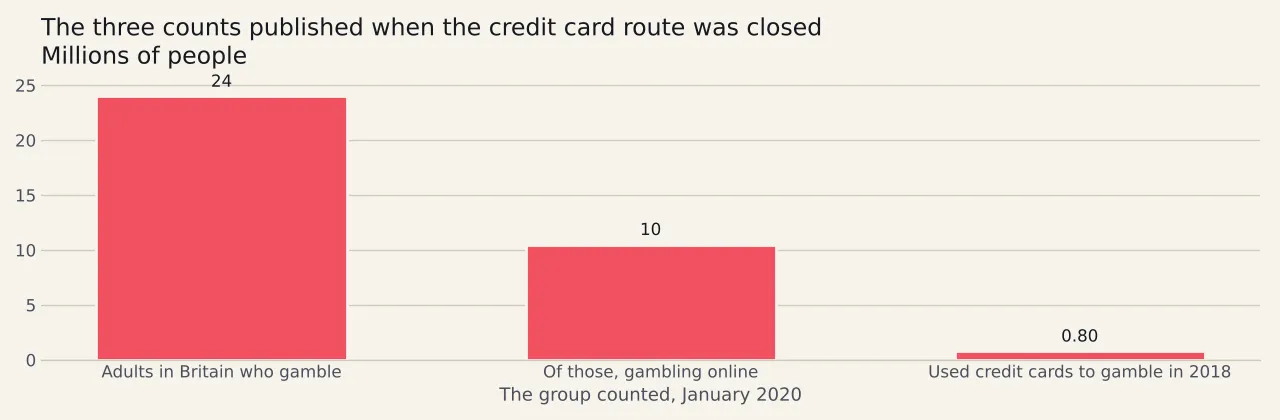
An evaluation followed on 2 November 2021 and it cut two ways. The great majority of those who had been using credit cards for gambling did not look for a substitute. Fifteen per cent, which came to 17 people in the survey, reported borrowing elsewhere instead: four through payday lending and one through a phone account.
Both of those are small surveys and this page says so rather than rounding them into something firmer. What they support is a narrow claim: closing the route moved a minority of people onto other credit rather than off credit altogether.
06
What the reader gives up, and what still works
Four protections are absent from offers of this kind and each one matters to somebody paying by card. Nothing holds the counter to ten times. Registering with the national self-exclusion scheme leaves this account standing, since membership follows the British licence rather than the website. No British body stands ready to hear a dispute about the payment. And at the far end of it stands an operator the regulator cannot touch.
Two things still work, and both belong to the reader rather than to the cashier.
- A bank or issuer block. It reads the betting category code carried by the payment, so it applies wherever the cashier is licensed. The banks that publish blocks also say a payment tagged wrongly can get through, and several print two days of waiting before a lifted block stops working.
- A wallet’s own block. One large wallet keeps its gambling block five screens into the account settings and runs a three-day wait before switching it off takes effect. Like the bank version, it works from merchant tagging and can miss an untagged merchant.
Nothing on this page assists anybody in getting past either of those, or past an identity check, and nothing here suggests a way exists. A reader who wants the brake on has the stronger instrument available: one registration with Gamstop Online closes every gambling site that holds a British licence, and 614,738 people had taken it up by 16 July 2026. The scheme publishes its own limit: a site that stands outside the system is beyond its reach.
07
A £20 card payment, worked through
Seven lines. Six of them resolve into pounds and the seventh is the one this sheet will not price.
£20 on a card, at 40 times
- Card payment, clearing the floor £20.00
- Credit it unlocks at a full match £20.00
- Staking the counter then asks for £20.00 × 40 = £800.00
- Retained by the games, 4p in the pound 4% of £800.00 = £32.00
- Credit set beside what the games keep £20.00 less £32.00 = −£12.00
- Owed to the issuer either way £20.00
- Expected cost of the play, where ten times costs £8.00 £32.00
At ten times the same lines read £200.00 of staking, £8.00 retained and £12.00 of credit surviving at 67p a pound, which is what the licensed side prices. What is not in the sum is the cost of carrying line six: no interest figure stands behind this sheet, so the charge for leaving £20 on a card is named and left unpriced rather than invented. Three published terms cut the figures further. In places a bonus may win no more than five times the credit. The clock is seven days more commonly than fourteen, and somewhere it is not published at all. And only slots move the counter. Each figure here is an expectation taken over a very large number of rounds.
08
Questions about paying by card here
- What does a card deposit to one of these sites actually buy?
- At the usual counter, £20 buys £20 of credit and £800 of staking, which is expected to cost £32.00 where 96 pence returns on the pound. The retention is larger than the credit, so nothing of the credit is expected to survive, and the £20 is owed to the issuer whichever way the staking goes.
- Do offers of this kind take credit cards?
- Their payment lists carry both large card networks and separate debit from credit nowhere. That silence is the published position. A British licence is not held in this part of the market, so the condition that would force the distinction does not reach it, and this sheet prices the payment rather than the card type.
- What is the British rule, exactly?
- Licence condition 6.1.2, live since 14 April 2020. Its effect is that gambling settled on a credit card is something a licensee may not take. Remote betting, gaming and lotteries are inside it, so is betting that is not remote, and so is a credit card routed to the licensee through a money service business. It binds licensees, not cards.
- Does the ban reach wallets and phone wallets?
- On the licensed side, yes. A licensee may take a wallet payment only where the wallet can satisfy it that credit money will be kept away from the gambling, and a wallet offering card top-ups may have to run separate pots so nothing funded on credit arrives. Put a credit card inside a phone wallet and the condition still sees a credit card.
- What did the rule cost in practice?
- The counts published with it were 24 million adults gambling in Britain, 10.5 million of them online, and an industry estimate putting 800,000 consumers on credit cards for gambling during 2018. One further figure, that among online gamblers paying on credit 22 per cent counted as problem gamblers, came out of a survey of roughly 150 people and should be read in that light.
- Did people find other credit after it?
- A minority did. The evaluation of 2 November 2021 found the great majority of former credit-card gamblers did not look for a substitute, while 15 per cent reported borrowing elsewhere. That 15 per cent came to 17 people in the survey, of whom four used payday lending and one a phone account.
- Will my bank stop the payment?
- If a gambling block is on, it will stop what it can read. A block works from the betting category code the payment carries, so it applies wherever the cashier is licensed. The banks publishing blocks say a payment tagged wrongly can get through, and several print two days of waiting before a lifted block stops working.
- What protection is lost by paying a cashier of this kind?
- Four things. Nothing holds the counter to ten times. Registering with the national self-exclusion scheme leaves the account standing, since membership follows the British licence. Disputes reach no British body. And over the operator the regulator is powerless. One registration with Gamstop Online closes every British-licensed site, and 614,738 people had taken it up by 16 July 2026.