
Printed 2026 · figures read October 2026
Paysafecard casino vouchers lose 40p a pound on the smallest code
Taken from each pound of credit on a £10 code, every month it is left unspent. The charge is a flat £4 against whatever credit remains, and the clock starts once the month of purchase has ended, so the smaller the code the heavier the charge falls. On a £100 code the same £4 is 4p a pound.
A printed code at the desk, and the terms behind each offer
Every link in this rack is a paid placement, and this site is owed a fee when a reader opens an account through one.
Betportal
Lowest wagering
Licence Licensed in Anjouan, Comoros, no Great Britain licence, run by BetPortal Gaming Ltd and Excite Ultra Media Ltd, reference ALSI-202601040-FI2.
WinBeast
Free bet included
Licence Licensed in Curaçao, no Great Britain licence, operator not named on the site.
EliteSpin
New for 2026
Licence Licensed in Costa Rica, no Great Britain licence, run by PrimeTier Limited, opened 2026.
Crown Jewelz
200% first deposit
Licence Licensed in Curaçao, number not verified, no Great Britain licence, operator not named on the site.
Scroll the rack sideways to reach the other columns. The label column stays put.
Not one of the offers printed above holds a Great Britain licence. Outside that licence a British player has none of its protection: Gamstop Online cannot shut the door, the ten-times limit on bonus wagering does not bind the operator, and no British complaints body will take up a dispute. You must be 18 or over to open an account anywhere in this rack.
Every figure in the rack is a term the operator itself publishes, read on 14 October 2026. The operator's terms in full are the ones that bind you.
A £25 code paid in whole, in pounds per pound
| What these offers ask | Under a British licence | |
|---|---|---|
| You put in | £25.00 | £25.00 |
| Handed over | £25.00 | £25.00 |
| Wagering | 40x | 10x |
| Cost per £1 kept | Nothing lasts | £0.67 |
£25 is the smallest code value that clears the £20 floor offers of this kind usually set, so it is the sum this strip prices, paid in whole so that no credit is left on the code to be charged against. Worked where a pound staked returns 96 pence and nothing counts short: £1,000 of staking leaves £40.00 with the games against £25.00 of credit, so nothing lasts. Ten times asks £250, leaves £10.00 behind and holds £15.00, at 67p of cost for each pound held. Ten is a Great Britain licence condition, and a cashier taking vouchers in this market holds Curacao, Anjouan or Costa Rica papers. The voucher’s own charges are not in this table: they attach to credit left unspent, and that arithmetic is below.
01
Cash turned into a printed code, with a ceiling on it
Six values exist and all of them are bought for cash over a shop counter: ten pounds, twenty-five, forty, fifty, seventy-five and a hundred. Codes can be put together in one payment, and the most one payment may carry is £40.
This route is carried about as widely as the two large wallets and no more widely than that. A reader choosing it is narrowing the field and taking on a fixed charge no other route in this section imposes.
£0.40 is that charge expressed per pound on the smallest code. Once the purchase month has closed, £4 goes monthly out of any credit still on the code. That makes this the only route here whose cost turns on how long the money sits still.
The two wallets from the same stable are priced at Skrill, Neteller and Trustly casino. The wallet with a prepaid card of its own is at muchbetter casino, the route nobody here carries at pay by phone casino, and the routes ranged by how widely they are carried at how you pay.
02
Four of the six values sit above the payment ceiling
£40 is the most one payment may carry, and four of the six code values exceed it.
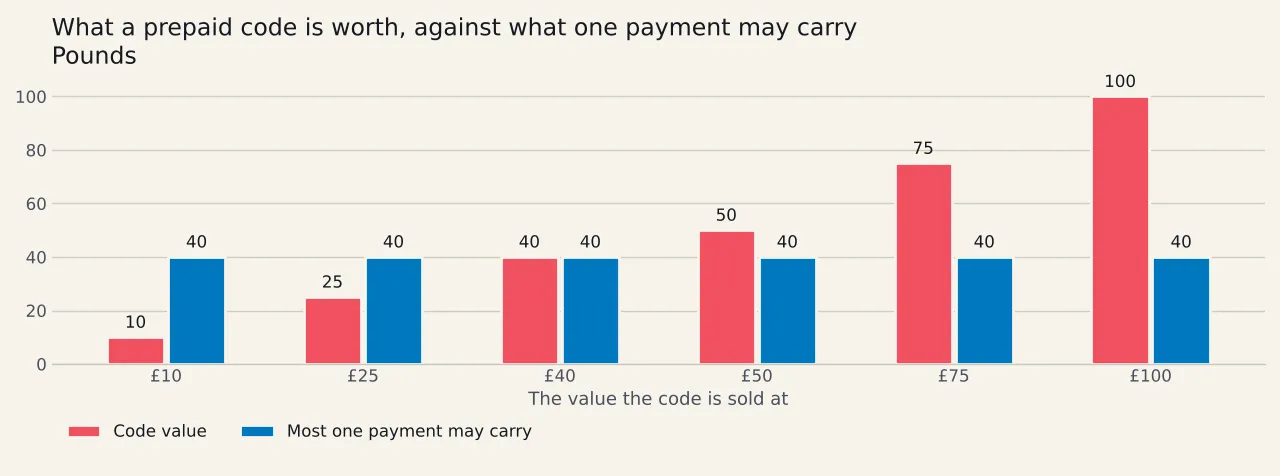
So a £100 code cannot be spent in one go at a cashier. It has to be split across payments, and each payment carries the £40 limit, which is why the large values suit a reader who deposits repeatedly rather than one who deposits once.
That matters against the floor. Offers of this kind ask £20 at least, or €20 where the cashier prices in euros, so the smallest code that clears that in a single payment is £25, and the second smallest is £40. A £10 code cannot open an account of this sort at all.
03
The charge is flat and the burden is not
£4 a month is the same figure on every code, which is exactly why it is not the same charge. The table divides it by each value and counts how long each one survives it.
| Code | Charge per pound | Months to empty | Clears the £20 floor |
|---|---|---|---|
| £10 | £0.40 | 2.5 | No |
| £25 | £0.16 | 6.25 | Yes |
| £40 | £0.10 | 10 | Yes |
| £50 | £0.08 | 12.5 | Yes, over two payments |
| £75 | £0.05 | 18.75 | Yes, over two payments |
| £100 | £0.04 | 25 | Yes, over three payments |
The charge per pound in column two is this press’s own division of £4 by each value, rounded to the penny, and column three is each value divided by £4. Ten times as much credit carries one tenth of the charge per pound, which is the arithmetic of a flat fee and the reason small codes are the expensive ones.
One line in the table is worth reading twice. A £10 code is empty inside three months and cannot clear the usual floor in the meantime, so it is the one value carrying a charge and no use.
04
Registering an account swaps one charge for three
The £4 is avoided by registering a named account with the issuer. Three other figures arrive with it, and all three are published.
- £5 a month from the thirteenth month. Let twelve months go by with nothing transacted and the account starts charging, which is a longer rope than the code’s two months and a thicker one at the end of it.
- £6 a refund. Each refund out of the account costs that, so moving money back out of the balance is priced in a way the code never was.
- £250 a month, or £24,000 a year. The payout limit, at the standard tier and the unlimited tier respectively. The standard figure is the only monthly payout ceiling published anywhere in this section.
That last figure is the one to weigh against a casino balance. £250 a month is less than the credit one stage of a larger package in this market can produce, so a reader taking winnings out through a standard account runs into a ceiling the voucher sets rather than the cashier.
A code bought for cash and spent the same week pays none of these charges. That is the honest use of the route, and it is the only use where the arithmetic on this page stays at nought.
05
Who stands behind the code
900021 is the firm reference number. A prepaid services company holds the UK issuance and sits on the Conduct Authority’s register. The voucher itself is part of a payments group whose consumer range takes in the two large wallets priced elsewhere here.
That common ownership is worth knowing for one practical reason. Loading one of those wallets from a voucher of this kind is the dearest entry on either wallet fee page, at 5.00 per cent at one of them and a band running up to 5 per cent at the other. Two products from one group, and the route between them is the costliest door in.
What the issuer’s permission does not provide is a bank guarantee. A balance of this kind is electronic money. Safeguarding is what holds it, rather than the compensation scheme behind bank deposits, and every wallet in this section runs under the same arrangement.
And the gambling side of the transaction is governed by nobody here. A cashier that accepts the voucher in this bracket of the market is licensed offshore, and the Commission’s register does not carry it.
06
What the licensed side moves, and what it leaves alone
£40.00 of retention becomes £10.00, and £15.00 of a £25 credit survives instead of nothing. That is the licence as arithmetic, and the counter is where all of it comes from.
The voucher’s own charges are unmoved by any of it. £4 a month against an idle code, £5 a month against an idle account from the thirteenth month, £6 a refund and £250 a month of payouts are the issuer’s terms and they apply whoever is at the far end of the payment.
What a licence would add beyond the counter is the familiar list. Identity dealt with before play rather than before a first payout. A complaint travelling a published route inside eight weeks. Membership of the national self-exclusion register, which a cashier outside the British system cannot offer. And a charging rule: a licensee may take no more for a payout than handling it costs, and nothing whatever for emptying a balance to the last penny.
That last rule is the sharpest comparison available on a page about fees. On the licensed side the cashier’s charge is capped by rule and the voucher’s charge is the reader’s own choice. Away from that licence, only the voucher’s charge is published at all.
07
A code in a drawer, worked through
Seven lines. The first five price the deposit and the last two price the waiting.
£25 in, and £4 a month against what is left
- Smallest code that clears the floor in one payment £25.00
- Credit the full match adds £25.00
- Staking the counter wants £25.00 × 40 = £1,000.00
- What the games keep out of that 4% of £1,000.00 = £40.00
- Credit set against what is kept £25.00 less £40.00 = −£15.00
- Monthly charge on a £10 code left unused £4.00
- That charge per pound of credit on the code £4.00 ÷ £10.00 = £0.40
Held to the British ten, lines three to five read £250.00 of staking, £10.00 kept and £15.00 of credit surviving, each surviving pound having cost 67p. Lines six and seven belong to the voucher and not to any cashier, and they apply on either side of the comparison: the same £4 on a £100 code is 4p a pound, and a £10 code is exhausted in two and a half months. Registering an account removes the £4 and introduces £5 a month from the thirteenth month, £6 a refund and a payout ceiling of £250 a month at the standard tier. All the gambling figures are averages over a great many rounds.
08
Questions about the voucher route
- What does an unused voucher cost to hold?
- £4 a month against whatever credit is left, with the clock starting as soon as the month of purchase ends. On a £10 code that is 40p of every pound, and the code is empty in two and a half months. On a £100 code the same £4 is 4p a pound and the code lasts 25 months.
- Can a voucher cover a deposit at these cashiers?
- Some do and some do not, and where they do the floor is usually £20, or €20 at a cashier pricing in euros. The smallest code value that clears it in one payment is £25, because a single payment may carry no more than £40. A £10 code cannot clear that floor at all.
- Why can a £100 code not be spent at once?
- Because the ceiling is on the payment rather than on the code. One payment may carry no more than £40, so a £100 code has to be spent across three of them. Codes may be combined inside a payment, which raises what can be assembled and not what can be sent.
- Does registering an account avoid the charge?
- It replaces one charge with three. The £4 a month goes, and in its place come £5 a month from month thirteen where twelve have gone by with nothing transacted, £6 for each refund, and a payout limit of £250 a month at the standard tier or £24,000 a year at the unlimited one.
- Is the payout limit a problem?
- It can be. £250 a month at the standard tier is less than the credit one stage of a larger package in this market can produce, so winnings taken out that way run into a ceiling the voucher sets rather than the cashier. The unlimited tier is published at £24,000 a year instead.
- Who issues the voucher?
- A prepaid services company on the Conduct Authority’s register, firm reference 900021, inside a payments group whose consumer products also include the two large wallets priced elsewhere in this section. The balance is electronic money, kept in safeguarding rather than covered by the compensation scheme standing behind bank deposits.
- Is it cheap to put a voucher into a wallet?
- It is the dearest entry on either wallet fee page: 5.00 per cent at one and a band running up to 5 per cent at the other. Two products from the same group, and the route between them costs more than any other way in. Paying the cashier straight from the code avoids it.
- Does a voucher change the price of the bonus?
- No. A £25 code paid in whole credits £25, the counter reads 40 times, £1,000 of staking is owed and £40.00 of it is expected to stay with the games. Held to the British ten the retention would be £10.00 and £15.00 of the credit would survive at 67p a pound.