
Printed 2026 · figures read October 2026
Skrill, Neteller and Trustly casino offers, priced down to the penny
The staking bill behind a doubled first match, which is as large as this part of the market runs to. Twenty pounds goes in, forty pounds of bonus comes back, the terms ask for forty times that bonus in turnover, and a 96 per cent payback keeps four pence of every pound of it. Source: the terms published with offers of this kind, read October 2026, worked out here.
Three wallets at the cashier, and the package standing behind each
Every link in this rack is a paid placement, and this site is owed a fee when a reader opens an account through one.
Betportal
Lowest wagering
Licence Licensed in Anjouan, Comoros, no Great Britain licence, run by BetPortal Gaming Ltd and Excite Ultra Media Ltd, reference ALSI-202601040-FI2.
WinBeast
Free bet included
Licence Licensed in Curaçao, no Great Britain licence, operator not named on the site.
EliteSpin
New for 2026
Licence Licensed in Costa Rica, no Great Britain licence, run by PrimeTier Limited, opened 2026.
Crown Jewelz
200% first deposit
Licence Licensed in Curaçao, number not verified, no Great Britain licence, operator not named on the site.
Scroll the rack sideways to reach the other columns. The label column stays put.
Not one of the offers printed above holds a Great Britain licence. Outside that licence a British player has none of its protection: Gamstop Online cannot shut the door, the ten-times limit on bonus wagering does not bind the operator, and no British complaints body will take up a dispute. You must be 18 or over to open an account anywhere in this rack.
Every figure in the rack is a term the operator itself publishes, read on 14 October 2026. The operator's terms in full are the ones that bind you.
This offer, in pounds per pound
| What these offers ask | Under a British licence | |
|---|---|---|
| You put in | £20.00 | £20.00 |
| Handed over | £40.00 | £40.00 |
| Wagering | 40x | 10x |
| Cost per £1 kept | £1.60 | £0.40 |
Left column: a 200 per cent first match, as large as this part of the market runs to, taken at the £20 stage such an offer accepts, with turnover of 40 times the bonus. Right column: the same £40, held to the multiple a Great Britain licence allows. A 96 per cent payback is assumed on both sides, both answers are averages across many plays rather than the result of any evening, and neither carries a ceiling on the win, because a package of that size publishes none. Four pence in the pound over 40 times the bonus comes to more than the bonus, so none of the £40 is expected to last the turnover out. Held to a multiple of ten, 60 pence in the pound does.
01
Twenty pounds through a wallet buys forty pounds of bonus and a £1,600 staking bill
£40.00 of bonus is what a doubled first match credits on the smallest stake it will take, and that stake is £20.00. Attached to the credit is turnover of 40 times it, so £1,600.00 has to be staked before any of it comes out. A 96 per cent payback prices that staking at £64.00 in expectation. The bonus being chased is £40.00, so the bill is already larger than the prize.
That is the offer. The three names in the title are how the £20.00 travels in and how anything surviving travels back, and each one prices its own leg. Two of them issue electronic money and hold a balance. The third holds nothing and moves money straight out of a bank account.
Offers of this kind are not licensed in Great Britain. A British licensee has not been able to ask a wagering multiple above ten since 19 January 2026, which is why 40 stands in the left-hand cell of the price line and 10 in the right. Everything below prices the route. The price line prices what the route reaches.
02
Three names, two electronic money licences and one bank sign-in
Two of the three issue electronic money and keep a balance for the customer. Skrill Limited carries firm reference 900001 on the Financial Conduct Authority register. The second wallet’s fee page gives its licence holder as Paysafe Financial Services Limited, at firm reference 900015 under the 2011 electronic money rules. One group owns both, and that group also issues the prepaid codes priced on paysafecard casino.
Electronic money is not a bank deposit. The compensation scheme standing behind a bank balance does not stand behind one of these, and the provider has to keep customer money in accounts separate from its own instead. That matters at the moment a provider fails rather than on any ordinary Tuesday, and the same regime covers the balances described on PayPal casino.
The third name is not a wallet. Trustly UK Limited holds authorisation as a payment institution at reference 1005703, and no card number enters the route at all: the customer signs into their bank and the bank sends the money. Its combined deposit and identification product, Pay N Play, is listed for five markets, which are Estonia, Finland, the Netherlands, Sweden and the United Kingdom.
Three further figures are that company’s own rather than anybody’s rule, and belong to it: a deposit inside six seconds, payouts landing instantly or within five minutes in more than 95 cases out of a hundred, and 99.7 per cent of payouts going through. Nobody enforces any of the three. The clocks somebody does enforce are laid out on fast withdrawal casinos.
03
Filling a wallet is priced anywhere between nothing and five per cent
Nothing is the cheapest way in. The first wallet prices a bank transfer at 0.00 per cent, a card at 1.00 per cent and its own rapid bank product at the same 1.00 per cent, then asks 2.50 per cent for cash handed over at a counter and 5.00 per cent for a prepaid code. The second prices most upload methods at a flat 2.5 per cent, a local bank deposit in a band topping out at 1 per cent, and a prepaid code in a band topping out at 5 per cent.
Two of those lines repay a second look. The 5.00 per cent code rate is one product of a group charging to load a second product of the same group. And a band beginning at nothing is a range rather than a price, so a reader plans around its upper end.
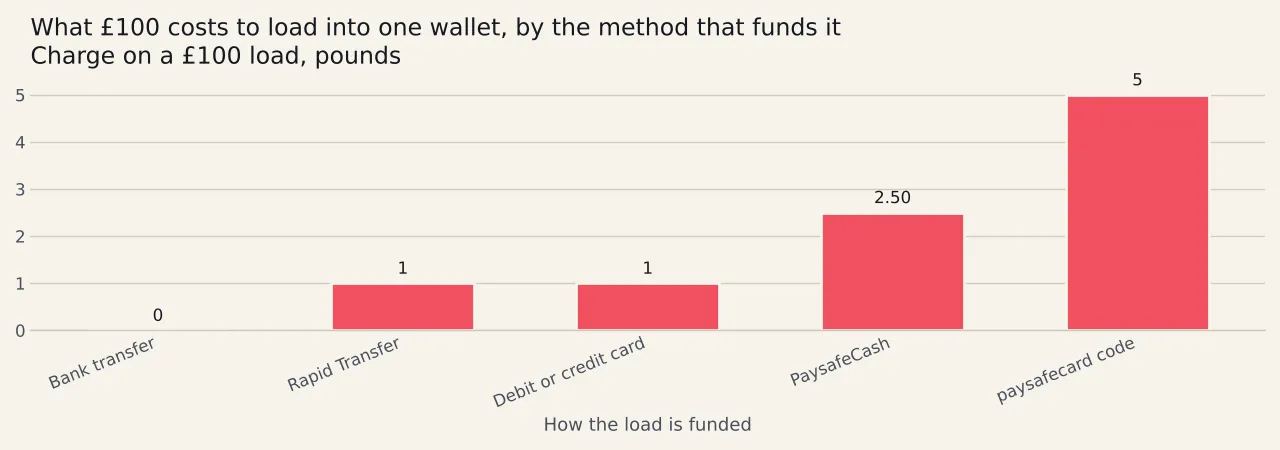
Set beside the £64.00 at the head of this page, every upload charge there is small. That ordering is the point of the page. The route costs pence. The terms cost pounds.
04
Emptying a wallet costs more, and the destination sets the rate
Coming out is dearer than going in at both wallets. The first asks 1.75 per cent to reach a bank and never less than EUR 3.50, 1.99 per cent to reach a Visa or a Mastercard and never less than EUR 0.99, 2.00 per cent to buy cryptocurrency, 3.49 per cent to reach the other wallet, and a flat EUR 5.50 by SWIFT. The second asks USD 10 flat for a bank payout, a card payout quoted as a band whose upper end is 7.5 per cent, 3.49 per cent to reach the first wallet, and nothing at all to pay a merchant site.
A floor priced in euros bites hardest on a small payout. A percentage without a floor stays proportionate at every size. A flat charge in dollars is the dearest of the three on a small sum and the cheapest on a large one. None of the three appears on a casino cashier screen, because the charge belongs to the wallet and not to the operator.
| The leg of the journey | Published rate | On £100 | Left of the £100 |
|---|---|---|---|
| Into a wallet by bank transfer | 0.00 per cent | £0.00 | £100.00 |
| Into a wallet on most methods | 2.50 per cent | £2.50 | £97.50 |
| Into a wallet by prepaid code | 5.00 per cent | £5.00 | £95.00 |
| Wallet to a casino cashier | 0.00 per cent | £0.00 | £100.00 |
| Out of a wallet to a bank | 1.75 per cent | £1.75 | £98.25 |
| Out of a wallet to a card | 7.5 per cent at the top | £7.50 | £92.50 |
| Out of a wallet to the other wallet | 3.49 per cent | £3.49 | £96.51 |
Row four is the one nobody expects. Paying a merchant is priced at nothing on both schedules, so the leg that actually reaches the casino is the free leg of the trip. The charges sit either side of it.
05
Four charges sit away from the cashier screen entirely
Four prices attach to the balance rather than to a payment, and a reader comparing only deposit and payout rates will meet none of them.
- Sitting still. EUR 5.00 each month at the first wallet, once half a year passes with no sign-in and no transaction. USD 5.00 each month at the second, on the identical test.
- Changing currency. Conversion costs 3.99 per cent in the first wallet. The second prices it at 4.49 per cent and cuts that as far as 1 per cent at its top membership tier. A sterling balance funding a package priced in euros meets the charge on both journeys.
- Sending to another customer of the same wallet. 2.99 per cent of the amount, and never below EUR 0.50.
- A chargeback. GBP 25 at one of the two, a flat administrative price for a card payment pulled back.
That last line is a useful marker. On the card rail a chargeback exists and carries a price. On the networks covered by crypto casino no such mechanism exists at any price, because a payment made there cannot be undone.
06
A credit card can fill a wallet and still not reach a British cashier
14 April 2020 is the date from which licence condition 6.1.2 closed the credit card to a British licensee collecting money for gambling, and the bar travels with the card into a wallet. A licensee may take wallet money only where the wallet can assure it that credit card funds are kept out, which can mean separate pots inside the wallet so that money loaded on a credit card never arrives at a gambling operator. Which kind of card is which is read off the first digits of the number, the part that identifies the issuer. The whole rule is set out on credit card casino.
All of that binds whoever holds a Great Britain licence. An offshore cashier holds no such licence, so none of it reaches them. The same gap runs through everything else the licence carries, and it reads better as a list of what is absent than as a warning.
- Self-exclusion. Gamstop Online takes in every gambling company licensed online in Great Britain, which means a registration with it does not reach a cashier outside that licence.
- Wagering. The multiple of ten that caps a British licensee caps nothing here.
- Disputes. No British body will adjudicate one against them, and the Gambling Commission says of itself in terms that it is not an ombudsman.
- Enforcement. A regulator cannot act against an operator whose licence it does not grant.
What that absence costs is printed one column over in the price line: 40 against 10, on the same £40 of bonus.
07
The staking bill, worked through, with the British figure beside it
One match, one multiple, one payback, and the same bonus run twice: once on the terms this market sets, once held to what a British licence would allow.
Cost of £1 of bonus, these terms against a licence
- Deposit, at the smallest stage the package takes £20.00
- Bonus credited, at a match of 200 per cent £20.00 × 2 = £40.00
- Turnover the terms demand, 40 times the bonus £40.00 × 40 = £1,600.00
- Four pence of each pound turned over, at 96 per cent back £1,600.00 × 0.04 = £64.00
- What each £1 of credited bonus costs, on these terms £64.00 ÷ £40.00 = £1.60
- The identical £40.00, held to a multiple of ten £400.00 × 0.04 = £16.00
- Per £1 of bonus: these terms, then a British licence £1.60 and £0.40
The wallet is not in this sum. Load at 2.50 per cent, then take the remaining £97.50 out at the top of a band reaching 7.5 per cent, and a £100 round trip costs £9.81, which is a fifteenth of the staking bill above it. Nor is a ceiling on the win, since a package of that size publishes none, nor a game that counts for less than its stake towards the total, which lifts the real turnover without moving the printed multiple. An average over many plays says nothing about one of them.
08
Eight questions about these three routes
- Does a Skrill or Neteller deposit change what a bonus costs?
- No. The wallet prices the journey and the operator prices the bonus. A £100 load costs between nothing and £5.00 depending on the method, while the £40 bonus behind a doubled first match carries £64.00 of expected losses at 40 times turnover and a 96 per cent payback. The route is priced in pence and the terms in pounds.
- Which leg of the trip is free?
- The leg that reaches the casino. Paying a merchant site is priced at nothing on both schedules, so the deposit itself carries no wallet charge at all. The charges sit either side of it, on the load going in and the payout coming out, and the payout side is dearer.
- What is the dearest published rate on these pages?
- A card payout quoted as a band whose upper end is 7.5 per cent, so £7.50 out of £100. Dearest on the way in is a prepaid code at 5.00 per cent, which is £5.00 out of £100. A band beginning at nothing is a range rather than a price, so the upper end is what a reader should plan around.
- Is money in one of these wallets protected like money in a bank?
- No. Both wallets issue electronic money, which is not a bank deposit, and the compensation scheme standing behind a bank balance does not stand behind one of these. Customer money has to be kept in accounts separate from the provider’s own instead. The third route holds no balance, because the customer signs into their bank and the bank sends the money.
- Can a credit card fund one of these wallets and then a casino?
- Not where the site holds a Great Britain licence. Licence condition 6.1.2, running from 14 April 2020, closed the credit card to any British licensee collecting money for gambling, and a licensee may take wallet money only where the wallet can assure it that credit card funds are kept out. Which kind of card is which is read off the first digits of the number.
- Do the deposit-speed figures mean a payout is quick?
- They are one payment company’s own figures, not a clock anybody enforces. What it publishes is a deposit inside six seconds, payouts landing instantly or within five minutes in more than 95 cases out of a hundred, and 99.7 per cent of payouts going through. The operator’s own approval step stands in front of all three and carries no published time limit.
- What charges apply when nothing is happening?
- Four of them. A dormancy price of EUR 5.00 each month at the first wallet and USD 5.00 each month at the second, both triggered by half a year with no sign-in and no transaction. A currency conversion charge of 3.99 or 4.49 per cent. A transfer to another customer of the same wallet at 2.99 per cent. And a chargeback at GBP 25.
- What would a British licence add that these offers lack?
- A wagering multiple capped at ten, which has applied from 19 January 2026 and would turn the £1.60 in the left-hand column into £0.40. It adds membership of Gamstop Online, which takes in gambling companies licensed in Great Britain and therefore reaches no cashier of this kind, and a complaints route ending at an independent dispute entity. A regulator cannot act against an operator whose licence it does not grant.