
Printed 2026 · figures read October 2026
Pay by phone casino deposits stop at £40, and £40 buys a £96.00 staking bill
The expected cost of turning over the bonus one full phone payment buys. A £40 charge is the largest this route carries, a package matching it at 150 per cent credits £60, and 40 times £60 staked at a 96 per cent payback costs this. Source: the offer terms this market attaches to such a match, read October 2026, worked here.
What a full phone charge opens, and what each package asks back
Every link in this rack is a paid placement, and this site is owed a fee when a reader opens an account through one.
Betportal
Lowest wagering
Licence Licensed in Anjouan, Comoros, no Great Britain licence, run by BetPortal Gaming Ltd and Excite Ultra Media Ltd, reference ALSI-202601040-FI2.
WinBeast
Free bet included
Licence Licensed in Curaçao, no Great Britain licence, operator not named on the site.
EliteSpin
New for 2026
Licence Licensed in Costa Rica, no Great Britain licence, run by PrimeTier Limited, opened 2026.
Crown Jewelz
200% first deposit
Licence Licensed in Curaçao, number not verified, no Great Britain licence, operator not named on the site.
Scroll the rack sideways to reach the other columns. The label column stays put.
Not one of the offers printed above holds a Great Britain licence. Outside that licence a British player has none of its protection: Gamstop Online cannot shut the door, the ten-times limit on bonus wagering does not bind the operator, and no British complaints body will take up a dispute. You must be 18 or over to open an account anywhere in this rack.
Every figure in the rack is a term the operator itself publishes, read on 14 October 2026. The operator's terms in full are the ones that bind you.
One phone charge, priced per pound of bonus
| What these offers ask | Under a British licence | |
|---|---|---|
| You put in | £40.00 | £40.00 |
| Handed over | £60.00 | £60.00 |
| Wagering | 40x | 10x |
| Cost per £1 kept | £1.60 | £0.40 |
£40.00 is used in both columns because it is the largest charge this route can carry, not because any operator asks for it. The 150 per cent match is the second stage of a three-stage package of the kind this market carries, and its multiple of 40 is reported rather than published by the operator, which is itself worth knowing. The right-hand column takes that identical £60 of credit and holds it against the multiple a British licence permits. Both columns assume a payback of 96 per cent, and both answers are long-run averages. Nothing is published on a maximum win, an expiry or a maximum bet, so none of the three can be costed here.
01
One phone charge carries £40, and £40 buys £60 of bonus and £2,400 of staking
£60.00 of credit is what a £40 deposit buys at the 150 per cent stage of a three-stage package of that kind. The terms attach 40 times the credit in turnover, which is £2,400.00 of staking, and staking of that size is expected to cost £96.00 where the payback is 96 per cent. The credit being chased is £60.00. The bill is £96.00.
£40 is also the ceiling on what this route can move in one go, and that ceiling is statutory rather than commercial. So a phone deposit and this offer meet at exactly the same figure, which is the only reason the price line opens at £40 rather than at the £20 minimum the package accepts.
A Great Britain licence covers no offer at this end of the market. Since 19 January 2026 a British licensee has had ten as its ceiling, and the licensed side of the price line shows what the same £60 would owe under it. Four pence in each staked pound is the house share when 96 pence in the pound comes back, so the multiple carries the whole of the difference.
02
The carve-out that permits the payment also puts it outside the payment rules
Two conditions sit on the exclusion that makes a phone-bill payment possible at all. A single payment may not pass £40. A subscriber’s payments may not pass £240 across one month. Both come from one exclusion in the Payment Services Regulations 2017, the one covering electronic communications, which reaches digital content charged to a phone bill, services based on voice, and tickets or donations going to charities on the register.
Read that again as a buyer. The route is available because the law treats it as something other than a payment service, and the two figures are the price of that treatment. They are not a casino’s deposit limits and no operator can raise them.
Ofcom has regulated phone-paid services, the premium-rate ones, since 31 January 2025, when the job passed to it from the Phone-paid Services Authority. That is who stands behind the charge itself. Nobody stands behind the gambling at the far end of it unless the site holds a licence, which is the business of the licensed side in this price line and of every page under how you pay.
03
Four networks print the same two numbers and describe them four ways
£40 and £240 appear on each of them. What differs is what each network says the ceiling covers and what it offers in the way of a bar.
| Network | One charge | Billing period | What it says about the ceiling |
|---|---|---|---|
| EE | £40 | £240 | Described as one limit covering every Premium Rate Service, and neither raised nor lifted on request. Its own examples include gambling. |
| Three | £40 | £240 | Usable for digital services and goods, topping up an online gambling service among them. New customers may be held lower for their first months. |
| Vodafone | £40 | £240 | The monthly figure takes in subscriptions, texts at premium rate, purchases made inside an app, and calls to numbers starting 09, 118 or 087. Gambling is not mentioned. |
| O2 | £40 | £240 | Covers certain Charge to Mobile items, plus digital content or voice services that the network itself does not supply. Gambling is not mentioned. |
Two of them name gambling on their own help pages and two do not. A reader should not read silence as a prohibition: the ceilings are identical either way, and so is the arithmetic above them.
04
Six payments is the whole month, and gambling is not alone in the queue
Six is what £240 divided by £40 comes to, and six is therefore the most this route can deliver inside a billing period. It is a maximum rather than an allowance, because the monthly figure is shared.
One network calls its figure, in terms, a single limit covering every premium-rate service on the account. Another lists purchases made inside an app, texts at premium rate, subscriptions and calls to three ranges of number as sharing the same £240. Put £20 of such charges on the bill in a month and the ceiling has £220 left, which is five full deposits rather than six.
Set that against the offer. £40 of deposit opens £60 of credit and £2,400 of required staking. Six such charges inside a month would be £240 of deposit, £360 of credit on the same stage and £14,400 of staking, at an expected cost of £576.00. The ceiling is not a safety feature at that scale, and nothing in it is designed as one.
A separate figure is worth holding beside it. From 28 February 2025 a British licensee has had to run a light-touch financial check where an online customer’s net deposits in a month exceed £150, using publicly available data only, with no effect on a credit rating. Four full phone charges cross that line. At sites of this kind nothing of the sort happens, because the duty belongs to the licence.
05
Nothing travels back along this route
£0.00 is the most a phone bill can receive. The route runs one way only, so getting money out means a bank account, a wallet of electronic money or a debit card, and the account will have to be able to take one. That is a second payment relationship, opened at the point money is leaving rather than arriving.
Two consequences follow for anybody using this page’s arithmetic. The deposit leg and the payout leg are different rails, so a comparison of speed has to be made on the payout rail and not on this one, which is the subject of fast withdrawal casinos. And the identity work that any payout requires is not avoided by the deposit being simple: a request for documents at the exit is a question about the account, not about the phone.
Where a wallet takes the payout, its own schedule applies, and two of those schedules are set out on MuchBetter casino and on Skrill, Neteller and Trustly casino. A payout to a bank at 1.75 per cent takes £1.05 from £60, which is roughly one per cent of what the wagering on that same £60 is expected to cost.
06
On a contract bill the money is borrowed until the bill is paid
A contract bill is settled after the fact, so the gap in between is credit. The Gambling Commission’s own evaluation of the credit card ban, which it published on 2 November 2021, puts a mobile phone account among the shapes borrowing takes, and that is what turns this route from a convenience into a question about money not yet earned.
The same evaluation is the only published count linking the two, and it is small. Most who had gambled with a credit card made no attempt to work around the ban. Fifteen per cent, meaning 17 people in that survey, reported switching to some other borrowed money. Payday loans accounted for four, a mobile phone account for one.
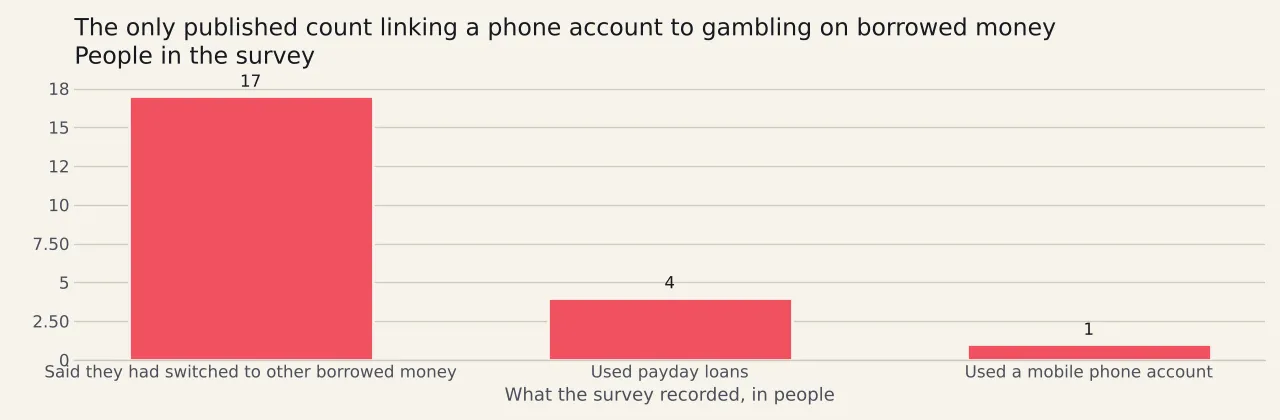
Credit cards themselves were closed off to a British licensee by licence condition 6.1.2 on 14 April 2020, and the detail of that sits on credit card casino. A phone bill and a credit card are different things, and the rule names only the card. The point is narrower and it is about timing: on a contract, the money for a deposit is spent before it is paid.
A bar is available on every network and it is not a spend cap. One network takes a text message to block online purchases and a second text to lift it, and says in terms that a spend cap leaves these charges untouched. Another offers either a bar on all charges or a spend manager that does not reach every type of purchase. None of those tools carries a published cooling-off period, unlike a card block at a bank.
07
What one full phone charge buys, worked through twice
One charge at the statutory ceiling, one stage of one package, and the same credit priced on both sets of terms.
A £40 charge, from deposit to staking bill
- Largest charge the route carries in one go £40.00
- Credit from the 150 per cent stage of the package £40.00 × 1.5 = £60.00
- Staking required before any of it is withdrawable £60.00 × 40 = £2,400.00
- Expected house share at a payback of 96 per cent £2,400.00 × 0.04 = £96.00
- Expected cost for each pound of that credit £96.00 ÷ £60.00 = £1.60
- The very same £60.00 under a ceiling of ten £600.00 × 0.04 = £24.00
- A pound of credit, here and then under a licence £1.60 beside £0.40
The phone charge itself adds nothing to the sum, since the network bills the £40 and no more. What the sum leaves out is on the operator’s side: no figure is put in public for the maximum win, for how long the credit lasts, or for the largest bet allowed while it is live. A term nobody publishes cannot be costed before the event, and saying so is the honest answer rather than an estimate. The payback of 96 per cent is an average across many plays and describes no single session.
08
Eight questions about paying from a phone bill
- How much can one phone-bill deposit carry?
- £40, and the figure is set by law rather than by a casino. It comes from an exclusion the Payment Services Regulations 2017 make for electronic communications, which also caps a subscriber’s charges at £240 inside a month. Britain’s four mobile networks print the same pair of numbers on their own help pages.
- What does a £40 deposit buy at offers of this kind?
- £60.00 of credit at the 150 per cent stage of the three-stage package, and £2,400.00 of required staking with it. Expected cost of that staking is £96.00 on a 96 per cent payback, more than the credit is worth. The same £60.00 under a British licence would carry £600.00 of staking and an expected cost of £24.00.
- How many deposits does the monthly ceiling allow?
- Six at most, because £240 divided by £40 is six. It is a maximum and not an allowance, since the monthly figure is shared with other charges. One network calls its £240 a single limit covering every premium-rate service, and another counts subscriptions, texts at premium rate, purchases made inside an app and calls to the 09, 118 and 087 ranges within the same total.
- Can winnings be paid back to the phone bill?
- No. The route is one way, so a payout has to leave by bank account, by wallet or by debit card. That makes the deposit rail and the payout rail different things, and any comparison of payout speed belongs to the second of them.
- Is a phone-bill deposit a form of borrowing?
- On a contract bill it is money spent before it is paid. The Gambling Commission’s evaluation of the credit card ban, which appeared on 2 November 2021, puts a mobile phone account among the shapes borrowing takes. In that survey 17 people reported switching to some other borrowed money, with payday loans behind four and a mobile phone account behind one, and the survey was small.
- Does the credit card ban cover a phone bill?
- It does not name one. Credit cards were closed to a British licensee on 14 April 2020, by licence condition 6.1.2, and that rule is about cards. The timing point about a contract bill is separate, and it stands whether or not any rule names it.
- How is a phone charge blocked?
- Every network offers a bar, and a spend cap is not one. One network blocks online purchases when a customer texts a keyword to a short number, and lifts the block on a further text, saying in terms that a spend cap leaves these charges untouched. Another offers a bar on everything, or a spend manager that does not reach every type of purchase.
- What does a British licence add that an offshore cashier does not have?
- Bonus wagering capped at ten, a rule running from 19 January 2026, which would cut the left-hand column of this price line from £1.60 to £0.40. It adds a light-touch financial check where net deposits in a month exceed £150, membership of Gamstop Online, and a complaint that has to be answered inside eight weeks with a route onward to an independent dispute entity.