
Printed 2026 · figures read October 2026
Crypto casino deposits buy a £30 bonus and a £48.00 staking bill
What it costs to play off the bonus a £20 coin deposit buys. The stage credits 150 per cent, so £30 arrives; the terms ask 40 times that in turnover; and a payback of 96 per cent leaves four pence of every turned-over pound with the house. Source: what packages of this kind publish, read October 2026, with arithmetic done on this page.
Coin at the cashier, and the terms that come with each offer
Every link in this rack is a paid placement, and this site is owed a fee when a reader opens an account through one.
Betportal
Lowest wagering
Licence Licensed in Anjouan, Comoros, no Great Britain licence, run by BetPortal Gaming Ltd and Excite Ultra Media Ltd, reference ALSI-202601040-FI2.
WinBeast
Free bet included
Licence Licensed in Curaçao, no Great Britain licence, operator not named on the site.
EliteSpin
New for 2026
Licence Licensed in Costa Rica, no Great Britain licence, run by PrimeTier Limited, opened 2026.
Crown Jewelz
200% first deposit
Licence Licensed in Curaçao, number not verified, no Great Britain licence, operator not named on the site.
Scroll the rack sideways to reach the other columns. The label column stays put.
Not one of the offers printed above holds a Great Britain licence. Outside that licence a British player has none of its protection: Gamstop Online cannot shut the door, the ten-times limit on bonus wagering does not bind the operator, and no British complaints body will take up a dispute. You must be 18 or over to open an account anywhere in this rack.
Every figure in the rack is a term the operator itself publishes, read on 14 October 2026. The operator's terms in full are the ones that bind you.
A coin deposit, priced per pound of bonus
| What these offers ask | Under a British licence | |
|---|---|---|
| You put in | £20.00 | Not in coin |
| Handed over | £30.00 | Not in coin |
| Wagering | 40x | Not in coin |
| Cost per £1 kept | £1.60 | No licensed site offers it |
The right-hand column carries no figure because there is nothing on the licensed side to price. Coin is not a payment option at any site licensed for Great Britain, so the same deposit cannot be made there at any multiple. That is an observation about the market and not a prohibition: the regulator’s own guidance covering digital and virtual currencies, dated 5 July 2021 and showing no change since, sets a test a licensee would have to pass rather than a door it may not open. The left-hand column is the middle stage of a package running over three deposits, of the sort this market carries, matching at 150 per cent, taken at its £20 minimum, with a multiple of 40 reported rather than published and a payback of 96 per cent assumed.
01
Twenty pounds of coin buys thirty pounds of bonus and £1,200 of staking
£30.00 of credit is what £20.00 opens at the middle stage of a three-deposit package of that sort, which matches at 150 per cent. Turnover of 40 times the credit follows it, so £1,200.00 has to be staked before anything can leave, and the house share is four pence in each staked pound where the payback is 96 per cent. £48.00 is the expected bill. The credit it chases is £30.00.
Offers of this kind list a route in coin, and they hold no Great Britain licence. Those two facts are related, and the relationship is what this page is for: coin in a cashier is strong evidence about the licence, because the licensed side does not run the method at all.
Figures are therefore absent from the price line’s second column, and deliberately so. There is no British version of this deposit to compare the left-hand column against. What a reader loses is not a worse price on the same thing. It is the whole apparatus a licence carries, and that is set out in part 04.
02
The guidance sets a test and nobody on the licensed side has shown it passed
5 July 2021 is the date on the regulator’s own guidance covering digital and virtual currencies, and the update log on it shows no change since. It addresses a licensee minded to take a digital currency as the means of payment, whether from a customer directly or through a payment processor. Satisfying itself is not enough: the regulator has to be satisfied too, on two points, that its obligations against money laundering can be met, and that it is acting in a socially responsible way.
That is a test. It is not a permission and it is not a bar. What follows from it, in the market rather than in the rule book, is that coin is not a payment option at sites licensed for Great Britain. Both halves of that sentence matter, and anybody writing that British sites are forbidden to take coins has merged them into something the source does not say.
A real prohibition reads differently, and the credit card is the comparison. There the rule carries a number and a date: licence condition 6.1.2, effective 14 April 2020, under which payment for gambling must not be taken on a credit card. Its reach takes in a credit card payment that travels through a money service business on the way, and it was read wider in that direction rather than narrower. One of these is a shut door. The other is a door nobody has walked through. The card rule is worked out in full on credit card casino.
03
A coin route is usual here, and the named coins are a short list
A route in coin is usual on offers of this kind. Some name the coins they take and some print the word and leave it at that. Where they are named, Tether turns up most often, Bitcoin and Ethereum are close behind, and Litecoin and Solana appear as well.
| What is listed | How widely carried | What it indicates about the licence | At a British-licensed cashier |
|---|---|---|---|
| A coin route of any kind | Usual | A strong signal | None |
| Tether | The commonest named | A strong signal | None |
| Bitcoin | Common | A strong signal | None |
| Ethereum | Common | A strong signal | None |
| Apple Pay | Close to universal | Nothing either way | Not barred |
| PayPal | Not carried | Nothing either way | Approved sellers only |
Read the last two rows against the first four. One wallet’s own policy permits a gambling payment only where the seller is an approved one and gambling is lawful in that jurisdiction, and a cashier here does not list it. Coin is the route the licensed side does not run at all, and a cashier here carries it. A cashier screen is therefore a reasonable first indication of which side of the licence a site sits on, and the coin logo is the clearest signal on it. Those wallet routes have prices of their own, set out on Skrill, Neteller and Trustly casino; the phone wallet sits on Apple Pay casino.
04
Twelve duties stop where the licence stops
Every line below is something the British operating licence requires. Strip the licence away and none of it survives, which is what the blank side in the price line actually stands for, rather than any opinion about a particular operator.
- Wagering. A licensee may not demand play-through above ten times the bonus, a rule running from 19 January 2026. Packages of this kind ask 35 and 40.
- Stakes and speed. One slot spin may not take above £5 from a customer of 25 or over, and the ceiling drops to £2 for anybody aged 18 to 24. A slot cycle may not begin inside 2.5 seconds of the one before it, and 5 seconds applies on other casino games. Autoplay is out.
- Withdrawals. A request once made may not be offered back for cancellation, and no clause may cap what comes out of a deposit balance.
- Complaints. Eight weeks from first receipt to the end of the process, then a route to an independent dispute entity. At least six months to bring one.
- Identity. Identity proved before play, the minimum being date of birth, name and address, on a rule that has run since 7 May 2019.
- Self-exclusion. Every online company licensed in Great Britain belongs to Gamstop Online, so the scheme reaches exactly as far as the licence and no further.
The self-exclusion line repays reading twice. The scheme’s terms say what it can do, which is exclude a person from the operators taking part, and what it cannot, which is prevent access to gambling run by organisations outside it. Anybody who has registered should read that as the measure of what the registration achieved. The helpline at the foot of this page answers at any hour.
One more thing proves nothing on its own, and that is a game a reader recognises. The industry was warned on 20 January 2025 that titles from licensed suppliers were appearing on unlicensed sites reachable from here, frequently where a reseller had broken a contract to put them there. A settlement followed: £4.75m, agreed by Evolution Malta Holding Limited on 23 July 2026, once six unlicensed websites open to consumers in Great Britain were found running its games through two operators it dealt with.
05
Three chains keep three clocks and none of them is enforceable
Three chains, three different clocks. A Bitcoin block lands on average every ten minutes, at spacings nobody can predict, and six of them is the usual bar before a payment is treated as done. Ethereum counts in slots of 12 seconds, 32 to an epoch, which the documentation puts at 6.4 minutes, with a checkpoint opening each one. TRON is quicker again, at roughly three seconds to a block.
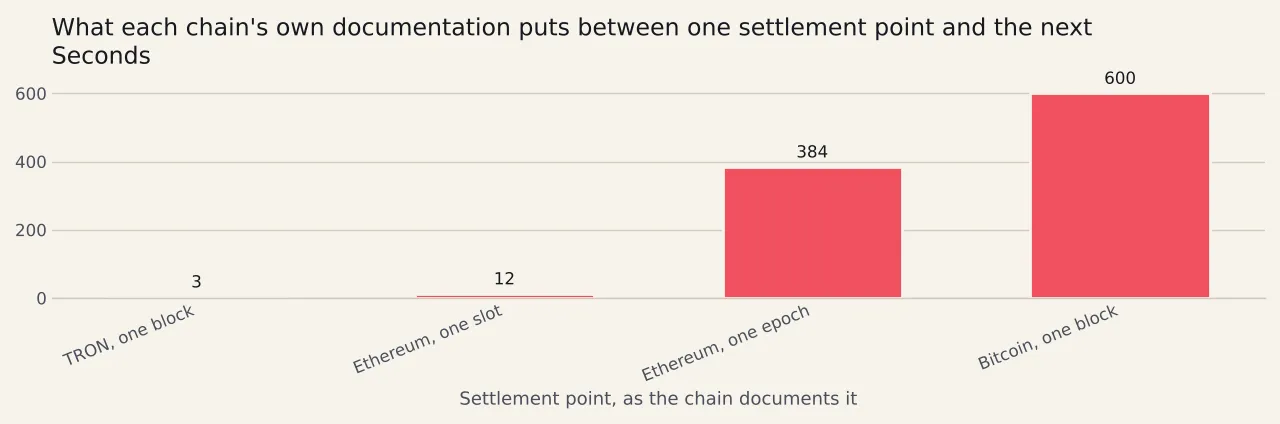
Two properties belong to the sending rather than to the waiting. What a network charges moves with how busy it is, so the cost of a deposit cannot be read off anything before it is made. And a payment cannot be reversed. There is no chargeback here at any price, while on the card rail a chargeback is ordinary enough that one wallet prints a figure for it at GBP 25.
Set those against the sterling rails, which publish clocks that somebody is answerable for. Faster Payments usually puts money there almost at once, with a tail running to two hours and longer outside working hours. Visa Direct fast funds binds a supporting issuer to make money available inside 30 minutes of approving the transaction. Chain intervals describe behaviour. Those two are commitments, and the difference is the subject of fast withdrawal casinos.
06
The money is unregulated before it reaches any cashier, and the coins may be taxable
Most cryptoassets are unregulated in the United Kingdom and no compensation scheme stands behind them. The Financial Conduct Authority states it plainly: buying cryptoassets stays high-risk, and anyone buying them should be ready to lose the whole lot. That is about holding the asset, before any question of where it gets spent.
- 8 October 2023. The marketing rules took effect. Risk warnings must be prominent, a first-time investor is given a day to reconsider, and bonuses for referring a friend stopped.
- 25 October 2027. The expected start of the regime bringing cryptoasset activities inside the Authority’s remit, under 2025 regulations extending the Financial Services and Markets Act 2000. A firm doing any of the newly regulated things will have to be authorised.
- Until then. A balance in coins sits outside the regime covering a sterling payment, and on that timetable it stays outside for another year.
Tax splits in two. On the gambling side, His Majesty’s Revenue and Customs puts it that winnings from betting and gambling go untaxed in this country, and that position covers a win taken in coin. On the coins themselves the answer runs the other way. The Cryptoassets Manual at CRYPTO22100 counts four things as disposals when capital gains are worked out. Tokens sold for money. Tokens exchanged for another kind of token. Tokens handed over in payment for something. Tokens given away, unless the person receiving them is a spouse or a civil partner. Nowhere in the manual is a casino deposit named, so the most that can honestly be said is that using or exchanging coins may produce a taxable gain, depending on the facts.
07
What a coin deposit buys, worked through, with nothing to set beside it
One package, one stage of it, one multiple and one payback. The licensed side stays blank, and the reason sits under the sum.
A £20 coin deposit, from credit to staking bill
- Value sent in coin, at the package’s smallest stage £20.00
- Credit the middle stage adds, a match of 150 per cent of the deposit £20.00 × 1.5 = £30.00
- Turnover owed before anything may leave £30.00 × 40 = £1,200.00
- House share of it, four pence in each pound £1,200.00 × 0.04 = £48.00
- Expected cost of a single pound of that credit £48.00 ÷ £30.00 = £1.60
- The same deposit at a site licensed in Great Britain No such deposit exists
- A pound of this bonus, against its licensed equivalent £1.60 against nothing to compare
The sixth line is the finding, not an omission. Coin is not offered at any site licensed for Great Britain, so no British figure can be set beside the £1.60 without inventing one. The network fee is left out for the same reason: it tracks demand and is unknowable until the moment of sending. Also absent are this package’s maximum win, its expiry and its largest permitted bet, none of which it publishes, and any exchange-rate movement between sending the coin and taking something back. A payback of 96 per cent is a long-run average and tells a reader nothing about one evening.
08
Nine questions about paying a casino in coin
- Is a UK-licensed casino banned from taking cryptocurrency?
- That wording gets it wrong twice over, and the answer is no. The guidance dated 5 July 2021 sets a test rather than a bar: a licensee minded to take a digital currency has to satisfy itself, and the regulator as well, on two points, meeting its obligations against money laundering and acting in a socially responsible way. What is true is that coin is not a payment option at sites licensed for Great Britain, which describes the market rather than any rule.
- What does a coin logo in a cashier actually tell me?
- That a Great Britain licence very probably does not stand behind the site, because the licensed side does not run the method. A cashier of this kind lists a coin route and is not licensed here. The settled way to check is the public register. A licensed site displays its status, carries a link out to that register, and what the register holds matches what the site says.
- What does an offer of this kind cost if I pay in coin?
- £48.00 in expected losses. A £20 deposit at the middle stage credits £30.00, the terms ask 40 times that credit, so £1,200.00 has to be staked, and a payback of 96 per cent keeps four pence from every pound of it. That is £1.60 for each £1 of credit. The coin route adds no figure to it that can be known in advance.
- Why is the right-hand side of this price line empty?
- Because there is nothing on the licensed side to price. A British site does not take coin, so the same deposit cannot be made there at ten times or at any other multiple. Printing a number there would mean inventing an offer that does not exist, and the absence is the comparison worth having.
- What is the wait on a coin deposit?
- The chain decides, and no figure any of them publishes is enforceable. A Bitcoin block lands on average every ten minutes at unpredictable spacings, with six of them the usual bar. Ethereum runs slots of 12 seconds, 32 to an epoch, which the documentation puts at 6.4 minutes. TRON manages a block in roughly three seconds. A card issuer supporting fast funds, by contrast, is held to half an hour.
- Can a coin payment be reversed?
- No. A payment on these networks cannot be undone, so no chargeback exists at any price. On the card rail a chargeback is ordinary enough that one wallet publishes a flat charge of GBP 25 for one. That is a difference in what the rail can do, not a difference in what any casino promises.
- Does a compensation scheme cover coins?
- No. Most cryptoassets are unregulated in the United Kingdom and none of them sits behind a compensation scheme. The Financial Conduct Authority says buying cryptoassets stays high-risk and that a buyer should be prepared to lose the whole amount. Cryptoasset activities are expected to come inside its remit from 25 October 2027.
- Is a win paid in coin taxable?
- The winnings are not. His Majesty’s Revenue and Customs puts it that winnings from betting and gambling go untaxed in this country, and that holds for a win taken in coin. The coins are a separate question: the capital gains guidance lists four kinds of disposal, and handing tokens over in payment for something is one of them, so using or exchanging coins may produce a taxable gain, depending on the facts.
- Does the self-exclusion scheme reach a site that takes coin?
- Only if that site holds a British online licence, because membership is defined by the licence rather than by the payment method. The scheme’s terms say it can exclude a person from the operators taking part, and that gambling run by organisations outside it is beyond what it can prevent. No cashier of this kind takes part.