
Printed 2026 · figures read October 2026
Fast withdrawal casinos still put £400 of staking in front of the button
The expected cost of reaching the withdrawal button on the smallest bonus this market offers. Twenty pounds in, ten pounds of credit, forty times that credit to be staked first, and four pence of every staked pound gone once the payback is 96 per cent. Source: the terms attached to small bonuses here at October 2026, priced in part 07.
What stands between a deposit here and a payout, package by package
Every link in this rack is a paid placement, and this site is owed a fee when a reader opens an account through one.
Betportal
Lowest wagering
Licence Licensed in Anjouan, Comoros, no Great Britain licence, run by BetPortal Gaming Ltd and Excite Ultra Media Ltd, reference ALSI-202601040-FI2.
WinBeast
Free bet included
Licence Licensed in Curaçao, no Great Britain licence, operator not named on the site.
EliteSpin
New for 2026
Licence Licensed in Costa Rica, no Great Britain licence, run by PrimeTier Limited, opened 2026.
Crown Jewelz
200% first deposit
Licence Licensed in Curaçao, number not verified, no Great Britain licence, operator not named on the site.
Scroll the rack sideways to reach the other columns. The label column stays put.
Not one of the offers printed above holds a Great Britain licence. Outside that licence a British player has none of its protection: Gamstop Online cannot shut the door, the ten-times limit on bonus wagering does not bind the operator, and no British complaints body will take up a dispute. You must be 18 or over to open an account anywhere in this rack.
Every figure in the rack is a term the operator itself publishes, read on 14 October 2026. The operator's terms in full are the ones that bind you.
The wait at the exit, priced per pound of bonus
| What these offers ask | Under a British licence | |
|---|---|---|
| You put in | £20.00 | £20.00 |
| Handed over | £10.00 | £10.00 |
| Wagering | 40x | 10x |
| Cost per £1 kept | £1.60 | £0.40 |
Speed is measured after a withdrawal has been requested, and a bonus decides when it can be requested at all. The left-hand column takes the thinnest match this market runs, 50 per cent at a £20 stage, with 40 times the credit to be staked and the same multiple on anything free spins win. The right-hand column holds the identical £10 to the multiple a British licence allows. A 96 per cent payback sits behind both figures and both are averages across many plays. Conversion on the left is capped at five times the credit and seven days are given to finish, so the left-hand column also runs against a clock the right-hand column does not have.
01
Four hundred pounds of staking comes before any payout, and it costs £16.00
£400.00 has to be staked before a penny of the smallest bonus here can be asked for. The credit is £10.00, on a £20.00 stake at a match of 50 per cent, and the multiple attached is 40. Four pence leaves every staked pound once the payback is 96 per cent, so the expected cost of getting to the button is £16.00, which is more than the credit.
That is the first thing a page about speed owes a reader. Every published clock in this section starts when a withdrawal has been requested. Nothing measures the time spent earning the right to request one, and on these terms that time is the expensive part.
A licence from the Gambling Commission is held by none of these cashiers. Ten times the credit is what a British licensee has been held to from 19 January 2026, which turns the same £10.00 into £100.00 of staking and £4.00 of expected cost. The clocks that follow belong to the licensed side, and terms of this kind do not inherit them.
02
Three things at the exit carry a clock or a rule, and the longest step has neither
Three, and no more. The payment rail is the first, and it has two published figures of its own. The duty to keep the exit as frictionless as the operator can manage is the second, under the technical standard governing product design. The third is the bar on asking, at the exit, for information the operator could reasonably have sought earlier.
What carries nothing at all is the approval step the operator runs itself, standing in front of all three. No rule puts a time limit on it. That is the single most useful fact on this page, because it is the step a reader is actually waiting on when a payout feels slow.
On the rail, two figures exist and both belong to payment systems rather than to any casino. Money sent over the bank rail is usually available almost straight away, and the published position allows for up to two hours, with more time again once the working day has closed. On the card rail, an issuer supporting the fast funds service gets half an hour after approving a transaction, and no longer, to put the money within reach, with the receiving bank still deciding when it actually lands. Figures from a published case study on that service: it carried 40.6 per cent of one operator’s withdrawals, moved £398m in real time, and reached more than 360,000 customers.
03
One figure covers the whole request, and it is industry data rather than a rule
Ninety-nine in every hundred requests are approved, processed and then paid, all of it inside 24 to 48 hours. That went up on the regulator’s blog on 17 July 2023, drawn from figures several of the biggest gambling companies supplied. It is the strongest withdrawal figure available anywhere and the honest basis for any claim about speed. It is also an average across the licensed market, not a promise from one site, and nothing like it is published on the offshore side.
Set against that window, the clocked part is small. Two hours out of 24 is the longest figure any payment system publishes, and the shorter published figure of 30 minutes would make the clocked slice smaller still. The rest of the window belongs to the approval step nobody times.
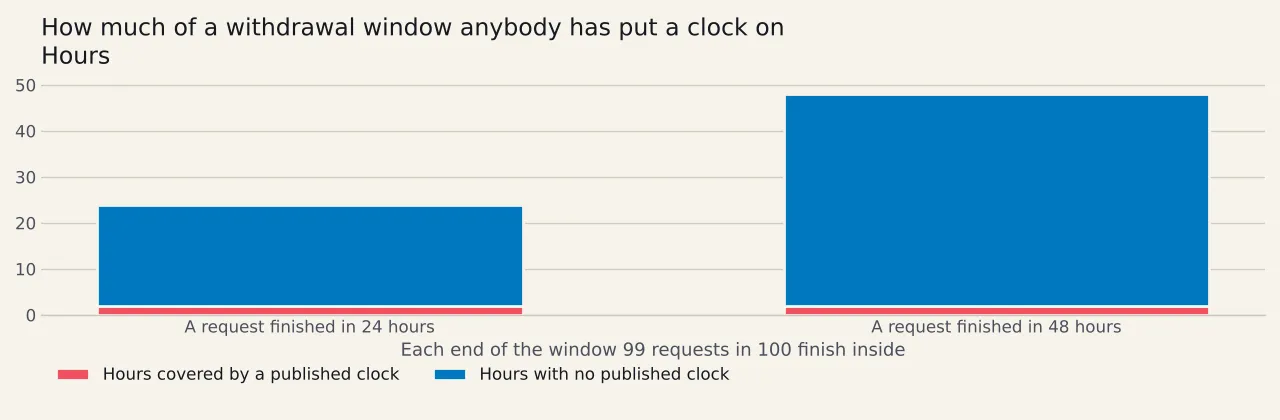
Withdrawal trouble is also the biggest single subject at the regulator’s contact centre, a line that takes more than 6,000 calls each year. That is a measure of how often the step with no clock on it is the step that goes wrong.
04
Four things a British licensee may not do at the exit
Each line below is a prohibition rather than a target, and each one is owed by the holder of a British licence and by nobody else.
| What is forbidden to a British licensee | The exception, where there is one | Owed by offers of this kind |
|---|---|---|
| Offering a customer the chance to cancel a request already made | None | Nothing |
| Adding friction at the exit that the deposit did not carry | None | Nothing |
| Letting harm-risk information delay the payout | Depositing and gambling may be affected; withdrawing may not | Nothing |
| Holding a payout back while checks run | Permitted on rare occasions, to avoid receiving the proceeds of crime | Nothing |
| Capping what comes out of a deposit balance | None; a cap on bonus winnings is a separate and lawful thing | Nothing |
| Charging more than a withdrawal costs to process | A cost-reflective fee is allowed if disclosed before the deposit | Nothing |
The right-hand column is the point of the table. Those are duties attached to a licence, so a site without one is under none of them, and the price of that is printed at the top of this page as 40 against 10.
05
A charge at the exit has a ceiling, and emptying a deposit balance has none
£0.00 is what a British licensee may charge where a withdrawal empties a deposit balance in full. Where a fee is charged at all it may not exceed what processing actually costs, it has to be disclosed before the deposit rather than discovered afterwards, and any ceiling on how large or how numerous withdrawals may be has to be reasonable.
Separately, a term that caps what a customer may draw from a deposit balance is not allowed at all. One illustration the regulator gives of a term it would strike out allows a day’s withdrawal of £50 and a week’s of £500. A player is entitled to take money out of that balance, winnings included, whenever they choose, and has to be told so.
A ceiling on bonus winnings is a different object and is lawful. Packages of this kind commonly stop conversion at five times the bonus. Some limit instead what a batch of free spins can win, to EUR 100. Some print no ceiling anywhere at all. On the £10.00 credit in the price line, a five-times cap means nothing above £50.00 survives however the staking goes, which is a limit on the answer rather than a cost inside it.
06
An identity request at the exit is usually a failure of timing
Documents before a first withdrawal are asked for right across this part of the market. At a British-licensed site that would be the wrong moment, and the rules say so in several places at once.
- The duty comes first. Age and identity get verified ahead of any gambling, under a rule live from 7 May 2019, with name, address and date of birth as the minimum.
- It is often invisible. A business may match details against databases such as credit reference agencies and the electoral roll, and ask for documents only where that is not enough, which is why a site can feel as though it asked for nothing.
- Asking late is a breach risk. A business may not make proof of age and identity a condition of withdrawal where it could have asked sooner, and a withdrawal held up for want of that information may put the operator in breach of the licence condition covering customer identity verification.
- Anti-money-laundering material too. Where extra information is needed for those checks it should be requested promptly and not only when a customer wants their money.
The regulator has also told operators the other half of this, which is worth stating for fairness: demanding documents from every customer before any withdrawal regardless of risk could itself be disproportionate and unfair. The balance it asks for is checks driven by each customer’s risk and carried out as the relationship develops.
Nothing in that paragraph is advice about avoiding a check, and this page gives none. An identity request is answered rather than worked around, and the routes that reach a cashier are priced on Skrill, Neteller and Trustly casino, MuchBetter casino and pay by phone casino, the last of which cannot carry a payout back at all.
07
What reaching the button costs, worked through both ways
The thinnest match in this market, run once on its own terms and once at the ceiling a British licence imposes.
Cost of reaching the withdrawal button
- Stake at the smallest the package accepts £20.00
- Credit at the thinnest match, half the stake £20.00 × 0.5 = £10.00
- Staking standing in front of any request £10.00 × 40 = £400.00
- Lost on the way through, four pence the pound £400.00 × 0.04 = £16.00
- Cost of each pound of credit on these terms £16.00 ÷ £10.00 = £1.60
- The identical credit where ten is the ceiling £100.00 × 0.04 = £4.00
- Per pound of credit: these terms, then a licence £1.60 then £0.40
Both figures are the cost of qualifying to ask, not the cost of the payout. Once a request is made the dearest published charge is nothing, since emptying a deposit balance in full cannot be charged for at a British-licensed site. The sum leaves out a cap of five times the credit on conversion, which puts £50.00 as the most this exercise can produce; seven days to finish, which is £400.00 of staking inside a week; and a game counting for less than its stake, which lifts the real staking while 40 stays printed. Behind it sits a payback of 96 per cent, a figure that holds only over the long run.
08
Eight questions about speed at the exit
- What is the strongest published figure for withdrawal speed?
- Ninety-nine in a hundred requests approved, processed and then paid, all inside 24 to 48 hours. It went up on the regulator’s blog on 17 July 2023, resting on figures that several of the biggest gambling companies had supplied. It is an average across the licensed market rather than a promise from any one site, and no equivalent figure is published on the offshore side.
- Which parts of a withdrawal actually carry a clock?
- Three things, and the longest step is not among them. The payment rail publishes two figures of its own. There is a duty to keep the exit as frictionless as the operator can manage. And there is a bar on asking at the exit for information that could reasonably have been sought earlier. No published figure puts a limit on the approval step the operator runs itself.
- How fast are the payment rails themselves?
- Money sent over the bank rail is usually available almost straight away, though the published position allows up to two hours, and more again once the working day has closed. On the card rail an issuer supporting the fast funds service must have money there no more than 30 minutes after approving the transaction, with the receiving bank still deciding when it lands.
- Does a fast payout mean the bonus was cheap?
- No, and the two figures do not touch. Speed is measured after a request is made, while the bonus decides when a request can be made at all. On the thinnest match in this market, £400.00 has to be staked first, at an expected cost of £16.00 against £10.00 of credit. Under a British licence the same credit would need £100.00 of staking and cost £4.00.
- Can a casino charge for a withdrawal?
- A British licensee may not charge anything for emptying a deposit balance in full. Where a fee applies at all it cannot exceed what processing actually costs, it has to be disclosed before the deposit rather than afterwards, while a cap on withdrawal size or count must be reasonable. None of those duties reaches a site without the licence.
- Can a withdrawal be cancelled and put back into play?
- Not at a British-licensed site. A customer must not be given the option to cancel a request already made, and must not then be invited to put those funds back on deposit. There is no exception written into that rule, and it is one of the duties a cashier of this kind does not carry.
- Why does an identity check appear at the exit?
- Usually because it was left too late. Offers of this kind ask for documents ahead of a first withdrawal. A British licensee settles age and identity before play begins, under a rule live from 7 May 2019, and cannot make proof a condition of withdrawing where it could have asked sooner; a hold-up for want of that information may put it in breach of the licence condition covering customer identity verification.
- Is a delayed payout ever allowed?
- Just one exception is published. An operator may, on rare occasions, keep a payout back while checks run to make sure what it is receiving is not the proceeds of crime. Information gathered to identify a risk of gambling harm is different: it may affect depositing and gambling, and it must not stop a withdrawal.