
Printed 2026 · figures read October 2026
Non GamStop Paysafe casinos, and the £80.00 that £100 of vouchers costs to clear
Expected cost of clearing the credit £100 of cash codes collects on a five-stage ladder, priced at the bottom of a published match range. £50 of credit at forty times is £2,000 of stakes, and 4 per cent of any counter is expected to be lost on a 96 per cent game.
Which cashiers take a cash code, and what each wants for it
Every link in this rack is a paid placement, and this site is owed a fee when a reader opens an account through one.
Betportal
Lowest wagering
Licence Licensed in Anjouan, Comoros, no Great Britain licence, run by BetPortal Gaming Ltd and Excite Ultra Media Ltd, reference ALSI-202601040-FI2.
WinBeast
Free bet included
Licence Licensed in Curaçao, no Great Britain licence, operator not named on the site.
EliteSpin
New for 2026
Licence Licensed in Costa Rica, no Great Britain licence, run by PrimeTier Limited, opened 2026.
Crown Jewelz
200% first deposit
Licence Licensed in Curaçao, number not verified, no Great Britain licence, operator not named on the site.
Scroll the rack sideways to reach the other columns. The label column stays put.
Not one of the offers printed above holds a Great Britain licence. Outside that licence a British player has none of its protection: Gamstop Online cannot shut the door, the ten-times limit on bonus wagering does not bind the operator, and no British complaints body will take up a dispute. You must be 18 or over to open an account anywhere in this rack.
Every figure in the rack is a term the operator itself publishes, read on 14 October 2026. The operator's terms in full are the ones that bind you.
Cash codes against the ladder, per pound of credit
| What these offers ask | Under a British licence | |
|---|---|---|
| You put in | £100.00 | £100.00 |
| Handed over | £50.00 | £50.00 |
| Wagering | 40x | 10x |
| Cost per £1 kept | Nothing lasts | £0.67 |
Five deposits of £20 are what a ladder of this length runs to, and the matches on one are published as a range of 50 to 100 per cent rather than as five figures, so £100 of cash codes collects between £50 and £100 of credit. The left-hand column takes the bottom of that range, because a page should not price an offer at its most flattering reading. Both columns then assume a 96 per cent return, each round counted whole, and the counter met inside the seven days such a package usually allows. £2,000 of stakes is expected to cost £80.00, which is £30.00 past the credit, so nothing is expected to last and no pound can be priced. At the licensed ten the same £50 asks £500 of stakes, costs £20.00 and leaves £30.00 behind, so a kept pound costs 67p. Only a Great Britain licence produces that ten, and a cashier of this kind has none. A voucher is a way of handing over £100 in cash and appears in neither column, because it moves no figure in either.
01
Some cashiers take a cash code, and three payments are needed for £100
Some cashiers of this kind publish the voucher and some do not, which is how the named money wallets go as well. The bank-login route is a little commoner. Cards, the phone wallets, transfers and coins appear at all of them.
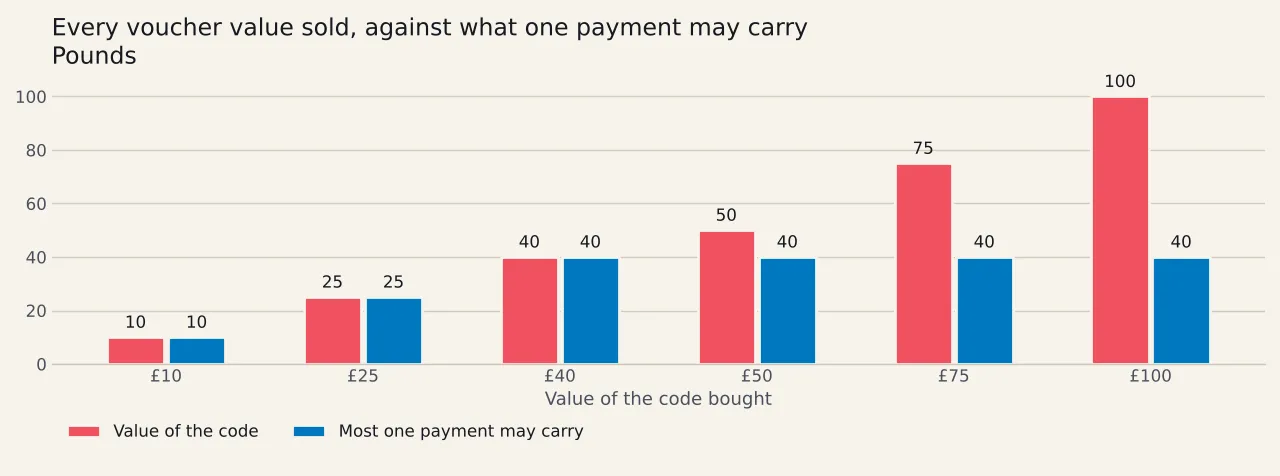
£40 is the ceiling on a single payment made with these codes, whatever a code is worth. £100 of credit on a code therefore cannot move in one go: it takes three payments, two of £40 and one of £20. Several codes may be put into one payment, so the ceiling binds the payment rather than the shopping.
£20 is the deposit floor a cashier of this kind usually sets, so each £20 arriving opens one stage of a ladder. £100 of codes funds five of them, which is exactly the length of the longest spin package these offers run to.
The other routes have guides of their own: non GamStop PayPal casinos for the wallet none of them publishes, non GamStop pay by phone casinos for a charge to the bill, and non GamStop casinos with £5 deposit for what the cheapest way in actually costs. The section index is at outside the licence.
02
A code of £100 and a payment of £40 do not fit together
Six values of code are sold for cash, from £10 at the bottom to £100 at the top. The payment ceiling sits at £40, which means the three largest values can only be spent in instalments.
| Code bought for cash | Payments to spend it | Stages of £20 it opens | Left stranded |
|---|---|---|---|
| £10 | 1 | 0 | £10.00 |
| £25 | 1 | 1 | £5.00 |
| £40 | 1 | 2 | £0.00 |
| £50 | 2 | 2 | £10.00 |
| £75 | 2 | 3 | £15.00 |
| £100 | 3 | 5 | £0.00 |
The right-hand column is the one a buyer acts on. A £10 code cannot reach the floor at all, and a £25 code opens one stage and leaves £5.00 sitting behind. Only two of the six values divide cleanly into £20 stages.
What is stranded does not sit still either, and the next part takes that up. Nothing in this table changes the multiple, the window or the ceiling on the winnings, because a payment ceiling is a rule about money moving and not about what the money buys.
03
Four pounds a month is taken from any balance a code still holds
£4.00 a month is the deduction against credit still sitting on a code, and it starts in the code’s second month. Registering an account with the provider avoids it and brings three charges in its place: £5 a month after twelve months without a transaction, £6 on a refund, and payout ceilings set by tier.
Put the deduction against the stranded figures in the right-hand column and the arithmetic is unkind to small balances. £5.00 left on a £25 code loses the whole of itself inside two months. £15.00 left on a £75 code is down to £11.00 after one month and £3.00 after three.
£6.00 is the fee for a refund on the registered account, and a refund is the only way back out of a code. Against a £10 code that is 60 per cent of the money, against a £25 code 24 per cent, and against a £100 code 6 per cent. Small codes suffer at both ends: dearest to hold and dearest to undo.
The provider’s British issuer is an authorised firm with a reference number on the public financial register, and it belongs to the group that also runs two of the named money wallets. That is a fact about who holds the cash, and it carries no implication at all about the cashier a code is spent at.
04
Paying in cash changes the trail and not the counter
Nought is what the voucher takes off the £2,000 counter in the price line. A code is bought with cash in a shop, so no card and no bank statement stands behind the deposit, and that is the whole of what the pairing changes.
Two consequences follow, and they run in opposite directions. A card gambling block reads a merchant category code and declines the payment. A code bought over a shop counter is not a card payment, so a block of that kind never sees it. The provider sets its own rules about where codes may be spent, which is the only control on that side.
On the other hand the money is gone in a harder way. Cash put on a code and spent at a cashier leaves no chargeback route, no card issuer to query and no bank dispute to raise. A withdrawal cannot travel back along the route the deposit took, so the money leaves by bank, by card or into a wallet instead.
Anybody reading this page with a block or a registration already in place should read it as a reason to keep both. The controls worth having are in the care note at the foot, and the figures above are the reason this page carries no others.
05
The licensed side prices a withdrawal charge and this side does not
Three rules govern what a British licensee may charge for a withdrawal, and together they are the clearest contrast with a voucher’s own schedule. A charge may not exceed the direct cost of processing the withdrawal. Any limit on the size or number of withdrawals has to be reasonable. A cost-reflective fee has to be disclosed before the deposit, and emptying a deposit balance has to be free.
Those rules are about the cashier rather than the payment provider, so they do not reach the £4.00 deduction or the £6 refund fee, which belong to the voucher. They do reach everything the cashier itself might charge, and that is the half of the transaction these offers leave unpriced.
The withdrawal data on the licensed side is published too. Figures from some of the largest gambling companies show about 99 per cent of withdrawal requests approved, processed and paid within 24 to 48 hours. Withdrawal trouble is nonetheless the commonest complaint reaching the regulator, even against that figure.
No equivalent figure exists for a cashier outside the licence, because no British body collects one and an operator publishes what it chooses. A reader comparing routes in should notice that the route out is where the published information stops.
06
Four things a voucher cannot buy back
Each item below is attached to a Great Britain licence. A payment method cannot supply any of them, and a cashier taking codes supplies none of them either.
- A ceiling on the multiple. Ten times the credit, in force for licensees from 19 January 2026. The counter in the price line is four times that figure.
- A scheme that closes doors. Gamstop Online is compulsory for operators licensed here and reaches nobody else, which its own terms state plainly. 614,738 registrations were on its books in the figures of 16 July 2026.
- A complaint with a clock on it. Three working days for the acknowledgement, eight weeks for the whole thing, and an independent body named at the close. At least six months is allowed for raising it at all.
- A regulator that can act. An ombudsman it is not, by its own description, so individual disputes fall outside its work, and over an unlicensed operator it holds no authority of any kind. Its warning notice of 20 January 2025 lists what a player meets instead: no safeguards, possible targeting of vulnerable customers, weak controls and exposure to fraud and unfair practice.
£100 of cash codes buys five deposits and £50 of credit. It does not buy a single line of that list.
07
A hundred pounds of codes, five stages, forty times over
The cash route and the counter it reaches, set out in single lines, with the licensed answer printed beside the total.
£100 of codes, priced to the last stage
- Cash codes bought over a counter £100.00
- Payments needed at £40 apiece £40.00 + £40.00 + £20.00 = 3
- Stages opened at the £20 floor £100.00 ÷ £20.00 = 5
- Credit at the floor of the match range 5 × £10.00 = £50.00
- Counter at forty times that credit 40 × £50.00 = £2,000.00
- Expected loss across the counter £2,000.00 × 0.04 = £80.00
- Credit left when it is finished £50.00 − £80.00 = −£30.00
- The same £50 at the licensed ten £20.00 of cost on £500.00 of stakes, so £30.00 lasts
- A kept pound, priced on both sides Nothing lasts · £0.67
Step four takes the weakest reading of a published range, and at the strongest reading the credit is £100, the counter £4,000 and the expected loss £160.00, so the deficit grows rather than shrinks with the bigger match. Left out of the sum: the spin winnings a package of this kind also counts at forty times, the seven-day window, the games that count at less than face value, and the £4.00 a month any code balance loses while it waits.
08
Questions about paying a cashier in cash codes
- How many cashiers of this kind take a cash code?
- Some do and some do not, which is how the named money wallets go too. The bank-login route runs a little wider. Cards, both phone wallets, a transfer and coins are published everywhere here.
- Can a £100 code be spent in one payment?
- No. One payment may carry £40 at most, whatever the code is worth, so £100 takes three payments: two of £40 and one of £20. Codes can be combined inside a single payment, which helps a reader holding several small ones rather than one large one.
- What does a £10 code reach at these cashiers?
- Nothing. £20 is the usual deposit floor here, printed as €20 at some cashiers, so a £10 code is half a stage and opens no credit at all. Of the six values sold, only £40 and £100 divide cleanly into £20 stages.
- What does an unspent code cost to keep?
- £4.00 a month, taken from whatever credit is left on it from the second month after purchase. £5.00 stranded on a £25 code is gone inside two months. A registered account avoids that charge and carries three of its own: £5 a month after twelve months without a transaction, £6 on a refund, and payouts rationed by tier.
- Does paying in cash make the bonus cheaper?
- No. £50 of credit at forty times owes £2,000 of stakes however the deposit arrived, and that counter is expected to cost £80.00 at a 96 per cent return. A payment ceiling governs money moving; it does not touch the multiple applied after the money lands.
- Can winnings come back onto a code?
- No. A code is bought with cash and spent in one direction, so the money comes back by bank, by card or into a wallet. There is also no card issuer to query and no chargeback route behind a cash deposit, which is a loss of recourse rather than a gain in privacy.
- What would a British licensee be allowed to charge for a payout?
- No more than the direct cost of processing it, with any limit on the size or number of withdrawals kept reasonable, any cost-reflective fee disclosed before the deposit, and no charge at all on taking a whole deposit balance out. Data from large licensed operators has about 99 per cent of withdrawal requests paid within 24 to 48 hours.
- Does a cash code get past a self-exclusion?
- It does not reach one. Gamstop Online covers the operators required to join it, which is every company licensed here, and the scheme states that a firm outside it lies beyond its help. A card block reads a merchant code and will not see a cash code, which is a gap in the controls and not a feature to use.