
Printed 2026 · rates read October 2026
Non GamStop casinos with £5 deposit, and the £4.75 a fiver actually delivers
What £5 becomes on the dearest published route for putting money into a wallet, where the charge is 5 per cent. Four such loads come to £19.00, which does not reach the £20 floor these cashiers ask. Five of them deliver £23.75 for £25 of cash.
Where each cashier sets its floor, and which routes it takes
Every link in this rack is a paid placement, and this site is owed a fee when a reader opens an account through one.
Betportal
Lowest wagering
Licence Licensed in Anjouan, Comoros, no Great Britain licence, run by BetPortal Gaming Ltd and Excite Ultra Media Ltd, reference ALSI-202601040-FI2.
WinBeast
Free bet included
Licence Licensed in Curaçao, no Great Britain licence, operator not named on the site.
EliteSpin
New for 2026
Licence Licensed in Costa Rica, no Great Britain licence, run by PrimeTier Limited, opened 2026.
Crown Jewelz
200% first deposit
Licence Licensed in Curaçao, number not verified, no Great Britain licence, operator not named on the site.
Scroll the rack sideways to reach the other columns. The label column stays put.
Not one of the offers printed above holds a Great Britain licence. Outside that licence a British player has none of its protection: Gamstop Online cannot shut the door, the ten-times limit on bonus wagering does not bind the operator, and no British complaints body will take up a dispute. You must be 18 or over to open an account anywhere in this rack.
Every figure in the rack is a term the operator itself publishes, read on 14 October 2026. The operator's terms in full are the ones that bind you.
Five loads of £5, priced to the credit
| What these offers ask | Under a British licence | |
|---|---|---|
| You put in | £25.00 | £25.00 |
| Handed over | £20.00 | £20.00 |
| Wagering | 40x | 10x |
| Cost per £1 kept | Nothing remains | £0.67 |
£25 of cash is what five loads of £5 cost at the dearest published rate for adding money to a wallet, which is 5 per cent and takes £1.25 of the £25. £23.75 lands, one £20 stage opens and £3.75 waits behind. The credit takes the generous reading of a published range of 50 up to 100 per cent, which makes £20 the best case and £10 the worst. Each side is then worked on a 96 per cent return, with rounds counted in full and the counter met inside the window. Forty times brings £800 of stakes at an expected cost of £32.00, and the £1.25 of load charges lifts the outlay to £33.25 against £20 of credit, so nothing remains to be priced. Where the licence sets ten, £200 of stakes costs £8.00, £12.00 of the credit stays alive, and 67p of expected play stands behind each kept pound. None of these cashiers holds that licence, and the route in costs the same £1.25 either way.
01
A fiver reaches no cashier of this kind, and the route takes a cut of it first
£20 is the floor these cashiers ask, printed in euros by some of them, so a £5 deposit opens nothing at any of them. That is the first half of the answer and the smaller half.
£4.75 is the second half. The dearest published rate for putting money into a wallet is 5 per cent, which turns a £5 load into £4.75 before it has gone anywhere. Four loads deliver £19.00 and stop short of the floor. Five deliver £23.75 and cost £25.
£1.25 is therefore the toll on reaching a £20 stage in fivers by the most expensive route published. The cheapest route charges nothing at all, which makes the spread between routes worth more than the difference between any two deposit sizes on this page.
Neighbouring guides take the rest: non GamStop casinos UK 10 deposit prices the tenner against the same floor, non GamStop Paysafe casinos works the cash-code route, and best non GamStop casinos sets these packages in price order by their credit. The index is at outside the licence.
02
Five published rates, and the dearest is 5 per cent
Five routes into one wallet carry five published rates, and the table applies each of them to a £5 load and to the £25 of loads a £20 stage takes.
| Route in | Rate | Taken from £5 | Taken from £25 | Delivered by five loads |
|---|---|---|---|---|
| Bank transfer | 0.00% | £0.00 | £0.00 | £25.00 |
| Debit or credit card | 1.00% | £0.05 | £0.25 | £24.75 |
| Rapid bank route | 1.00% | £0.05 | £0.25 | £24.75 |
| Cash over a counter | 2.50% | £0.13 | £0.63 | £24.38 |
| Prepaid voucher | 5.00% | £0.25 | £1.25 | £23.75 |
Column four is the one to act on. £1.25 against £25 is 5 per cent of the money before a single round is played, and the free route gives the identical £20 stage for nothing.
A card is one of the cheap routes here, and one caution belongs with it. A British licensee is allowed a wallet only on an assurance that no credit-card money comes through it, under a bar that has stood at licensed British sites from 14 April 2020.
03
Twenty-five pence off a fiver, or nothing off a fiver
25p is the worst case on a single £5 load and nought is the best, and both figures come from the same published schedule. The drawing puts the five rates side by side at that size.
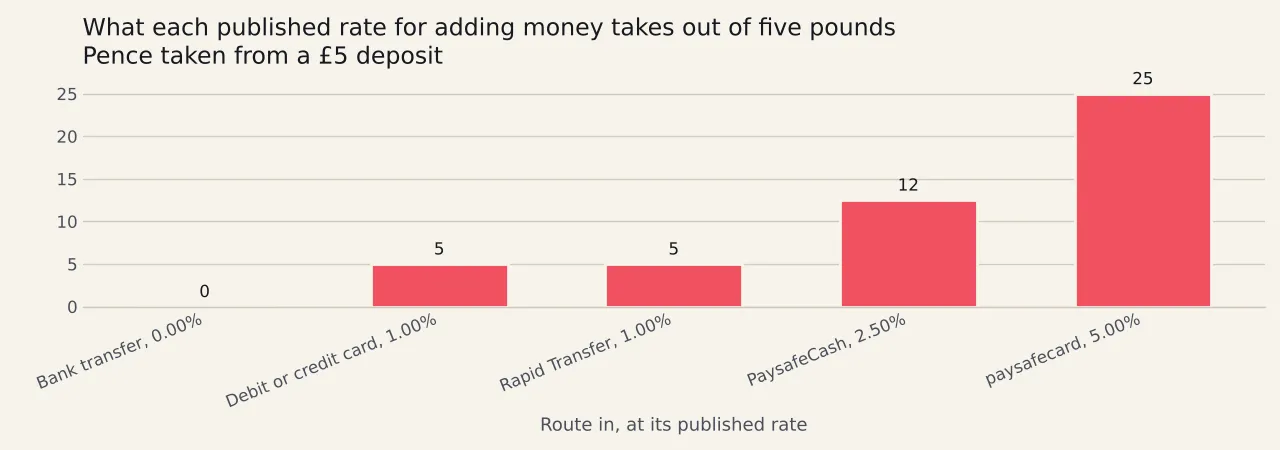
£3.75 is what waits in the wallet after the stage opens, and leaving it there is not free either. The same schedule takes EUR 5.00 a month from an account left unused for half a year, neither logged into nor transacted on, so a remainder parked and forgotten is a remainder spent.
Rates on the way out are a separate schedule again, and they carry minimums rather than percentages alone. A minimum does not shrink with the payment, which is the mechanism that makes every small movement of money dearer per pound than a large one.
04
The counter does not notice the deposit size at all
£800 of stakes is what £20 of credit owes at forty times, whether that £20 arrived in one payment or five. The multiple is applied to the credit, and the credit is a percentage of the deposit once the deposit has landed.
- One £20 payment. Credit £20, counter £800, expected cost £32.00, nothing expected to remain.
- Five £5 loads, free route. The same £20, the same £800, the same £32.00.
- Five £5 loads, dearest route. The same counter plus £1.25 of charges, so £33.25 of outlay against £20 of credit.
£1.25 is 6.25 per cent of the credit it unlocks. That is the real cost of the pairing in this search term, and it runs the opposite way to what the term implies: a small deposit habit makes a route’s percentage matter more, not less.
£3.75 of the £23.75 that lands never reaches a stage at all, because stages come in twenties. A reader who stops there has paid £25 for £20 of deposit and £20 of credit, with £1.25 gone in charges and £3.75 parked. Nine loads would fund a second stage: £45 of cash, £2.25 of charges, £42.75 landing, two stages of £20 open and £2.75 waiting.
One figure cannot be dodged by choosing a size. Twenty-five times is where the stakes are expected to cost precisely the credit, on a game returning 96 per cent. Forty times takes 60p more than each pound it handed over, and no deposit size alters that.
05
A euro floor and a sterling account meet somewhere, at a published rate
3.99 per cent is the foreign exchange charge on the wallet schedule checked here, and it matters because some of these cashiers write their floor as €20 rather than in pounds. A sterling reader meets a conversion at some point in the chain, whether the wallet does it or the cashier does.
That charge compounds with the one in part three rather than replacing it. £25 of loads at the top rate gives up £1.25, and a conversion on the remainder gives up a little more, and neither figure appears in any headline here.
Three things follow for anybody deciding in fivers.
- Pick the route by its rate, not by its speed. The spread on £25 of loads runs from nothing to £1.25 on one published schedule.
- Count the conversion. A euro floor and a sterling bank account mean an exchange somewhere, at a published percentage.
- Count the remainder. Anything left in the wallet after the stage opens carries the dormancy charge if it sits for six months.
Speed is the one thing a route can genuinely claim, and the claims have to be read as the provider’s own. One bank-login provider states deposits completing in under six seconds, more than 95 per cent of its payouts instant or inside five minutes, and a payout success rate of 99.7 per cent. Those are its figures about its own service, not a regulator’s measurement, and they say nothing about how long a cashier takes to approve anything.
None of those three argues for one cashier over another. They are reasons to know the whole outlay before the counter starts, which is what this page exists to supply.
06
Four things the cheapest route cannot buy
A free way in is worth £1.25 on this page, and that is all it is worth. The four items below come with a licence, and no payment route supplies any of them.
Wagering is held to ten times the credit at a British licensee, a ceiling dated 19 January 2026. Forty times is the figure these offers ask, and those two numbers are the whole of the gap the price line draws.
Self-exclusion comes with the same licence. Gamstop Online takes in the companies that hold one, so one registration shuts the whole licensed market, and its terms concede that it cannot shut an operator which stays outside. The register held 614,738 people when figures were last published, on 16 July 2026.
Four clocks sit on a complaint at a licensed cashier: an acknowledgement inside three working days, shortened to 24 hours at an operation that never closes, a conclusion inside eight weeks, and six months at minimum in which a customer may bring one. The closing letter must name a dispute body independent of the operator.
The regulator is the fourth. It calls itself no ombudsman, so it decides no individual dispute even over a licensee, and where no licence was ever issued it has nothing to decide with. An operator trading without a licence commits the offence, and what follows from it lands on the business.
07
Five fivers in, twenty pounds of credit, forty times over
The cheapest small-deposit path to one stage, step by step, with the licensed answer beside the total.
£25 of fivers, priced to the counter
- Loads of £5 bought at the dearest rate 5 × £5.00 = £25.00
- Charge at 5 per cent of the money added £25.00 × 0.05 = £1.25
- Money that actually lands £25.00 − £1.25 = £23.75
- Stage opened, with the remainder waiting £20.00 in, £3.75 left over
- Credit at the strong end of the match range 100 per cent of £20.00 = £20.00
- Counter set by the forty times line £20.00 at 40x = £800.00
- Expected loss over the counter 4 per cent of £800.00 = £32.00
- Outlay, play and charges together £32.00 + £1.25 = £33.25
- At a licensed ten, the same credit 4 per cent of £200.00 = £8.00, £12.00 alive
- Price of a kept pound, both sides Nothing remains · £0.67
Step five takes the generous reading of a match range printed as 50 per cent up to 100; at the middle of it the credit is £15 and the counter £600. Step two disappears entirely on the free route, which is the single cheapest decision available on this page. Not counted: the window on the bonus, the games counting below face value or not at all, whatever ceiling the terms put on the winnings, and the £3.75 left sitting in the wallet once the stage opens.
08
Questions about a five pound deposit
- Does a £5 deposit open anything at these cashiers?
- No. A cashier of this kind wants £20 before it credits anything, and some write that figure in euros. A fiver is a quarter of a stage, so five are needed before a match is struck at all.
- What does a £5 load actually deliver?
- £4.75 on the dearest published route into a wallet, where the charge is 5 per cent, and the full £5.00 on the free one. Four loads at the top rate deliver £19.00 and miss the floor. Five deliver £23.75 and cost £25.
- What is the cheapest way to reach a £20 stage?
- A bank transfer, which the schedule checked prices at nothing. A card and the rapid bank route both charge 1.00 per cent, cash over a counter 2.50 per cent, and a prepaid voucher 5.00 per cent. The spread across £25 of loads is £1.25.
- Does splitting a deposit into fivers change the wagering?
- No. £20 of credit owes £800 of stakes at forty times whether the £20 came in one payment or five, and the expected cost of that counter is £32.00 on a 96 per cent payback. Load charges are added to that figure, not taken out of it.
- What do the charges come to as a share of the credit?
- £1.25 on £20 of credit, which is 6.25 per cent of it. A small-deposit habit makes a route’s percentage matter more rather than less, and the free route removes the whole of that figure.
- What happens to money left in the wallet?
- It carries a charge if it sits still. The schedule checked takes EUR 5.00 a month from an account left unused for half a year, neither logged into nor transacted on, so the £3.75 waiting after a £20 stage opens is not free to leave there.
- Does paying a euro floor in sterling cost anything?
- It costs a conversion. Some of these cashiers print their floor in euros, and the wallet schedule checked here charges 3.99 per cent for foreign exchange. That sits on top of the load rate rather than replacing it, and neither figure reaches a headline.
- What is given up by depositing here at all?
- The ten-times ceiling, which has applied since 19 January 2026. Membership of Gamstop Online, a scheme that closes licensed sites and nothing else. A complaint with eight weeks on it and a dispute body to go to after that. And a regulator with authority, which over a company it never licensed it does not have.