
Printed 2026 · figures read October 2026
Bitcoin slots clear £40 of bonus for £64.00, before the chain takes its cut
Expected cost of serving a £40 credit at forty times, which is the multiple more of these cashiers ask, on a reel giving back ninety-six in the hundred. Whatever the chain charges to move the coin sits on top of it, and no cashier out here quotes that. Terms read October 2026.
The ranked packages, with the coins each cashier lists
Every link in this rack is a paid placement, and this site is owed a fee when a reader opens an account through one.
Betportal
Lowest wagering
Licence Licensed in Anjouan, Comoros, no Great Britain licence, run by BetPortal Gaming Ltd and Excite Ultra Media Ltd, reference ALSI-202601040-FI2.
WinBeast
Free bet included
Licence Licensed in Curaçao, no Great Britain licence, operator not named on the site.
EliteSpin
New for 2026
Licence Licensed in Costa Rica, no Great Britain licence, run by PrimeTier Limited, opened 2026.
Crown Jewelz
200% first deposit
Licence Licensed in Curaçao, number not verified, no Great Britain licence, operator not named on the site.
Scroll the rack sideways to reach the other columns. The label column stays put.
Not one of the offers printed above holds a Great Britain licence. Outside that licence a British player has none of its protection: Gamstop Online cannot shut the door, the ten-times limit on bonus wagering does not bind the operator, and no British complaints body will take up a dispute. You must be 18 or over to open an account anywhere in this rack.
Every figure in the rack is a term the operator itself publishes, read on 14 October 2026. The operator's terms in full are the ones that bind you.
A £40 credit bought with coin, priced to the pound
| What these offers ask | Under a British licence | |
|---|---|---|
| You put in | £40.00 in coin | No coin cashier |
| Handed over | £40.00 | No coin cashier |
| Wagering | 40x | Not offered |
| Cost per £1 kept | Nothing kept | No licensed equivalent |
On this one sheet the right-hand column carries words where the others carry figures, and that is the printable fact: a cashier licensed in Great Britain does not take a deposit in coin, so this purchase cannot be set beside a licensed price at all. On the left, a cashier of this kind lists at least one coin and a stage opens at the equivalent of twenty pounds, so a £40 stage matched in full is inside what most of them publish. Forty times £40.00 is £1,600 of staking, which at ninety-six in the hundred takes £64.00, and the bill therefore overtakes the credit. Nothing here counts what the chain charges to move the coin, which no cashier quotes, or the rate struck between a coin and sterling. Each figure is an average taken over many attempts.
01
Thirty pounds of bonus, and reels are the only games that move it
£40.00 is credited on a stage of forty pounds matched in full, which is inside the band most of these cashiers publish. Forty times that credit is £1,600 of staking owed before any part of it becomes withdrawable money, and the terms name the place it has to be spent.
On most offers of this kind, slots are the games that count towards wagering. Others also name slots and add that the qualifying titles differ from country to country, so a reader in Britain cannot tell from the banner which titles will count for them. Anything that is not a reel, a wheel or a card table or a bingo room, contributes nothing to the figure. Buying the bonus in coin changes none of that: the coin decides how the money arrives, and the terms decide where it goes.
At ninety-six in the hundred a reel keeps 4p of each staked pound, so £1,600 of turnover is expected to take £64.00. The credit was £40.00. A deficit of £24.00 therefore comes out of the deposit, and here the deposit arrived as coin, which adds two costs a sterling transfer does not carry.
A Great Britain licence is held by no cashier out here. Some are licensed in Anjouan, some in Costa Rica, and more of them in Curaçao. Gamstop Online binds companies on the British register and reaches no further, as the scheme’s own terms of use say in plain words: it cannot help prevent somebody reaching gambling services run by organisations that do not take part in it.
Two sheets nearby carry the rest of the argument. Online slots uk sets out the design rules a licensed reel has to obey, and mobile slots prices a session on a handset. Everything in this section stands under what you play.
02
Four charges stand between a coin and a stake, and two are unpublished
Four costs attach to funding a spin this way, and the order matters because the first two are paid before the reels turn at all.
- What the chain charges. Paid to the chain, not to the casino, and quoted in the chain’s own units rather than in pence. Some of the fee models below carry a worked example. Bitcoin carries none, its charge moving with the traffic on the network.
- The exchange. A price has to be struck between a coin and sterling twice over, once going in and once coming out, and neither leg is a published figure anywhere.
- The staking. £64.00 on the arithmetic above. Of the four charges named here, this is the one the published terms let a reader settle in advance.
- The absence of recall. A coin payment does not come back. No chargeback stands behind one, and most of the asset class sits outside the scheme that compensates for a failed regulated investment.
The published fee models are the part a reader can actually work with, so here they are at the figures their own documentation gives.
| Coin or token | How the charge is worked out | The documentation’s own example | Pace of a block |
|---|---|---|---|
| Bitcoin | Moves with the traffic on the network | No figure published | About 10 min |
| Ether | Gas used, multiplied by a base fee plus a priority fee, with the base fee burned | 0.000252 ETH | 12 sec a slot |
| TRX on TRON | Free bandwidth of up to 600 units a day, then TRX burned by the byte | 0.27 TRX | About 3 sec |
| Tether, to an address holding it | About 65,000 energy, paid from stake or by burning | About 6.85 TRX | About 3 sec |
| Tether, to an address without it | About 131,000 energy, paid the same two ways | About 13.45 TRX | About 3 sec |
The Ethereum example is the clearest of them. 21,000 is the gas a plain transfer burns, and the documentation prices that at 12 gwei a unit, which comes to 252,000 gwei and is written as 0.000252 ETH. A gwei is a thousand millionth part of an ether. The base fee half of the charge is burned, not collected. The Tether figures sit on a fee model attributed to the documentation it was recorded from, and they double depending on whether the receiving address already holds the token, which is a detail nobody announces at a cashier.
03
The payment clock and the reel clock are nothing like the same length
About an hour is the settlement benchmark on Bitcoin. A block lands on a ten-minute average, with the intervals themselves random rather than regular, and six confirmations is a common point for treating a payment as done. Six of those averaged blocks is 3,600 seconds.
Put that beside the pace of the games it is buying. A reel on a British-licensed lobby may not begin a new cycle inside 2.5 seconds of the last one, under RTS 14D, so 3,600 seconds is room for 1,440 presses. A casino game that is not a reel carries a longer floor, five seconds under RTS 14G, which is 720 rounds in the same hour. Those two rules run opposite to most expectations: the wheel is the slow product and the slot is the quick one.
The obligation outlasts the payment by a wide margin. £1,600 of staking at 10p a press is 16,000 presses, and at the lawful floor those occupy 40,000 seconds, which is eleven hours and seven minutes. Counted in ten-minute blocks that is 66 of them and two thirds of a 67th. The deposit settles inside one hour; the staking behind the credit takes eleven.
That floor is written into the licence and not into the software. A reel reached off the British register may cycle faster than 2.5 seconds, which compresses the eleven hours and leaves all 16,000 presses in place. One supplier settled at £122,835 on 25 June 2026 rather than take a financial penalty, after a game of its own started a fresh cycle 1.97 seconds in. Sixteen titles were caught, and the regulator found the supplier had been timing them with a stopwatch, a method it called open to significant inaccuracy.
04
A pound is a unit of account and a coin is not
Two currencies are in play the moment a sterling player funds a balance with a dollar token. Tether’s token tracks the US dollar at parity and Tether states full backing from its reserves, so the peg is to dollars and sterling is nowhere in it. The rate between a pound and a dollar moves both ways, and no cashier publishes which rate it will apply.
The token also moves across more than a dozen chains, and the lists published for it disagree with one another, so a reader choosing a chain from a drop-down is choosing a fee and nothing else about the game. Issuing and redeeming have stopped on five of them, and a decision taken in August 2025 left those tokens unfrozen and so still movable, which is the kind of detail that decides whether a deposit arrives at all.
On the asset class itself the financial regulator is blunt. Its published position is that buying the class stays high risk, and that anyone doing it should be ready for the whole sum to go, with most of the class unregulated and outside the compensation scheme. 8 October 2023 is when the marketing rules landed, and three things came with them: a warning placed where it will be read, a wait of 24 hours before a first-time buyer may act, and no bonus for introducing a friend.
That framework is being widened rather than loosened. 25 October 2027 is the date the 2025 cryptoassets regulations are expected to bite. They pull cryptoasset activity inside the financial regulator’s perimeter, and a firm doing the newly regulated work will have to hold permission for it. None of that reaches a casino licence, and none of it turns an offshore lobby into a regulated firm.
05
The winnings are not taxed and the coins can be
Nothing is owed on a win. Gambling winnings go untaxed here, HMRC has put crypto gambling inside that answer, and a reader braced for a bill on a lucky press is braced for the wrong thing.
The coin is a different asset under different treatment. Four movements appear in HMRC’s cryptoassets manual as disposals for capital gains: a sale into money, a swap into another kind of token, a payment made in tokens, and a gift to anybody other than a spouse or civil partner. A casino deposit is not named in the manual, so whether a given movement is a disposal turns on the facts of it rather than on a published rule.
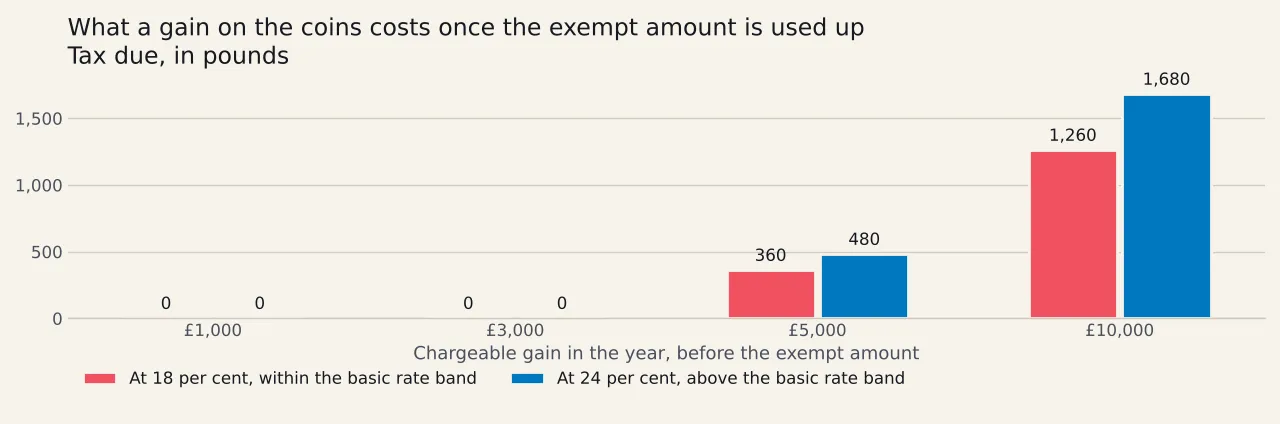
Where a gain does arise, the 2026 to 2027 figures are an exempt amount of £3,000 a year, 18 per cent while the basic-rate band lasts and 24 per cent after it. A reader converting sterling to coin, funding a balance, and converting back has made at least two movements in a market that moves, and that is the shape of the exposure rather than a prediction about it.
The sequencing is worth stating as arithmetic. The staking costs £42.00 in expectation. The network fee is small in the published examples and unquantified on one chain. The exchange is unquantified on every chain. A tax question can only arise on the coin legs. Of the four items, exactly one can be established ahead of the payment.
06
Nobody licensed here runs a coin cashier, and that is not a ban
No outright prohibition exists. The guidance on digital and virtual currencies sets two tests for a licensee that wants to take them in. It has to satisfy the regulator, and itself, on the laundering side. It has to do the same on acting responsibly. The page still carries its date of 5 July 2021 and its own update log shows nothing changed after it. So the accurate sentence is that the method is absent from licensed cashiers, not that it is barred to them.
What is a prohibition, and a narrower one than readers expect, is the credit card rule. 14 April 2020 is the date licence condition 6.1.2 took the credit card out of a British cashier. Its reach takes in a card sent to the licensee via a money service business, and a wallet as well, unless the wallet provider can assure the operator that card money cannot get through.
Which leaves the licensed half of the price line with nothing to price, and the measure behind it is worth stating as a number anyway. Were a licensee to credit the same £40, the heaviest staking it could ask is ten times, which is £400 of turnover costing £16.00, leaving £24.00 and putting a kept pound at 67p. That is a measure rather than an offer, because the deposit under it could not be made in coin at any licensed cashier.
The duties behind that measure are the part a reader is actually giving up, and they are published one by one: the ceiling of ten on bonus staking, the stake limits on a reel, the two cycle minimums, the autoplay ban, the rule that a withdrawal request may not be cancelled, the rule against putting a ceiling over what leaves a deposit balance, a complaint that has to be finished inside eight weeks with the closing letter naming the adjudicator to go to next, identity checking before play, financial limit prompts, and membership of the national self-exclusion scheme. An industry warning notice is equally plain about the other side: unlicensed sites operate without regulation, may target people who have excluded themselves, may run weak controls, and leave a player facing fraud and unfair practice with no remedy.
Two more sheets in this section take the same ground from different ends. New casino sites covers what a lobby opened this year still has to carry, and high roller online casinos covers what happens to a large balance.
07
Thirty pounds of bonus at thirty-five times, line by line
Below, the credit goes through the reels at full weight, with nothing left unstaked when the seven days the package allows run out.
That forty times, worked through
- Coin deposited, valued in sterling at the point of arrival £40.00
- Credit handed over, the stage matched in full £40.00
- Turnover the terms demand at forty times £40.00 × 40 = £1,600.00
- Taken by the reels at ninety-six in the hundred £1,600.00 × 0.04 = £64.00
- The credit, after that cost £40.00 − £64.00 = −£24.00
- Price of a kept pound, left column then right No pound survives, against no licensed equivalent
There is no second answer to print. A licensee could not take line one at all, so what this sheet compares is the absence of the method rather than a different price for it. Had the same credit come from a licensed cashier funded in sterling, ten times would ask £400.00, take £16.00 and leave £24.00 at 67p a kept pound. Outside both columns sit the chain’s charge, unquoted on one of the chains, the two exchange legs, unquoted on all of them, the ceiling of 100 euros over a batch of spin winnings, and the absence of any published largest stake, which leaves no way of telling beforehand which stake would void the claim.
08
Questions about paying for a spin in coin
- What do bitcoin slots cost to clear on these offers?
- £64.00 of expected cost. Forty times a £40 credit is £1,600 of staking, and a reel giving back ninety-six in the hundred keeps 4p of every staked pound. The credit was £40.00, so serving the staking costs more than the credit is worth, and that is before anything is paid to move the coin.
- Why does the licensed half of the price line carry words instead of figures?
- Because no cashier licensed in Great Britain takes a deposit in coin, so there is no licensed version of this purchase to price. That is not a prohibition. The guidance on digital and virtual currencies, still dated 5 July 2021 with nothing in its update log since, sets a licensee that wants to take them two tests: the laundering side, and acting responsibly. In practice the method is absent.
- What does it cost to move the coin?
- It depends on the chain, and only some of the published models give a worked figure. 21,000 is the gas a plain Ethereum transfer burns, and the documentation’s own example prices that at 12 gwei a unit, which comes to 0.000252 ETH. On TRON, 0.27 TRX is what a 270 byte transfer burns once the free bandwidth is gone. Bitcoin publishes no figure at all, its charge moving with the traffic on the network.
- How long before a coin deposit counts as settled?
- About an hour on Bitcoin. A block lands on a ten-minute average, the intervals being random rather than regular, and six confirmations is a common point for treating a payment as done. One Ethereum epoch is 32 slots of 12 seconds, which is 6.4 minutes. TRON blocks come about every three seconds.
- Can a coin payment be called back?
- No. A Bitcoin payment does not come back, no chargeback stands behind one, and most of the asset class sits outside the scheme that compensates for a failed regulated investment. The 2025 cryptoassets regulations pull cryptoasset activity inside the financial regulator’s perimeter, and that regime is expected to bite on 25 October 2027.
- Is a win from a coin-funded spin taxable?
- The winnings are not. Gambling winnings go untaxed here and HMRC has put crypto gambling inside that answer. The coins are a separate matter: a sale into money, a swap into another kind of token, a payment made in tokens and a gift to anybody but a spouse or civil partner all appear as disposals for capital gains, and the manual does not name a casino deposit, so it turns on the facts.
- Does holding the coin cost anything before the first press?
- It can, because a sterling player holding a dollar token is holding dollars. Tether’s token tracks the US dollar at parity and Tether states full backing from its reserves, so the peg is to dollars and not to sterling. The financial regulator’s published position on the asset class is that buying it stays high risk, and that anyone doing so should be ready for the whole sum to go.
- What does a reader give up by funding a spin this way?
- Every duty that attaches to a British licence, because no cashier out here holds one. The scheme’s own terms of use say it cannot help prevent somebody reaching gambling services run by organisations outside it. The ceiling of ten on bonus staking, the two cycle minimums, the eight week limit on a complaint and the named adjudicator at the end of it are licence conditions. Trading here without a licence is an offence, not a thing the regulator supervises.