
Printed 2026 · figures read October 2026
Casino no deposit bonus, and the £1,050 of staking £30 of credit carries
What £30 of credit must send through the games before any of it can be taken out, at thirty-five times the bonus, the cheaper of the two multiples this page prices. Slots only, fourteen days to finish, and the credit opens on a £20 deposit.
The offers priced here, their deposits, their multiples and their windows
Every link in this rack is a paid placement, and this site is owed a fee when a reader opens an account through one.
Betportal
Lowest wagering
Licence Licensed in Anjouan, Comoros, no Great Britain licence, run by BetPortal Gaming Ltd and Excite Ultra Media Ltd, reference ALSI-202601040-FI2.
WinBeast
Free bet included
Licence Licensed in Curaçao, no Great Britain licence, operator not named on the site.
EliteSpin
New for 2026
Licence Licensed in Costa Rica, no Great Britain licence, run by PrimeTier Limited, opened 2026.
Crown Jewelz
200% first deposit
Licence Licensed in Curaçao, number not verified, no Great Britain licence, operator not named on the site.
Scroll the rack sideways to reach the other columns. The label column stays put.
Not one of the offers printed above holds a Great Britain licence. Outside that licence a British player has none of its protection: Gamstop Online cannot shut the door, the ten-times limit on bonus wagering does not bind the operator, and no British complaints body will take up a dispute. You must be 18 or over to open an account anywhere in this rack.
Every figure in the rack is a term the operator itself publishes, read on 14 October 2026. The operator's terms in full are the ones that bind you.
£30 of credit on a £20 deposit, in pounds per pound
| What these offers ask | Under a British licence | |
|---|---|---|
| You put in | £20.00 | £20.00 |
| Handed over | £30.00 | £30.00 |
| Wagering | 35x | 10x |
| Cost per £1 kept | Nothing to keep | £0.67 |
Figures assume 96 per cent of stakes coming back, every round counting in full, and the counter finished inside the window. Thirty-five times £30 is £1,050 of staking, expected to cost £42.00, or £12.00 beyond the credit it was charged against. The balance empties before the counter fills, so no pound is left to put a price on. Thirty-five is the multiple assumed, and the band recorded for sites outside the British licence runs from thirty times to sixty. The right-hand column holds the deposit and the credit still and moves the multiple alone, down to the ten a Great Britain licence allows. No cashier selling on these terms holds that licence, so the comparison measures what is missing rather than offering a second way in. Every figure is an average across many attempts and predicts none of them.
01
What an offer of this kind credits, and what it wants first
£20 is the smallest deposit this kind of offer tends to take, and a euro cashier writes it as €20. Nothing is credited until it lands. No rung of this sort opens at nothing paid in, which is the first thing worth knowing to anyone who reached this page from the four words typed into a search box.
After the deposit comes a match. First-stage rates of 50, 100, 150 and 200 per cent are all ordinary here, and a total of 300 per cent across three separate deposits is not rare. Against a £20 floor those rates credit £10, £20, £30 and £40. This page prices the £30 rung at the cheaper of the two multiples the trade runs.
Thirty-five times the bonus is that multiple. Forty is the other figure in common use, and it sometimes counts spin winnings alongside bonus funds. Ten is the ceiling for a British licensee. The distance between those lines is what this guide measures, and on a single £30 credit it comes to £750 of extra staking.
A chip credited before any money changes hands is a different product, and a British one. Under the licence it runs £5 to £10, a pattern the market settled on and not a figure any rule sets. Three guides take those rungs apart: free £5 no deposit casino, free £10 no deposit and, where the credit arrives as spins instead of cash, free spins no deposit. The whole ladder is listed under nothing down.
02
Every rung of this kind, costed on the multiple it actually carries
£1,050 is the obligation on this page’s rung. The others are the same sum with different inputs, so the table sets them out and lets the choice be made on figures.
| Credit on a £20 deposit | Multiple | Staking owed | Expected cost | Left of the credit |
|---|---|---|---|---|
| £10, matched at 50 per cent | 40x | £400.00 | £16.00 | −£6.00 |
| £20, matched in full | 40x | £800.00 | £32.00 | −£12.00 |
| £30, matched at 150 per cent | 35x | £1,050.00 | £42.00 | −£12.00 |
| £40, matched at 200 per cent | 40x | £1,600.00 | £64.00 | −£24.00 |
| £30, under a Great Britain licence | 10x | £300.00 | £12.00 | £18.00 |
Twenty-five decides the shape of the right-hand column. Staking costs 4p in the pound where 96 per cent comes back, so twenty-five times the credit costs exactly the credit. Under twenty-five, something is expected to survive. Over it, the credit goes first and the rest is taken from the money paid in.
Thirty-five and forty are the two multiples in ordinary use at this end of the trade. A bigger headline buys a bigger obligation and not a bigger balance, which is why the £40 row is the worst row in the table rather than the best.
03
Slots only is weighting taken all the way down to nought
Nought is what a roulette round adds to the counter on an offer of this kind. Slots count and nothing besides. A reader who planned to serve £1,050 on a game with a thin house edge cannot do it on these terms, because the thin edges sit on the games that do not count.
The licensed form of the same term is softer. The Commission looked at a bonus asking ten times across all slots while a blackjack round counted at 50 per cent and a roulette round at 30. It capped the multiple and left the weighting where it found it.
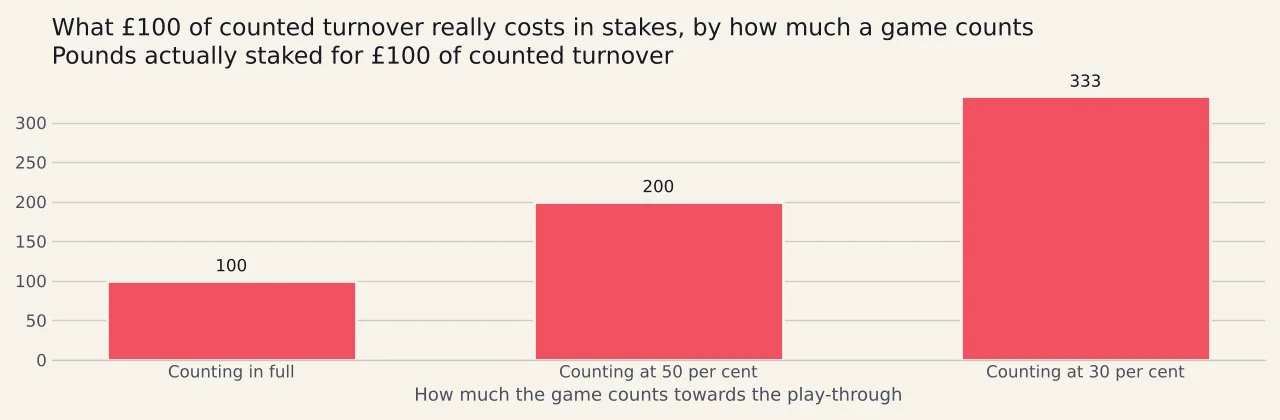
The multiple itself never moves. What moves is the real money behind it. A round worth half its stake to the counter wants two pounds staked to shift it by one.
- Counting in full. £1,050 on the counter is £1,050 of real stakes, at an expected cost of £42.00.
- Counting at a half. The same £1,050 on the counter wants £2,100 staked, at £84.00.
- Counting at nought. The counter stands still and the stake is spent outside the offer.
The list of what counts sits lower down a terms page than the multiple does, and decides more of the price. Read it before the deposit.
04
Some publish a maximum bet and some publish nothing
€5 a round is a maximum stake of the sort printed while a bonus is running, and plenty of cashiers print none at all. A term nobody publishes cannot be priced before paying in, and it is the term most often reached for afterwards when an operator decides an obligation was never properly served.
It sets the clock as well. £1,050 at a €5 ceiling is 210 rounds. The same £1,050 at 10p a spin is 10,500 rounds. 2.5 seconds is the shortest slot cycle a British licence permits, which would stretch 10,500 spins past seven hours of unbroken play. That minimum is a condition of the licence and reaches nobody outside it, so the same obligation can be served quicker on these terms than it could be served here.
The window is the other half of the clock. Fourteen days is a common one, seven is commoner, and some cashiers publish no window at all. £1,050 across fourteen days is £75.00 of staking a day with no gaps. £1,600 across seven days is £228.57 a day. A window nobody prints cannot be planned around at all.
What the credit may become belongs in the same list. A ceiling of five times the credit is usual, which on this rung is £150. Spin winnings held to €100 a batch is another form of it. Some cashiers print no ceiling whatever. A cap of that sort is lawful here as well, and it is a different animal from a cap on what may leave a deposit balance, which a British licensee is forbidden to impose.
05
A clause about discretion outranks every figure on this page
£170,000 fell on a British licensee on 3 July 2025 over a bonus rule reserving the right to shut accounts or take back winnings whenever the operator chose. An independent audit of its controls was ordered alongside the money. The regulator’s objection: wording like that is opaque, and it can fall unfairly on a customer.
Licence condition 7.1.1 is the lever. It asks four things of a term at once: that it is not unfair on the Consumer Rights Act 2015 test, that it is transparent on the same test, that it is kept somewhere a customer can reach, and that a material change is notified before it bites. The same condition bars an unfair commercial practice at any point in the dealing, under the 2024 Act covering digital markets, competition and consumers.
Four code provisions sit on top of it, all written about incentives. The terms have to be plain and fair and within reach of anyone the offer is put to. The benefit may not be cut back because a qualifying spend was reached early. The size of the benefit should fit what a customer actually gambles, in kind and in level. And the licensee has to be able to show the regulator how it satisfied itself that its terms were fair.
None of that crosses the water. Anjouan, Costa Rica and Curacao are where the paper behind an offer of this kind generally comes from. A clause of exactly the shape that cost £170,000 here would cost nothing there. The reading takes one search of a terms page: look for the word discretion before the deposit, because a term letting the house decide afterwards makes every number above it provisional.
06
Ten times is the ceiling here, and on this rung it is worth £750
Ten times the bonus is the British ceiling, in force from 19 January 2026 and binding on every holder of the licence. Code provision 5.1.1 carries the rule, at paragraph 3a. A wagering requirement means a total of stakes to be placed before funds can be taken out, and the cap bites on the multiple while leaving everything else alone.
£500 is the figure the regulator put behind its own illustration of the problem, a £10 bonus carrying fifty times. Sixty times was the high point it recorded at some licensees, and ten was set to cut that end off. The same response carried one operator’s own figures, with three quarters of what it offered already inside one to ten times.
Set the two sides beside each other on this rung and the ceiling has a price. £1,050 of staking at thirty-five times; £300 at ten. £750 of staking and £30 of expected cost lie between them. Under the licence £18.00 of the credit is expected to stand, so a pound kept costs 67p of play. At thirty-five times, nothing is expected to stand at all.
That is the comparison, and on this rung it runs one way. It is also not the whole of what the licence buys.
07
What else the licence carries, and why none of it travels
Not one of these cashiers holds a Great Britain licence, and each says so in its own terms. Each item below binds whoever does hold one, which is why not a line of it reaches a reader who opens an account on these terms.
- The multiple. Ten times is the ceiling under the licence. Thirty to sixty is the pattern recorded outside it, attributed to a trade publication rather than a regulator. Thirty-five and forty are the two figures this guide prices.
- The scheme. Gamstop Online takes in every operator holding the British licence, and 614,738 people had registered with it by 16 July 2026. It states its own limit plainly: an operator outside the scheme is outside its reach.
- The complaint. Three working days to acknowledge one, eight weeks to finish the whole process, and a closing letter that has to name the independent body a customer may go to next. It is no ombudsman, as the Commission puts it on its own enquiries page.
- The money. No term may cap the amount a customer takes back out of a deposit balance, and no licensed operator may offer the chance to call a withdrawal back once it is sent.
- The checks. Nobody plays here until age and identity are established, bonus play included, and a business may not hold a payout over identity it ought to have asked about earlier.
Documents before a first withdrawal is the published position almost everywhere at this end of the trade. That is ordinary enough in itself. It is also the moment at which a reader outside the licence has the least leverage, because the duty to ask early is a condition of a licence none of these cashiers holds, and the regulator that enforces it has no reach over any of them.
08
Thirty pounds, thirty-five times over, step by step
Below is the left-hand column, broken into single steps, and the British figure sits beneath it.
A £30 credit against a 35x line
- Deposit the match is paid on £20.00
- Credit handed over, matched at 150 per cent £20.00 × 1.5 = £30.00
- Staking owed, thirty-five times the credit £30.00 × 35 = £1,050.00
- 4p in the pound, taken across that staking £1,050.00 × 0.04 = £42.00
- Left of the credit once the staking is served £30.00 − £42.00 = −£12.00
- The same £30 at the British ceiling of ten £300.00 × 0.04 = £12.00, leaving £18.00
- Cost per £1 kept, outside and under a licence Nothing to keep · £0.67
Four things the seven lines leave out. The ceiling on the winnings, which removes the outcomes that make an average what it is. The weighting list, which can double the real stakes standing behind step three. The window, which turns an unfinished obligation into nothing whatever. And the spread of results, where most single attempts end with the balance at zero long before the counter is served.
09
Questions about a chip bought with a deposit
- Is there a casino no deposit bonus at this end of the market?
- No. An offer of this kind wants £20, or €20, in the account first, and the credit then arrives as a percentage of it. A chip handed over before any money is paid in is a British-licensed product, and under the licence it runs £5 to £10. That range is what the market does, not what a rule requires.
- What is the real cost of clearing £30 of credit here?
- £42.00 in expectation. Thirty-five times the bonus is the lower of the two multiples in ordinary use, so £30 of credit becomes £1,050 of staking, and staking costs 4p in the pound where 96 per cent comes back. The credit is only £30, so the sum falls £12.00 short and the rest is taken from the money paid in.
- Why does the same credit leave £18.00 under a British licence?
- Because ten times is as far as a British licensee may go. Ten times £30 is £300 of staking, costing £12.00 on the same payback and leaving £18.00 of the credit standing. 67p of expected play stands behind each pound kept. That ceiling has held over every British licensee since 19 January 2026.
- Which multiple leaves a bonus worth nothing?
- Twenty-five, where 96 per cent of stakes come back. There the staking costs exactly what the credit is worth and the expected balance lands on nought. Under twenty-five something survives; over it the shortfall comes out of your own money. Offers of this kind run at thirty-five and at forty.
- Which games move the counter on an offer like this?
- Slots, and nothing else at all. A roulette or blackjack round moves the counter by nought on an offer of this kind. The licensed version of the term only discounts those games: the Commission recorded a blackjack round at 50 per cent and a roulette round at 30, then capped the multiple and left weighting as it was.
- How long does £1,050 of staking actually take?
- 10,500 rounds at 10p a spin, or 210 of them at a €5 maximum bet of the kind some cashiers publish. The shortest slot cycle a British licence permits is 2.5 seconds, which would stretch 10,500 spins past seven hours. That minimum is a licence condition and binds nobody selling outside it.
- Can a site of this kind cancel the winnings once the wagering is done?
- Nothing published stops it. A bonus rule letting an operator shut an account or take back winnings at its own choosing cost a British licensee £170,000 on 3 July 2025, with an independent audit of its controls attached. The condition behind that penalty binds holders of a Great Britain licence, and the paper behind an offer of this kind is Anjouan, Costa Rica or Curacao.
- What protection is given up by taking the bigger match?
- The ten times ceiling. A place in Gamstop Online. Eight weeks as the outside limit on handling a complaint. An independent body to escalate to when the answer comes back wrong. The bar on any term that limits how much of a deposit balance may be withdrawn. And the duty to settle identity before play rather than at payout. No British body will take up a dispute with one of them, and the regulator cannot act either.