
Printed 2026 · figures read October 2026
20 free spins on registration no deposit cost 15.36p a spin to clear
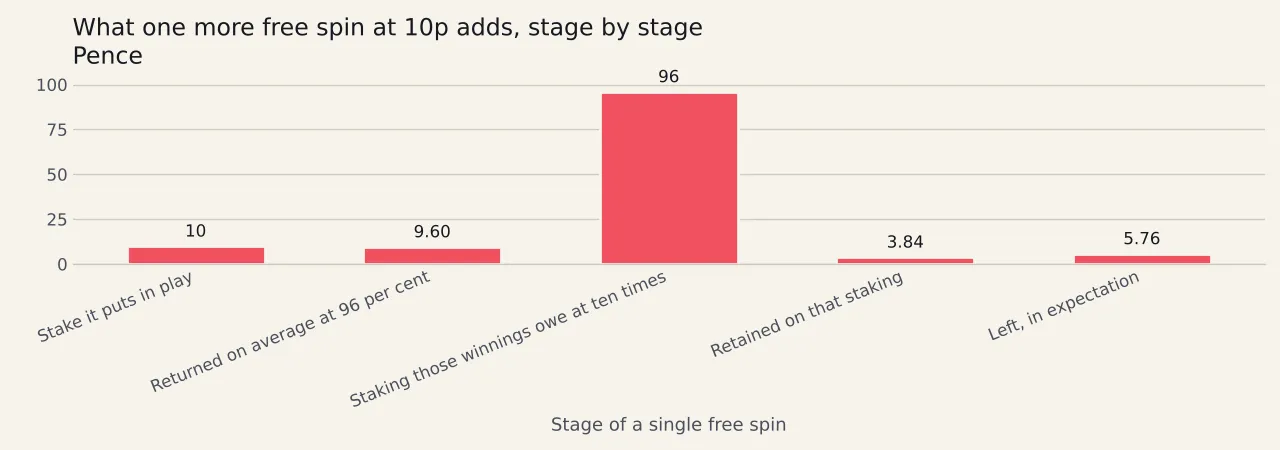
What one 10p spin costs to release, in expectation, where the winnings carry the forty times line this trade applies. The same spin returns 9.6p. Terms read October 2026.
The offers set out column by column
Every link in this rack is a paid placement, and this site is owed a fee when a reader opens an account through one.
Betportal
Lowest wagering
Licence Licensed in Anjouan, Comoros, no Great Britain licence, run by BetPortal Gaming Ltd and Excite Ultra Media Ltd, reference ALSI-202601040-FI2.
WinBeast
Free bet included
Licence Licensed in Curaçao, no Great Britain licence, operator not named on the site.
EliteSpin
New for 2026
Licence Licensed in Costa Rica, no Great Britain licence, run by PrimeTier Limited, opened 2026.
Crown Jewelz
200% first deposit
Licence Licensed in Curaçao, number not verified, no Great Britain licence, operator not named on the site.
Scroll the rack sideways to reach the other columns. The label column stays put.
Not one of the offers printed above holds a Great Britain licence. Outside that licence a British player has none of its protection: Gamstop Online cannot shut the door, the ten-times limit on bonus wagering does not bind the operator, and no British complaints body will take up a dispute. You must be 18 or over to open an account anywhere in this rack.
Every figure in the rack is a term the operator itself publishes, read on 14 October 2026. The operator's terms in full are the ones that bind you.
Twenty spins, in pounds per pound
| What these offers ask | Under a British licence | |
|---|---|---|
| You put in | £20.00 | £20.00 |
| Handed over | £2.00 | £2.00 |
| Wagering | 40x | 10x |
| Cost per £1 kept | Nothing kept | £0.67 |
The second row is twenty spins valued at 10p apiece, which is £2.00 of play and £1.92 of winnings where the reels give back ninety-six per cent. You put in is the twenty pounds or twenty euros a stage demands on offers of this build. Forty times those winnings costs £3.07 to serve and the winnings are £1.92, so nothing is left to put a price on. Forty times is the figure in the left-hand column, and the reported spread away from the licence is thirty to sixty. Ten in the right-hand cell is the heaviest multiple British rules permit, and no cashier of this build answers to those rules.
01
Twenty spins is two pounds of play and £1.92 of winnings
£2.00 crosses the reels. Twenty spins at the ordinary fixed value of 10p is two pounds of stake, and at a payback of ninety-six per cent they give £1.92 back into the account. Those two figures are the whole of the offer before a single condition is read.
Twenty is not a count this trade actually drops. The smallest instalment published is twenty-five in a day, and the biggest stage hands over a hundred at once. Twenty is what the licensed British market gives on sign-up, where five to twenty is the ordinary band and fifty appears occasionally.
So the word registration is doing different work on either side of the comparison. On an offer of this build it means a twenty pound stage deposit first. In the licensed market it can mean an account opened and spins credited with nothing paid in. The arithmetic below follows the offshore reading, because that is the product this page prices.
Rungs either side are priced on sheets of their own: 25 free spins on registration no deposit one rung up, 10 free spins one rung down, and 5 free spins no deposit at the bottom. The general shape of the product is in free spins no deposit, which hangs with the rest of the ladder under nothing down.
02
Price one spin and the rest of the page prices itself
9.6p is what a single 10p spin returns on average. Every figure on this sheet is that number multiplied by twenty, which makes the single spin the honest unit for comparing one banner against another.
The multiple decides what the 9.6p is worth. Four lines are in play: none, ten, thirty-five and forty. Three of them are the lines this trade runs, and the ten is what a British licence would impose if one applied.
| The line applied to the winnings | Staking it owes | Cost of serving it | Left of the 9.6p |
|---|---|---|---|
| None, where no line is printed | £0.00 | 0.00p | 9.60p |
| Ten, the heaviest a licence allows | £0.96 | 3.84p | 5.76p |
| Thirty-five, the lighter line off the register | £3.36 | 13.44p | −3.84p |
| Forty, the commoner line off the register | £3.84 | 15.36p | −5.76p |
Twenty-five is the hinge in the right-hand column. Four pence taken twenty-five times over comes to a whole pound in the pound, so twenty-five as a multiple leaves nothing and anything heavier leaves less than nothing. Both multiples this trade publishes sit above the hinge.
Multiply the last row by twenty and the page is finished. £3.07 of cost against £1.92 of winnings, and a hole of £1.15 where the balance used to be.
03
15.36p against 9.6p is the whole of the argument
15.36p is what one spin costs to set free. The spin wins 9.6p on average, the forty times line asks £3.84 of staking on that 9.6p, and four pence in every pound of staking stays with the house.
Nothing about the count softens it. Add a spin and the account gains 9.6p of winnings and takes on 15.36p of expected cost, so each extra spin on the banner subtracts 5.76p rather than adding anything. A hundred spins on these terms is a deeper hole than twenty, not a better offer.
£1.15 is the size of the hole at twenty spins, and it is paid out of the twenty pounds that bought the stage. That is the sentence a buyer needs: on the published line the spins do not pay for their own release, so the deposit does.
One thing in this area has never been settled. No published position says whether a free spin is itself an item of bonus funds. What stands is narrower: when the money a spin produces is credited as bonus funds at a licensed site, the limit of ten governs what may then be asked of it. Beyond the licence the question does not arise, because no limit of any size applies.
04
Seven hundred and sixty-eight presses stand behind two pounds
768 spins is £76.80 of staking converted back into presses of 10p each. That is the physical shape of the obligation: not a sum of money but a number of times somebody has to start a game.
Thirty-two minutes is how long that takes at the quickest cycle a British licence tolerates, which allows two and a half seconds to pass before a fresh game may begin. The twenty spins themselves take fifty seconds. The ratio is thirty-eight to one.
That floor under the speed belongs to the licence and travels nowhere with the offer. A site outside it may spin as quickly as its software allows. Faster reels do not reduce the 768 presses; they only shorten the time it takes to lose.
Nothing about this is a matter of taste. The same standard forbids turbo, quick spin and slam stop, bars a game from dressing a losing round up as a win, and stops a casino running several games at once. Each of those is a British rule about pace, and each one stops at the licence.
05
What the blue side of the strip above is measuring
The British licensing system covers no offer of this build. The jurisdictions are Anjouan, Curaçao and Costa Rica. The second of the two priced readings is not decoration. It is the price of that difference, written as a number.
Four things come with a British licence and none of them comes with these.
- The national exclusion scheme stops at the licence. Every online operator licensed here has to belong to it. An operator that stays out of it is beyond anything the scheme can do, as its own terms of use admit. Its published total was 614,738 people on 16 July 2026, with registrations up sixteen per cent year on year.
- Ten is a ceiling, and only here. Play-through of bonus funds may not be required beyond ten times at a licensed site. What this trade prints is thirty-five and forty, which is where 15.36p a spin comes from.
- The complaint has a clock and an exit. Eight weeks caps the whole procedure here, start to finish, and the closing letter has to set out the route to an independent adjudication entity. No such duty attaches off the register.
- The regulator has no reach. It describes itself as not being an ombudsman even over the operators it does licence, and it treats trading here without a licence as an offence rather than as a matter for supervision.
Weighed against a two pound drop, that is a long list. It is also the only part of the comparison that cannot be bought back later, which is why it sits beside the arithmetic rather than underneath it.
06
The terms around the multiple move the answer too
Three terms beyond the line change what twenty spins are worth, and this trade publishes each of them patchily.
- How long the spins live. Spins can live a single day in places, three days after they are switched on elsewhere, while the cash side of the offer runs seven days more often than fourteen. An unused instalment is not carried forward anywhere.
- What the spins may pay at most. A cap of a hundred euros on what a batch of spins pays is one form. A ceiling of five times the bonus over bonus winnings is the commoner one. No ceiling printed anywhere is a gap in the terms and not the absence of a limit.
- The largest stake allowed while the offer is live. Five euros gets printed from time to time. Often nothing is printed, so a stake that would void the claim cannot be identified in advance.
Where a term is missing the price cannot be established in advance, and no figure should be invented to fill the hole. Everything on this sheet assumes the published limits are respected and the windows are met.
A ceiling on a bonus is lawful in Britain as well, so it is not the thing that distinguishes the two sides. What a licensee here may not do is put a ceiling over withdrawals from a deposit balance, the regulator’s own example of a bad term being one allowance by the day and a larger one by the week. Your own money and the winnings sitting with it leave when you say so.
07
One spin and then twenty, worked through
The sum is run on a single spin and multiplied at the end, which is the only way the count and the multiple stay separate.
Twenty spins at forty times, worked through
- One spin, at ninety-six per cent back £0.10 × 0.96 = £0.096
- Staking that one spin owes at forty £0.096 × 40 = £3.84
- Four pence in each pound of it £3.84 × 0.04 = £0.1536
- One spin, after the line is served £0.096 − £0.1536 = −£0.0576
- Twenty of them −£0.0576 × 20 = −£1.15
- Price of one pound kept, offshore then licence No pound survives, against £0.67
Swap ten for forty in step two and the same five lines give £0.96 of staking a spin, 3.84p of cost, 5.76p surviving each spin and £1.15 surviving the twenty, at a price of 67p for every pound of it. Neither column makes room for a ceiling on the winnings, for games counted at a fraction of their stake, or for a window that shuts before the staking is done.
08
Questions about a twenty spin drop
- What do 20 free spins on registration come to on these offers?
- Less than nothing. Twenty spins at 10p put £2.00 through the reels and return £1.92 on average, and the forty times staking this trade demands costs £3.07 to serve. The account ends £1.15 down, and that gap is funded by the £20 the stage required.
- What does a single free spin actually cost to clear?
- 15.36p at forty times, against the 9.6p the spin returns. The winnings owe £3.84 of staking and four pence in every pound of staking stays with the house. At thirty-five times the cost is 13.44p and at the British limit of ten it is 3.84p.
- Does a longer spin count make the offer better here?
- No, because each spin subtracts 5.76p in expectation once the forty times line is on it. Twenty spins are £1.15 behind, a hundred would be £5.76 behind and a hundred and fifty £8.64 behind. The count scales the hole rather than closing it.
- Do any of these cashiers hand spins over without a deposit?
- None of them. Twenty pounds or twenty euros is the floor at every stage, so the spins are bought. Sign-up drops of five to twenty with nothing paid in belong to the British licensed market, and fifty turns up there occasionally.
- How many presses of the button does the staking take?
- 768 at 10p a press, which is thirty-two minutes where two and a half seconds is the shortest a British licence lets a cycle run. The twenty advertised spins take fifty seconds. Nothing off the register is bound by that minimum, so the time can shrink while the 768 presses do not.
- Why is twenty-five times the point where the sum turns negative?
- Because four pence of every pound staked stays behind on a game paying back ninety-six per cent, and twenty-five such four-pence slices make a pound. A multiple of twenty-five leaves exactly nothing of the winnings, and the thirty-five and forty this trade runs both sit past that point.
- What happens if the spins expire before the staking is finished?
- The winnings go and nothing is owed back. Spins can live one day, or three, while the cash beside them runs seven days or fourteen. Being most of the way through the staking counts for nothing when the window shuts.
- What is the licensed side of the strip above for?
- The same twenty spins priced under the heaviest wagering a British licence permits, which is ten times. It is also shorthand for what is missing: the national exclusion scheme, an eight week ceiling on a complaint and an adjudicator who is not the operator, and a regulator with power to act. No cashier of this build carries that licence.